Movers › Building & House Moving & Raising
After Building and House Moving and Raising: Maintenance, Follow-Up Costs and the Care Nobody Mentions Up Front
There is a photograph every house-moving customer takes: the house in the air, or the house rolling down the road on dollies, neighbours watching. Nobody photographs month four, when a door that worked in October sticks in February, a hairline crack opens over a window, and the owner cannot tell whether they are looking at a house settling into its new life or a problem compounding quietly. That uncertainty — and the follow-up work it should trigger — is the real subject of the year after a building is moved or raised.
House moving and raising companies sell the dramatic part well. The aftercare is usually a paragraph in the contract, if that. Yet the follow-up costs are real, the maintenance calendar is specific, and the difference between a moved house that serves for another century and one that develops chronic problems is mostly decided in the first year on its new foundation. This guide covers that year: what is normal, what to watch, what to schedule, and what to budget — written for owners who have already spent heavily on the move itself and need the follow-up spend to be deliberate, not panicked.
First, collect the handover documents
Before the cribbing is hauled away, you should hold a small file that will govern every later decision:
- The opening and closing elevation surveys. A careful mover or foundation contractor records benchmark elevations across the house before the lift and again after it is set. Those paired readings are your baseline. A future engineer comparing a new reading against the closing survey can answer "is it still moving?" in an hour; without the baseline, the same question becomes an argument.
- The foundation and engineering documents. Plans, pier or footing details, soil information if any was gathered, and the engineer's sign-off. If the house was raised for flood compliance, the post-construction elevation certificate documenting the finished lowest-floor elevation belongs in this file too — your flood insurer will want it, and a compliant elevation can reduce National Flood Insurance Program premiums substantially, by an average of about 30 percent a year in one national cost guide's summary.
- Permits and final inspections. The lift is not finished, administratively, until final inspections are closed: foundation, plumbing, electrical and mechanical reconnections. Unclosed permits surface years later at sale.
- The warranty terms, in writing. What does the mover warrant — the set, the level, the foundation work — and for how long, and what does the warranty require of you? Some foundation contractors include a follow-up survey on their own work at no charge. If yours does, put its date in a calendar now.
If any of these are missing, ask for them in the first week, while the job is still open in the contractor's office. Reconstructing them in year two is slower and sometimes impossible.
What is normal in the first weeks and months
A house that has been lifted, moved and set has changed shape slightly, and its finishes — drywall, plaster, tile, trim — need time to catch up with the structure. Foundation specialists who publish aftercare guidance list a consistent set of expected, non-alarming developments:
Hairline movement at drywall joints, especially above doors and windows. The frame has redistributed its loads; the board shows it first. This is cosmetic and, crucially, temporary in appearance only if the house has stopped moving — which is why the advice is to photograph cracks now and patch later, after a full seasonal swing, rather than immediately.
A door or two needing adjustment. Most doors improve during a leveling lift; a few need a hinge or strike plate moved once the new plane has settled. A door that was fine before and now binds badly is a different signal — that one earns a phone call.
Occasional ticks and creaks as framing settles into its new bearing. These quieten over the first weeks. Noise that persists for months, or grows, is worth reporting.
Backfilled ground settling. The excavated pits and trenches around a new foundation compact further after rain. Topping up soil once or twice in the first months is normal maintenance, not a defect — though a pit area that sinks noticeably or holds water against the foundation is a drainage problem to raise promptly.
Opened grout lines over tiled areas, and floors that simply feel unfamiliar underfoot for a week or two. You had adapted to the old tilt without realising it.
The triage rule that follows from all of this: normal after-effects are hairline, stable and improving. Anything wide, growing, or accompanied by a second symptom — a crack plus a sticking door plus a sloping floor — moves from "watch" to "call." Foundation guidance commonly flags cracks wider than about an eighth of an inch, and multiple symptoms appearing together, as the threshold for a professional assessment.
The cosmetic-repair trap: wait a season
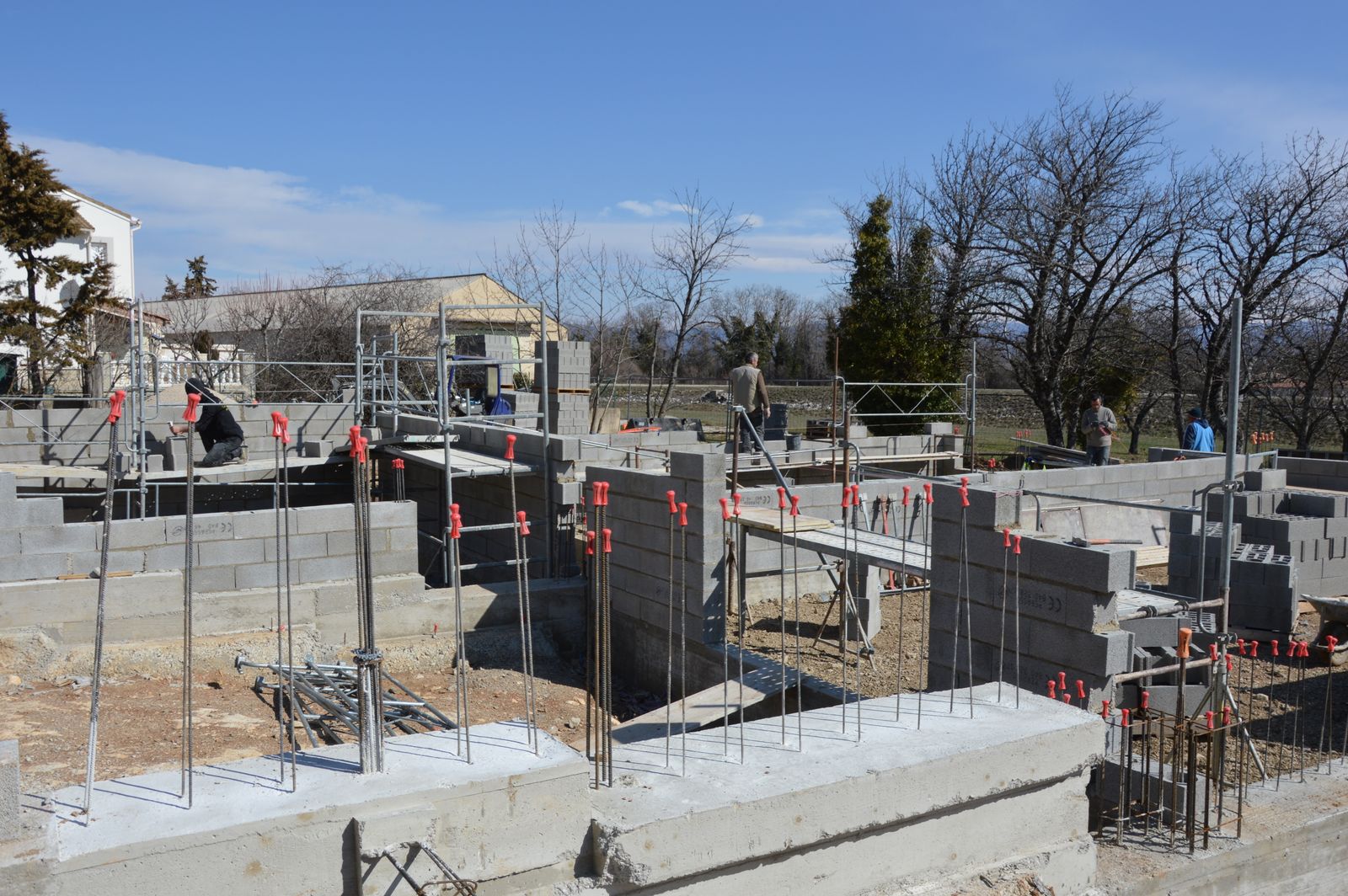
The most common aftercare mistake is repairing finishes too early. One long-established foundation firm gives the working rule: if the house was raised less than about an inch and a half, wait at least four weeks before interior repairs; if it was raised more, wait at least eight weeks — and specialists who write detailed aftercare guides go further, recommending a full season before cosmetic work, because soil and structure respond to a complete cycle of wet and dry, hot and cold.
Sequence matters as much as timing. Start outside: seal cracked mortar, separated window joints and gaps at the top of walls first, so moisture cannot enter while you wait. Then, once the house has had its settling period and a follow-up reading confirms stability, do the interior work once — drywall, doors, grout — rather than patching the same crack three times at three prices. On a tight budget, patience is not a virtue here; it is a line-item saving.
The follow-up costs nobody quotes up front
Budget for the year after as its own small project. The main items, with the ranges published pricing gives them:
| Follow-up item | Typical cost signal | Notes |
|---|---|---|
| Follow-up elevation survey / inspection | Sometimes included in the mover's warranty; otherwise an engineer's or foundation inspection fee | The single most valuable follow-up purchase: it converts worry into a measurement |
| Cosmetic repairs (drywall, doors, grout) | Modest if done once, after settling; multiples if done early and redone | Wait at least 4–8 weeks; a full season is safer |
| Utility fine-tuning | Small call-out fees; larger if a reconnection needs rework | Utility reconnection itself ran $2,000–$5,000 (up to $3,000–$10,000 in broader guides) inside the original project — post-move adjustments should be minor if the work was sound |
| Drainage and grading corrections | From DIY soil top-ups to paid regrading or drain work | Water management is the main long-term protection for any foundation |
| Underpinning, if settlement continues | About $1,000–$3,000 per pier; a typical home needing 8–12 piers runs $8,000–$25,000 | The serious contingency — not expected after a sound move, but the reason monitoring matters |
Two of those rows deserve emphasis. The follow-up survey is cheap insurance against the expensive row: continuing differential settlement — one part of the foundation dropping more than another — caught early is a conversation with your mover under warranty; caught in year three, after finishes have cracked through two cycles, it is an underpinning project. And drainage is the maintenance item with the longest shadow. Most foundation movement is soil movement, and most soil movement is moisture movement: expansive clays shrink and swell, poorly compacted fill consolidates over the first two to five years, and water ponded against a new foundation works on it every wet season. Extending downspouts, maintaining grade away from the house, and keeping backfill topped up are unglamorous tasks that protect a five- or six-figure lift.
The systems check: plumbing, HVAC and the quiet failures
A moved or raised house has had every service severed and reconnected: water, sewer, gas, electric, HVAC. The reconnections that fail usually fail quietly. In the first month, run a deliberate systems pass:
- Plumbing. Check every drain for speed — a slow drain after a set can signal a stressed or poorly graded line — and look under the house and at every visible joint for weeping. Sewer lines are the least forgiving of a house that moved; a camera inspection is worth its fee if drains behave oddly.
- Gas and combustion. Confirm every gas appliance was recommissioned properly, and treat any gas smell, at any point, as an emergency call, not a maintenance note.
- HVAC. Ducts that were split for the move can leak at the joints. Uneven heating or cooling by room, new whistling, or a system working harder than before the move all point at ductwork worth a look while the contractor's work is still fresh.
- Electrical. Test outlets and look for anything that behaves differently — a circuit that trips, a light that flickers — and report it early, while responsibility is easy to assign.
Keep a single claim file if anything is wrong: photographs with dates, the surveys, the contract and warranty, and notes of every conversation. Damage and defect claims in this trade are won on documentation assembled at the time, not reconstructed later.
The longer calendar: years one to five
After the first season, a moved or raised house returns to something close to ordinary maintenance — with two additions. First, an annual walk-around with the closing survey in mind: doors and windows for new binding, cracks for growth (a pencil mark and a date at a crack's tip is a perfectly good monitoring instrument), the foundation line for new gaps, and the ground for ponding or erosion. Second, respect the consolidation window: new foundations and disturbed soil typically settle over the first two to five years before stabilising, so hard landscaping, paving and additions tight against the house are better done after the early movement has declared itself — or built to tolerate it.
How long do the results last? A house set on a properly engineered foundation, on competent soil, with drainage maintained, should not need to be moved or lifted again in any planning horizon worth discussing — the intervention is meant to be permanent, and the historical stock of moved houses still in service after a century says it can be. What shortens that life is never the lift itself. It is water unmanaged, settlement unmonitored, and small symptoms left to become structural ones.
Questions to put to your mover before the last truck leaves
- Will I receive opening and closing elevation surveys, and will you re-read the benchmarks once, at no charge, if I report a symptom?
- What exactly does your warranty cover — set, level, foundation — for how long, and what maintenance does it require of me?
- Which inspections remain open, and who closes them?
- If the house was raised for flood compliance, when do I receive the post-construction elevation certificate?
- Whom do I call in month six about a crack or a slow drain — and is that call inside the warranty or billable?
This site lists 657 building and house moving and raising providers — a small, specialised trade, which cuts both ways after the job: there are fewer firms to choose from, and the good ones know their reputation travels by exactly these follow-up stories. A mover who answers the five questions above without hesitation, and who schedules the follow-up before you ask, is telling you how your house's first year will go. Believe them — in either direction.

Sources
- Solidara Foundation Repair, "What to Expect After House Leveling" — establishes the handover documents (opening and closing surveys, support log), the normal first-weeks symptoms after a lift, the normal-versus-call triage table, and photographing cracks before repairing them after a seasonal swing.
- AAA Foundation Service, "Home Repairs After Foundation Leveling" — establishes the waiting rules before interior repairs (at least four weeks for lifts under 1.5 inches, at least eight weeks for larger raises) and the exterior-first repair sequence.
- Shipshape help centre, "Settling and Foundation Movement" — establishes consolidation settling over the first two to five years, differential settlement and its symptoms, and underpinning costs of $1,000–$3,000 per pier and $8,000–$25,000 for a typical home.
- MyHomePros, "How Much Does It Cost to Raise a House?" — establishes project cost structure including utility disconnection and reconnection at $2,000–$5,000 and flood-elevation context.
- Modernize, "How Much Does It Cost to Raise a House?" — establishes utility reconnection budgets of $3,000–$10,000 in broader project accounting and that a compliant flood elevation can lower NFIP premiums by an average of about 30 percent a year.
- Revolution Contractors, "Home Elevation Florida" — establishes the five-stage elevation process ending in utility reconnection, final inspections and a post-construction elevation certificate.
- Photo by Ulrick Trappschuh, https://www.pexels.com/photo/15458299/
- Photo by Curtis Adams, https://www.pexels.com/photo/8031882/
- Photo by mali maeder, https://www.pexels.com/photo/yellow-and-black-excavator-69483/
More guides
- How to Hire a Moving Company That Won't Hold Your Furniture HostageMovers › Moving & Storage
- How Much Do Movers Cost? Local vs. Long-Distance Pricing ExplainedMovers › Moving & Storage
- Binding vs. Non-Binding Estimates: The Difference That Decides Your Final BillMovers › Moving & Storage
- Moving Insurance and Valuation: What 'Full Value Protection' Really CoversMovers › Moving & Storage
- Long-Distance Moving: A Start-to-Finish Guide for Household GoodsMovers › Household Goods Moving & Storage
- All Guides & ArticlesBrowse the full guides library