Movers › Heavy Equipment Movers
After Heavy Equipment Movers: Maintenance, Follow-Up Costs and the Care Nobody Mentions Up Front
The truck leaves, the ramps come up, and your excavator is sitting exactly where the site plan said it should sit. That is the moment most moving budgets quietly expire. The relocation line item closes, everyone exhales, and then — usually within the first week — the machine starts presenting its own follow-up bills: a hydraulic weep that was not there before loading, a track running looser than it did at the old yard, a damage note somebody meant to file and did not.
I have coordinated relocations where the move itself was the cheapest, calmest part of the whole transaction, and the month after it was neither. This guide is about that month, and the year that follows it: what to inspect before you sign anything, what follow-up maintenance a transported machine actually needs, what it costs on a tight budget, and which deadlines — unlike most maintenance — will not wait for you.

The first 48 hours: inspect before you sign, photograph before you wash
The single most expensive mistake in equipment moving happens on delivery day, and it costs nothing to avoid. Before you sign the delivery receipt as clean, walk the machine the way you walked it at loading — if you walked it at loading. Compare against the condition report and the photographs taken at origin: cylinder rods for new scoring, hydraulic hoses and fittings for weeps, track tension and undercarriage for shifted components, glass, lights, mirrors, handrails and every detachable item that travelled separately — buckets, forks, counterweights, GPS receivers, radios.
Note every exception on the delivery receipt itself, in writing, before the driver leaves. A note on the receipt is not, by itself, a legal claim — but it is the contemporaneous evidence a later claim stands on, and damage discovered after a clean signature gets argued about in a way damage noted at the tailgate does not.
Then resist the urge to pressure-wash. Transport throws road film over everything, and washing feels like care. It also washes away the evidence: fresh hydraulic oil, coolant traces and grease flung from a failing seal all read clearly on a dirty machine and vanish down the drain on a clean one. Photograph first, in daylight, from the same angles as the origin photos. Wash second.
The claim clock is already running
If the move crossed state lines, carrier liability for loss and damage sits under the Carmack Amendment, and its deadlines are floors a contract cannot shorten. You have at least nine months from delivery to file a written claim with the carrier. The carrier must acknowledge it in writing within 30 days, and must pay, decline or make a firm settlement offer within 120 days; if it is still open after that, the carrier owes you a written status update every 60 days. If the claim is denied, you have at least two years from the written denial to sue.
A valid claim is a specific thing, not a complaint. Under the federal claim rules it must identify the shipment, state that you hold the carrier liable, and ask for a specified or determinable amount of money. A damage note on a delivery receipt, an inspection report or an appraisal alone does not count as a claim. So the sequence that protects a tight budget is unglamorous: note it at delivery, photograph it the same day, get a repair estimate in writing, and file the formal claim with the estimate attached — well inside nine months, not in month eight when the estimator has retired.
One budget warning that surprises people: the carrier's liability and the carrier's insurance deductible are different things. Federal guidance treats the carrier as responsible for the actual loss regardless of its own deductibles or exclusions, unless you agreed in writing to limit that liability. If a settlement offer arrives discounted by somebody else's deductible, that is a negotiation position, not a rule.
What transport actually does to a machine
A well-run haul is gentle. It is still a distinct mechanical event, and a short list of follow-up checks catches nearly everything it can cause:
- Fluids and filters. Machines are often loaded with fuel and hydraulic oil sloshing against seals at angles they never see in service. Check engine oil, hydraulic oil and coolant levels after the first working day, not just at unloading, and look at the ground it parked on overnight.
- Hydraulic fittings and hoses. Tie-downs, vibration and loading angles stress hose runs. A fitting that weeps a teaspoon a day at the new site was very often torqued or chafed during the move.
- Track and tyre condition. Track tension set for a trailer deck is not necessarily track tension for work. Check sag against the manual before the machine earns its first hour, and re-torque wheel nuts on wheeled machines after the first short run.
- Batteries and electrics. Machines sit, alarms and telematics draw, and a battery that started at origin arrives tired. Load-test before the first booked job depends on it.
- Calibration and attachments. Buckets, forks and quick couplers that travelled detached need their pins, locks and safety devices verified, and anything with a scale, sensor or GPS mast needs a function check, not an assumption.
None of this requires a dealer visit. It requires an operator, a manual, a grease gun and about an hour — which is why it is the highest-value hour in this entire guide for anyone moving on a tight budget.
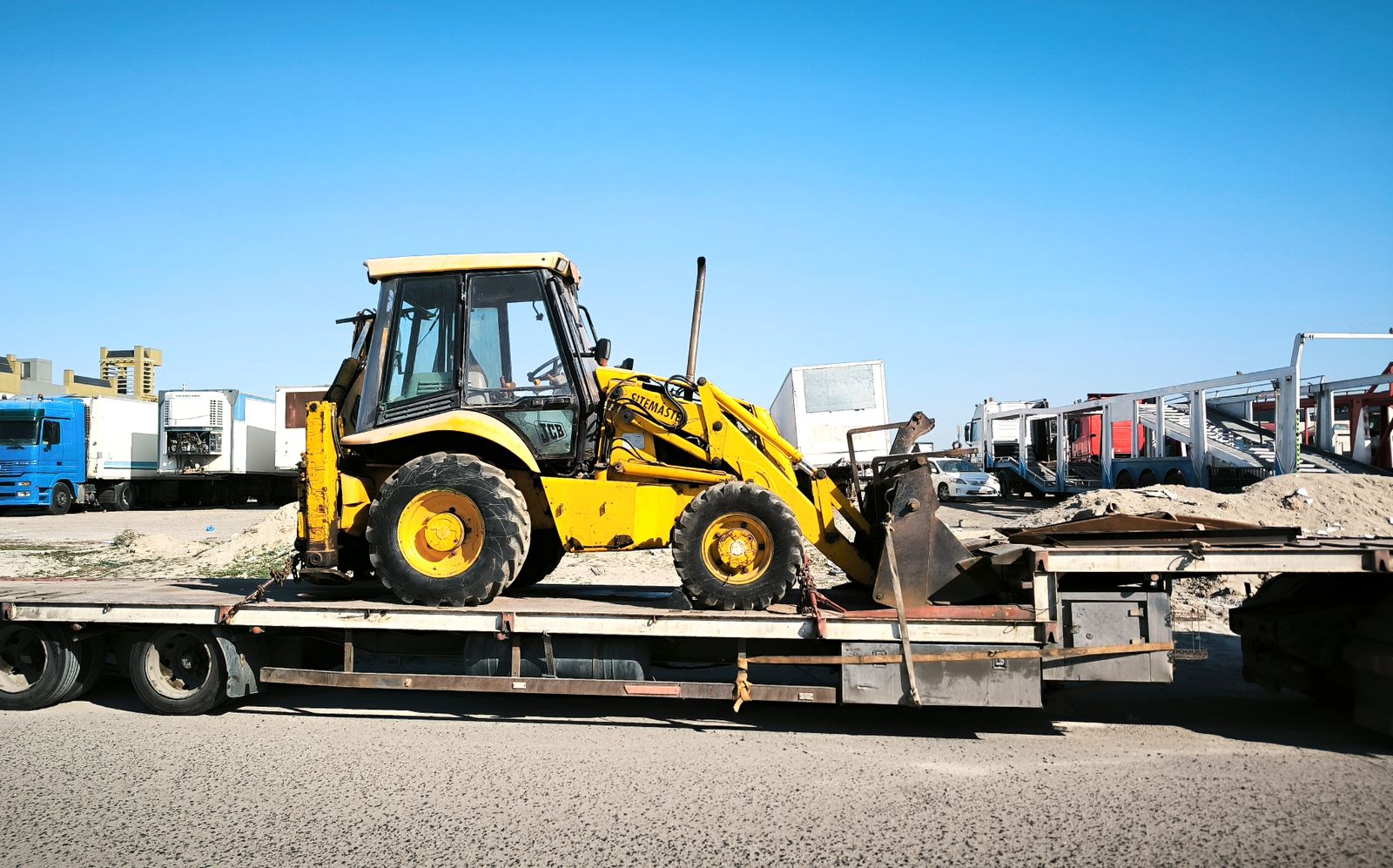
The service interval does not care that you moved
Here is the follow-up cost nobody mentions up front: the machine's hour-based service schedule kept running in the background of everyone's attention while the move consumed it. Machines are serviced on operating hours — typically at 250, 500, 1,000 and 2,000-hour intervals — and a relocation has a way of landing a machine at a new site three weeks before a major service nobody budgeted for, because the budget meeting was about trucks.
Published maintenance benchmarks for mid-size excavators put the routine services in a predictable ladder: roughly $300–$600 for a 250-hour service (engine oil and filter, fuel filter check, greasing, belt inspection), $500–$1,000 at 500 hours with hydraulic and fuel filters and fluid sampling added, $1,200–$2,500 at 1,000 hours, and $2,500–$5,000 at the 2,000-hour major service. Overall, keeping a mid-size excavator running is commonly benchmarked at $45–$75 per operating hour all-in, and annual maintenance at roughly 10–15 percent of the machine's purchase price across heavy equipment generally.
The relocation-specific move is simple: read the hour meter at delivery, subtract it from the next interval, and put that service — at its real price — into the new site's first-quarter budget before the machine starts work. A 500-hour service discovered by a warning light is an emergency. The same service discovered by arithmetic is a line item.
The follow-up costs, gathered in one place
| Follow-up item | Typical cost | When it falls due |
|---|---|---|
| Post-delivery inspection (in-house operator, ~1 hour) | Labour only | Delivery day and first working day |
| Fluid top-ups and a load-tested battery replacement if needed | Tens of dollars to a few hundred | First week |
| 250-hour routine service | $300–$600 | On the hour meter, not the calendar |
| 500-hour service with filters and fluid sampling | $500–$1,000 | On the hour meter |
| Fluid analysis sample | $20–$50 per sample | At service; cheapest early warning available |
| Undercarriage repair if transport damage is established late | Four figures and up | Whenever it surfaces — the expensive way |
| Damage claim preparation (estimate, photos, filing) | Staff time; estimate often free from a repairer | Within 9 months of delivery at the latest |
Two lines deserve emphasis. Fluid analysis — sending an oil sample to a lab for $20–$50 — is routinely described by maintenance professionals as the highest-return spend in the whole programme, because it converts a failing hydraulic pump from a surprise into a schedule. And the last repair line is the budget argument for the first section of this guide: undercarriage and cylinder work runs to thousands — a scored boom cylinder can cost $2,800–$4,500 to put right — so the difference between "noted at delivery" and "noticed in month three" is frequently the difference between the carrier's money and yours.
Preventive versus reactive: the arithmetic that decides your year
Industry maintenance analysis puts preventive programmes at roughly $14–$22 per operating hour, against $85–$140 per hour for run-to-failure operation once expedited parts, overtime and collateral damage are counted, with unplanned downtime of 4–7 percent under a preventive regime versus 18–24 percent reactive. Fleet research cited by the Association of Equipment Management Professionals puts total cost of ownership about 22 percent lower for mature preventive programmes. You do not need to believe every decimal to use the shape of it: after a move, when cash is tightest, the temptation is to defer the $500 service. The arithmetic says the deferred service is the most expensive one you will ever buy.
A workable budget structure, borrowed from fleet practice, splits maintenance money three ways: about 40 percent to fixed-interval servicing, 45 percent held as a reserve for wear components — undercarriage, ground-engaging tools, brake packs, pins — and 15 percent to condition monitoring, meaning fluid sampling and telematics. For a single relocated machine on a tight budget, the percentages matter less than the habit: three pots, named in advance, so a worn track cannot eat the money that was meant for the 1,000-hour service.

Setting up the new site so follow-up actually happens
Relocation breaks maintenance systems more reliably than it breaks machines. Service records live in a binder at the old yard. The mechanic who knew this excavator's noises is now 400 miles away. The telematics subscription still reports to an email address nobody monitors. Spend the first week rebuilding the boring infrastructure:
- One file per machine, moved with the machine. Service history, hour-meter reading at delivery, delivery condition report, claim correspondence and the next three service intervals, in one place the new site controls.
- A named local repairer before you need one. Get the first fluid sample and the post-move check done by the shop you would call at midnight. The relationship is the asset; the invoice is small.
- Telematics and alarms re-pointed. Subscriptions, geofences and alert recipients updated to the new site and its actual staff.
- Warranty and service-contract addresses updated. Coverage that writes to the old yard about a recall or a due service is coverage you are paying for and not receiving.
- A calendar entry for the claim deadline. Nine months from delivery, named with the machine and the carrier, set now — not when someone remembers the dented handrail.
Finding follow-up help without overpaying for it
You do not need a national contract to get this done; you need the right category of help in the right order — operator checks in-house, routine services with a competent local shop, dealer involvement reserved for warranty work and diagnostics your shop cannot run. This site lists 2,791 heavy equipment movers, and the same depth of local supply exists on the service side of the fence in most working regions: get two quotes for the first service, judge them on whether they ask for the machine's hours and history, and keep the one that does.
The move ends when the truck leaves. The costs end — or compound — depending on what you do in the following week. Inspect before you sign, photograph before you wash, file inside the clock, and read the hour meter before the warning light reads it for you. That is the whole secret, and it is mostly free.
Sources
- 49 CFR Part 370, Principles and Practices for the Investigation and Voluntary Disposition of Loss and Damage Claims — what a valid claim must contain and how carriers must acknowledge and dispose of claims.
- Carmack Amendment, 49 U.S.C. 14706 — the nine-month minimum claim period, the 120-day disposition rule and the two-year window to sue after a written denial.
- HeavyDutyYard, "Heavy Equipment Maintenance Costs: What to Budget" — maintenance at 10–15 percent of purchase price annually, per-hour benchmarks by machine class, and service costs at 250, 500, 1,000 and 2,000-hour intervals.
- The Machine Daily, "Budgeting for Heavy Equipment Preventive Maintenance: Cost Breakdown" — preventive programmes at $14–$22 per operating hour against $85–$140 reactive, the 40/45/15 budget split, and the AEMP finding of 22 percent lower total cost of ownership.
- Equipment.link, "Used Heavy Equipment Inspection Checklist" — the all-in cost formula separating immediate, near-term and deferred defects after a machine changes hands or location.
- Photo by mali maeder, https://www.pexels.com/photo/69483/
- Photo by Tayssir Kadamany, https://www.pexels.com/photo/38095094/
- Photo by R9 Media Photo Collective, https://www.pexels.com/photo/40840366/
More guides
- How to Hire a Moving Company That Won't Hold Your Furniture HostageMovers › Moving & Storage
- How Much Do Movers Cost? Local vs. Long-Distance Pricing ExplainedMovers › Moving & Storage
- Binding vs. Non-Binding Estimates: The Difference That Decides Your Final BillMovers › Moving & Storage
- Moving Insurance and Valuation: What 'Full Value Protection' Really CoversMovers › Moving & Storage
- Long-Distance Moving: A Start-to-Finish Guide for Household GoodsMovers › Household Goods Moving & Storage
- All Guides & ArticlesBrowse the full guides library