Movers › Barrels & Drums
Barrels and Drums for Small Businesses: What Changes When It Is Not Personal
A homeowner buys a 55-gallon drum to catch rainwater or store feed, and the transaction ends at the till. A small business buys the same drum — a detailer taking solvent, a food producer taking oil, a farm shop taking hydraulic fluid, a brewery taking sanitiser — and the transaction begins a paper trail that can follow that drum for years: what it held, what rating it carried, how it was stored, when it was emptied, whether it was legally "empty," and who took it away.
That is the change this guide is about. When barrels and drums are not personal, four things change at once: the specification you must buy to, the volume economics, the contracts and service levels on offer, and the legal and tax treatment of both the drum and what is inside it. This site lists 232 barrels and drums suppliers, which is plenty of choice and plenty of ways to buy the wrong drum confidently. Here is how a small business should think instead.
The specification change: ratings stop being optional
Personally, a drum needs to not leak. Commercially, if anything you ship or store is regulated, the drum needs a UN performance rating, marked on the drum itself — codes such as UN 1A1 or 1A2 for steel and 1H1 or 1H2 for plastic (HDPE), with the letters and numbers after the slash encoding the packing group and pressure it was tested for. Those drums have passed drop, leakproofness and hydrostatic pressure tests for their class of contents. An unrated drum carrying a regulated material is not a saving; it is a violation with a handle.
The three material families divide by job, not by preference:
| Family | New price, 55-gal class | Weight | Business strengths | Watch for |
|---|---|---|---|---|
| Steel | About $60–$150, by lining and rating | About 44 lb | Strength, UN ratings for flammables and hazardous liquids, reconditionable for multiple cycles | Rust; lining compatibility with contents |
| HDPE plastic | About $55–$120 | About 22 lb | Corrosion-proof, lighter freight, food-grade versions exist | Solvent compatibility; limited reuse cycles |
| Fiber | About $25–$70, plus liner | About 12 lb | Cheapest shipping weight for dry goods and powders | No liquids; essentially single-use |
Open-head drums (removable lid, for solids, pastes and anything you scoop) and tight-head drums (fixed top with bungs, for liquids you pour or pump) are different tools; ordering the wrong head is the classic first business mistake, and it is made constantly. Sizes below the standard 55 gallons — 30 and 15 gallons — suit small-batch producers whose contents expire before a 55 is used, and the per-gallon premium is usually cheaper than spoiled product.
The volume change: reconditioned drums and the deposit economy
Businesses buy drums by the pallet and the truckload, and at volume a second market opens that barely exists for consumers: reconditioned drums. Certified reconditioners collect used drums, burn out or caustic-wash the residues, restore, test and recertify them for resale — at typically 30 to 50 percent less than new. Published ranges put reconditioned steel at about $35 to $60 and reconditioned HDPE at about $25 to $50, against new steel at $80 to $150 and new HDPE at $60 to $100 in several market guides.
The conditions matter more than the discount. A reconditioned drum is only as good as its reconditioner's testing and its traceability: what did it hold before, how was it cleaned, and does it carry a valid rating for your contents now? Reconditioned drums suit non-hazardous industrial fluids and general storage well. For food, pharmaceutical and many hazardous applications, new — with its certification and clean history — is the defensible buy, and your insurer or your customer's own supplier rules may simply require it.
Volume also brings drum-service contracts a consumer never sees: scheduled delivery and pickup of empties on the same truck, drum deposit and return schemes with your product supplier, and closed-loop arrangements where your supplier takes back its own drums for refill. Each converts a purchasing chore into a service level: ask about minimum drops, pickup windows for empties (a yard full of empties is a cost, a smell and an inspection finding), and who bears loss and damage on deposit drums.
The legal change: "empty" is a definition, not an impression
Here is the rule that surprises every small business exactly once. Under the EPA's RCRA empty-container provision, 40 CFR 261.7, a drum that held hazardous waste is legally "RCRA empty" — and outside hazardous-waste regulation — only when all waste has been removed by the practices commonly used for that container (pouring, pumping, aspirating) and no more than one inch of residue remains on the bottom, or no more than 3 percent by weight of capacity for containers of 119 gallons or less (0.3 percent above that size). Acute hazardous waste carries stricter conditions again.
A drum that fails that test is not scrap. It is hazardous waste, with cradle-to-grave responsibility attached to your business as its generator — which is why the cheerful offer of a stranger to "take those old drums away free" deserves suspicion rather than gratitude. EPA's own damage-case work on drum reconditioners found facilities receiving drums that were not RCRA empty at all, with contamination and injuries downstream; the generator who sent them does not stop being responsible because a truck drove away. Use reconditioners and recyclers you can name, get paperwork for every load of empties that leaves, and keep it.
Transport has its own layer: a drum retaining hazardous residue can fall under DOT rules as if it still held its contents — the empty-packaging rule at 49 CFR 173.29 — so crushed, shredded or leaking uncleaned drums cannot simply be loaded and hauled as scrap. Your carrier, your labels and your shipping papers need to match what is actually in the drum, including "nothing."
Storage, too, is regulated at business scale in ways a garage is not: fire codes govern how many drums of flammable liquid you may store and where; secondary containment — bunding or spill pallets sized to a share of the stored volume — is standard practice and often required; and your insurer will have its own drum-storage conditions whether or not an inspector ever visits. Ask your insurer before your first pallet arrives, not after your first claim.

The money change: tax, deposits and total cost
Business drums live in your accounts, not your shed, and three treatments differ from the personal version. First, drums bought as packaging or as reusable plant are a business cost — expensed or, for durable returnable fleets, treated as assets — and the product inside them is inventory; your accountant, not this guide, draws those lines, but draw them deliberately rather than by default. Second, deposits on returnable drums are liabilities and receivables to track, not money spent and forgotten; businesses lose real sums to deposit drums that wander. Third, sales tax and exemptions on packaging vary by state and by whether the drum leaves with the product, stays, or returns — a question worth one phone call to your state tax authority or accountant before you standardise a drum programme, because the answer changes the per-unit maths across thousands of units.
Total cost is the deeper discipline. A drum's real price is purchase, plus freight in, plus storage space, plus handling equipment (drum dollies, tippers and forklift attachments are their own small capital world), plus empty-drum pickup or disposal, minus deposit recovered or reconditioned resale value. The cheapest drum on the quote sheet regularly loses that full calculation to the reconditioned drum with free empties pickup.
Service levels: what to put in the contract
A small business should buy drums the way it buys any recurring supply: in writing, with service levels named. Delivery lead time and what happens when it slips, because an empty drum dock stops production as surely as an empty ingredient silo. Specification by UN code and material, not by colour and hope. Reconditioned-drum standards: cleaning method, testing, rejection rights on delivery. Empties: pickup frequency, condition required (bungs in, labels on, RCRA-empty where the law applies), and the paperwork you receive. Price: the unit price, the deposit, the freight, and the review period — drum prices track steel and resin markets, and an open-ended price is a future argument. And an exit: what happens to your deposit drums and your empties if you change supplier.
For the smallest businesses — and owners winding down
The rules do not scale down as kindly as the volumes do. A two-person workshop generating a drum a month of solvent waste carries the same RCRA-empty definition, the same DOT residue rules and the same cradle-to-grave responsibility as a plant generating a hundred — with less administrative help to carry them. The workable pattern for very small operators is consolidation: buy product in drums from suppliers who take their own empties back, use reconditioners who collect on rounds rather than by the truckload, and never let empties accumulate into an informal drum yard. Owners retiring or downsizing a business should treat the drum inventory — full, part-full and "empty" — as a closing item with a cost line, arranged through a licensed handler while the business still trades, not as a surprise bequeathed to whoever buys the building.

The short version
Personally, a drum is a tub. Commercially, it is a rated package, a tracked deposit, a regulated waste object at the end of its life and a line in your accounts throughout it. Buy to the UN code your contents require, price reconditioned against new on the full cost cycle, contract the empties pickup before the first delivery, and keep the paperwork that proves your drums were empty when they left. Do those four things — with any of the suppliers this site lists, 232 in barrels and drums — and the humble drum stays what it should be for a small business: boring, cheap and legally invisible.
Sources
- EPA, Used Drum Management and Reconditioning — the RCRA empty-container provision at 40 CFR 261.7, how reconditioners clean, restore, test and certify steel and plastic drums, and EPA's finding that non-empty drums reach reconditioners despite the rule.
- Williams Mullen, EPA's Review of the RCRA "Empties" Rule — the RCRA-empty tests in full: removal by commonly used practices, no more than one inch of residue, or 3 percent by weight for containers up to 119 gallons and 0.3 percent above.
- Lubes'n'Greases, No Place for a Shortcut — DOT's empty-packaging rule at 49 CFR 173.29: drums retaining hazardous residue ship as if full, and uncleaned crushed or shredded drums cannot be hauled as ordinary scrap.
- Wholesale drum buyer's guides, market price surveys — new 55-gallon steel at $60–$150 and HDPE at $55–$120 by lining and rating, fiber at $25–$70, and reconditioned drums at 30–50 percent below new (reconditioned steel $35–$60, HDPE $25–$50), with UN marking codes 1A1/1A2 for steel and 1H1/1H2 for plastic.
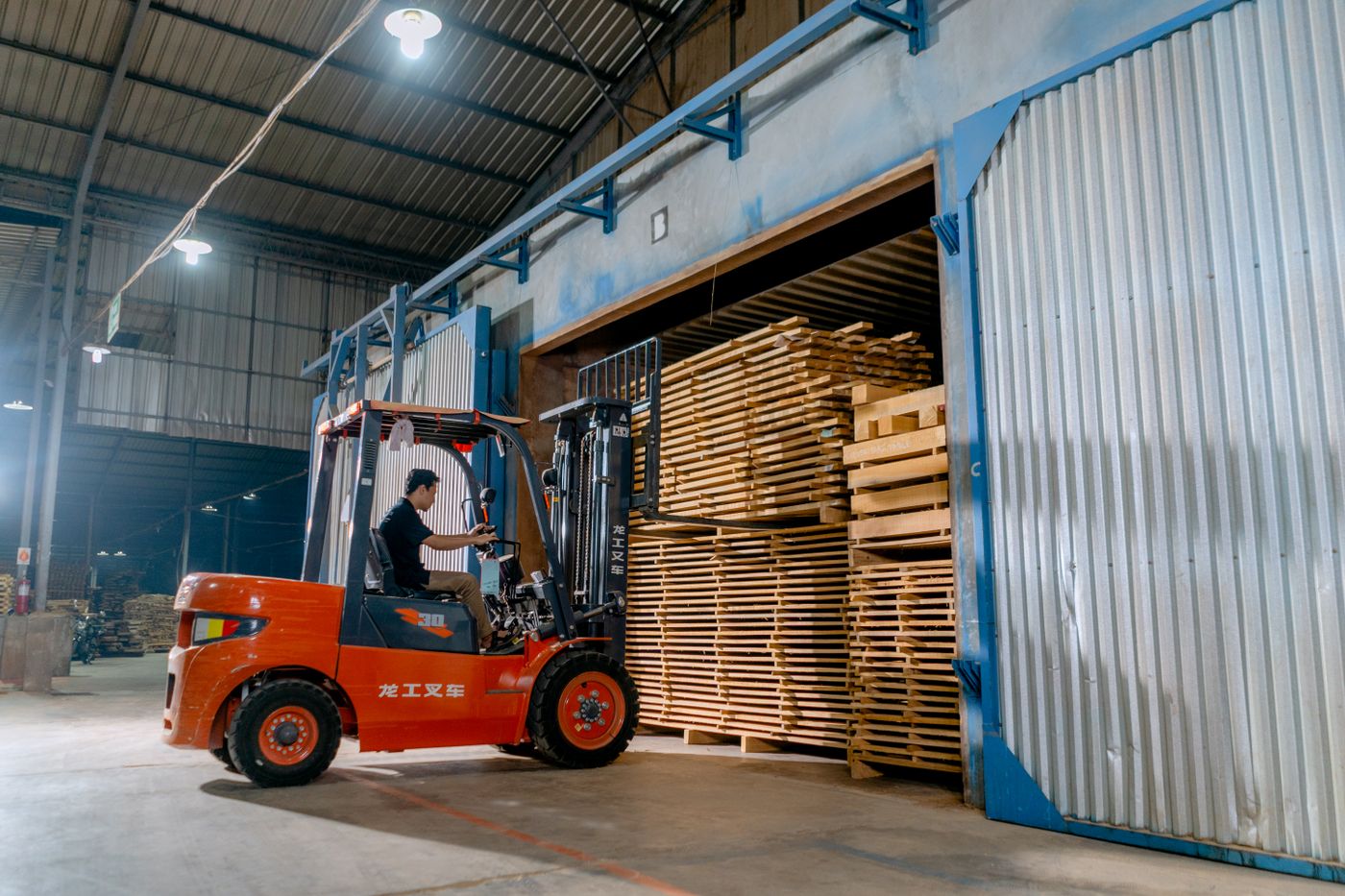
Photos: forklift driver — photo by Mandiri Abadi, https://www.pexels.com/photo/a-man-driving-a-forklift-15016531/ ; man operating industrial machinery — photo by Mehmet Turgut Kirkgoz, https://www.pexels.com/photo/11765538/ ; warehouse interior — photo by Tiger Lily, https://www.pexels.com/photo/4483610/
More guides
- How to Hire a Moving Company That Won't Hold Your Furniture HostageMovers › Moving & Storage
- How Much Do Movers Cost? Local vs. Long-Distance Pricing ExplainedMovers › Moving & Storage
- Binding vs. Non-Binding Estimates: The Difference That Decides Your Final BillMovers › Moving & Storage
- Moving Insurance and Valuation: What 'Full Value Protection' Really CoversMovers › Moving & Storage
- Long-Distance Moving: A Start-to-Finish Guide for Household GoodsMovers › Household Goods Moving & Storage
- All Guides & ArticlesBrowse the full guides library