Movers › Heavy Equipment Movers
Booking Heavy Equipment Movers Online vs. In Person: What Changes, What Does Not
A heavy equipment move looks simple from a distance: one machine, one trailer, one destination. Up close it is a chain of measurements, permits and judgements, and a single wrong number — a height guessed two inches low, a weight taken from a brochure instead of a scale ticket — can stop the truck at a bridge, a state line or the end of your own driveway.
That is why the question of how you book matters, and why it matters differently here than it does for a sofa. Booking online and booking in person are not two prices for the same product. They are two different ways of gathering the information the price is built from. This guide walks through what actually changes between them, what stubbornly does not, and how to use each channel for the part it is good at.
First, what a heavy equipment quote is actually built from
Every legitimate quote, however it arrives, is assembled from the same parts. A legal-size load on a lowboy or RGN trailer typically runs $3.50 to $8.00 per loaded mile in current industry guides. Once a load goes oversize or overweight, quotes quoted all-in — linehaul, permits, escorts and fuel together — typically run $5.00 to $15.00 or more per mile. Short local work is rarely priced by the mile at all: a legal local move under about 100 miles commonly lands at $300 to $800 flat, and a local oversize move at $800 to $2,500 or more, because dispatch minimums, loading time and paperwork are fixed costs that do not shrink with distance.
Underneath the per-mile figure sit the thresholds that decide whether you need permission to move at all. Federal interstate limits are 80,000 pounds gross vehicle weight, 20,000 pounds on a single axle, 34,000 pounds on a tandem, and 102 inches — 8 feet 6 inches — of width. Height is set by the states and generally runs 13 feet 6 inches to 14 feet 6 inches. Cross any of those lines and the load becomes a permitted load: a single-trip permit in every state it crosses, typically $15 to $200 per state for ordinary oversize and $50 to $500 or more for overweight, with escort or pilot cars — roughly $1.50 to $3.00 per mile per vehicle, or $500 to $1,500 per day — once width, length or height crosses that state's trigger. Loading help is separate again: crane loading can run $500 to $3,000 or more, and rigging $200 to $1,000.
None of those numbers cares how you booked. What the booking channel changes is how accurately the inputs — dimensions, weight, site access, timing — are captured before the number is produced.
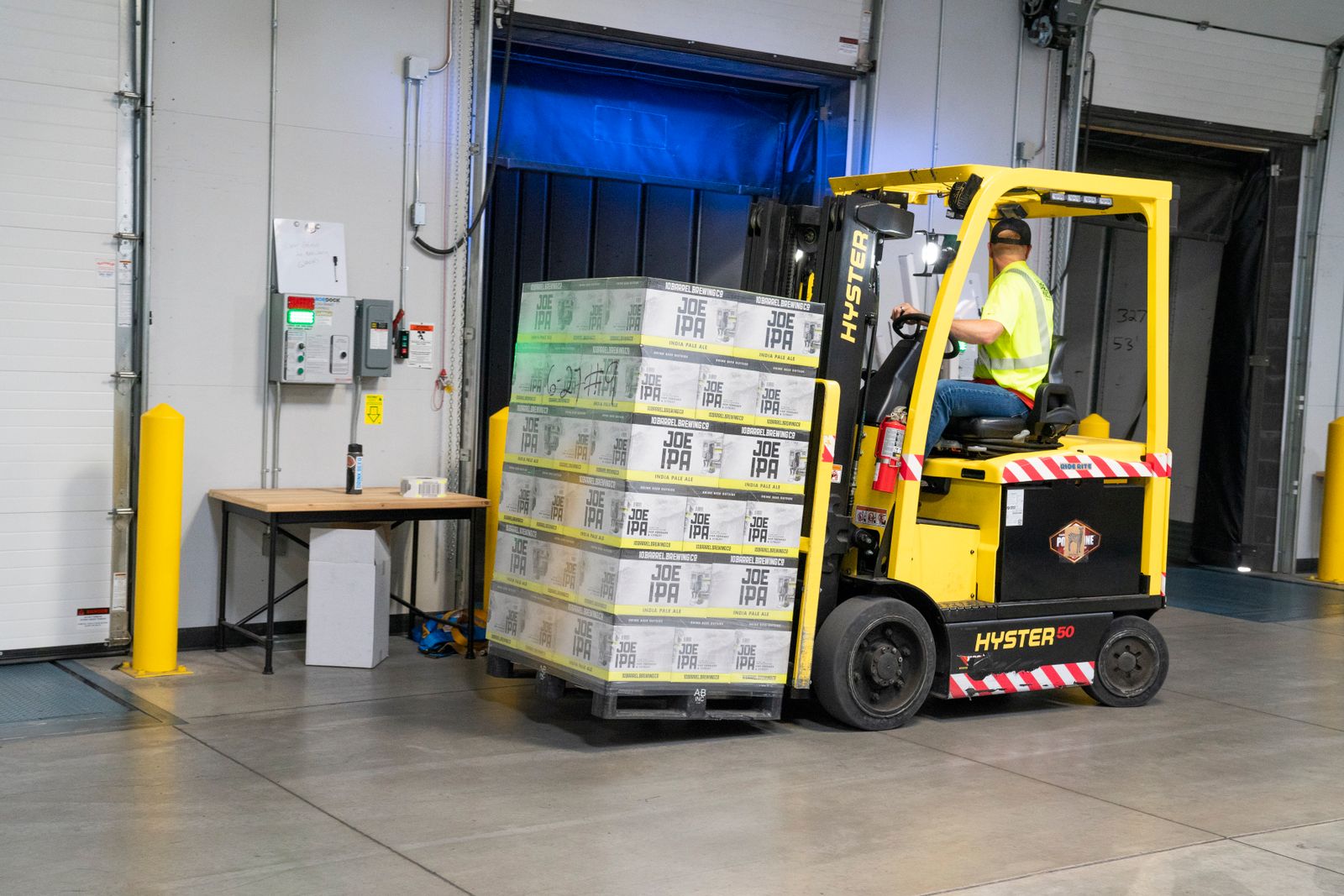
What booking online does well
Speed of comparison. An online form or marketplace lets you put the same machine in front of five carriers in an afternoon. For a standard, legal-size machine with a published spec sheet — a skid steer, a compact excavator, a scissor lift — that comparison is real, because the inputs are verifiable from the manufacturer's plate and every carrier is pricing the same object.
A written record from the first minute. A form submission, an email quote and a platform message thread are documents. When a dispute starts, the side with the paper usually wins it, and online booking generates paper by default. In-person booking generates paper only if you insist on it.
Access to capacity you do not know. Heavy haul is a thin market in many regions. An online broker or load board can find the RGN that happens to be deadheading back through your state next Tuesday — a truck no amount of local phone calls would have surfaced, and one whose empty return miles can make its price genuinely lower, not just apparently lower.
Asynchronous detail. Photographs, spec sheets, serial plates and site pictures can be attached, forwarded and re-checked. A dispatcher pricing at midnight sees exactly what you sent, not what a salesperson remembered you saying.
Where online booking quietly fails
The failure mode is not fraud, most of the time. It is compression. A web form reduces your machine to a make, a model and two postcodes, and heavy equipment resists that reduction.
Dimensions get rounded, and rounding is expensive. Operators type the transport height from memory. Attachments travel or they do not. A bucket, a ripper or a folded boom changes the load's length and weight distribution. If the real load crosses a permit threshold the quoted load did not, the move stops being the move that was priced — permits are reissued, an escort is added, and the difference lands on your invoice, legitimately.
Weight is guessed from brochures. Operating weight in a spec sheet is a dry, base-configuration figure. Fuel, fluids, attachments, accumulated modifications and the mud in the tracks are not in it. Overweight permits are issued against declared weight and axle spacing; a scale ticket beats a PDF every time, and no web form asks for one.
Sites disappear. The form knows the address. It does not know about the soft shoulder after rain, the low branch at the gate, the 12 percent grade, the overhead line at 14 feet, or the fact that the yard gate is narrower than the load. In person, a competent estimator sees those things because they are standing in them. Online, they surface on move day, priced as surprises.
Broker and carrier blur. Online, the company quoting you may not own a truck. A broker arranges transport through a carrier; a carrier hauls it. Federal rules require household goods brokers to disclose that they are brokers, and the same question — are you the carrier, or are you arranging one? — is the single most useful sentence in any heavy equipment booking, online or off. Broker quotes can be estimates the eventual carrier never agreed to, deposits of 10 to 35 percent are commonly collected up front and are often non-refundable, and accountability for a damaged machine gets passed between two companies that each say the other was responsible.
What booking in person does well
The survey is physical, and physical beats described. The federal household goods rules make the principle explicit for home moves: a mover must offer a visual survey of the goods, in person or virtually by live or recorded video that clearly shows what is being moved, before issuing a written binding or non-binding estimate. Heavy equipment is freight, not household goods, so that specific rule does not govern it — but the logic transfers exactly. A person who has walked around the machine, read the plate, measured the height with the boom in transport position and photographed the access road has priced your move. A person who has read your form has priced a description of your move.
Accountability has an address. A yard, a dispatch office and a name you have shaken hands with do not guarantee honesty, but they change the economics of dishonesty. A local carrier that loads equipment in your county every week is protecting a reputation it cannot re-register under a new name next month.
Route knowledge is local knowledge. The estimator who drives these roads knows which bridge is posted, which county road floods, which state line inspection station is strict about axle weights, and which permit office turns a single-trip application around same-day. That knowledge rarely appears as a line item. It appears as the absence of problems.
Where in person quietly fails
One quote is not a market. The yard you visited may be excellent and expensive, and you will never know, because loyalty and habit are not price discovery. In-person booking narrows your sample to whoever is near enough to visit.
Verbal comfort evaporates. "We'll take care of the permits" said across a desk is not a contract term. In-person deals drift toward handshake understandings about who supplies the crane, who pays waiting time, and what happens if the machine will not start on load day. Online channels force those questions into fields and checkboxes; a yard conversation lets everyone leave with a different memory of the same agreement.
Availability is whatever is in the yard. A small local fleet has the trailers it has. If your load needs a multi-axle RGN and the local carrier owns flatbeds and one step deck, the in-person relationship can tempt both of you into making the wrong trailer work.
What does not change, whichever way you book
| Element | Online | In person |
|---|---|---|
| Permit thresholds | Same federal and state size and weight limits | Same — the road does not care how you booked |
| Who is liable for declared weight and dimensions | You, if your figures were wrong | You, if your figures were wrong — an estimator's own measurements shift this, which is the point of the survey |
| The documents that control the job | Written estimate, order and bill of lading | Identical — get them in both cases |
| Escort and permit costs | Set by the states crossed | Set by the states crossed |
| The need to verify the carrier | USDOT and MC numbers, checked against the legal name on the quote | Identical — a yard visit is not a licence check |
Read that table as the real answer to the title. The physics, the law and the paperwork are channel-proof. Only the quality of the information feeding the quote, and the ease of comparing and verifying, move between channels.
A hybrid that works: online for the market, in person for the machine
Dispatchers who book equipment every week tend to converge on the same sequence, and it uses each channel where it is strong.
- Build the machine file first. Photograph the serial plate. Record transport dimensions with attachments in travel position, and get a scale weight if the machine is anywhere near a threshold. Photograph both sites — gate, surface, overhead, turning room. This file is the booking, in every channel.
- Shop online with the file, not a form's minimum. Send the same file to three or four carriers or a broker, and require line-item quotes: linehaul, permits, escorts, fuel, loading, waiting time. An all-in number you cannot decompose cannot be compared.
- Shortlist on paper, verify in the registry. Check each finalist's USDOT and MC numbers and confirm the legal name matches the quote. Ask, in writing, whether they are the carrier or arranging one.
- Put eyes on the finalist's operation — or make them put eyes on yours. For a permitted, high-value or awkward-site move, an in-person survey by the carrier, or at minimum a live video walk-around of machine and sites, is worth more than the last $200 of price negotiation. For a legal-size machine between two paved yards, the file plus a line-item quote is honestly enough.
- Lock the unchanged things in writing. Binding versus non-binding, who files and pays for permits, escort responsibility, cancellation and waiting-time terms, and what happens to the price if measured dimensions differ from declared ones. Say it in the document, not the driveway.
The honest bottom line
Book online when the machine is standard, the sites are simple and the load is comfortably legal — and spend the saved effort on line-item quotes and licence checks. Book in person, or demand an in-person survey, when the load is near a permit threshold, the machine's real weight is uncertain, either site is awkward, or the machine is valuable enough that a loading mistake is a five-figure event. This site lists 2,791 heavy equipment movers, so the market is there to be compared — but comparison only protects you if every quote is pricing the same measured machine, on the same route, under the same paperwork. Get the machine file right, and the channel matters far less than people selling either one will tell you.
Sources
- O Trucking, Lowboy Trucking Rates 2026 — legal lowboy rates of $3.50–$8.00 per mile, oversize and overweight all-in rates of $5.00–$15.00+ per mile, local flat rates, and permit and escort cost ranges.
- Logi Transports, Heavy Equipment Transport Cost in 2026 — the federal interstate size and weight envelope, trailer-type rate bands, and local move minimums.
- HTS Logistics, Heavy Equipment Transport Cost — how a heavy haul quote is assembled from linehaul, fuel, permits, escorts and accessorials, and state escort triggers.
- FMCSA, Motor Carrier Safety Planner, household goods estimate requirements — the visual survey rule, in person or virtual, and the binding and non-binding estimate definitions under 49 CFR 375.401.
- FMCSA, Your Rights and Responsibilities When You Move — carrier and broker definitions and the consumer guidance on verifying registration.
Forklift in a warehouse — photo by ELEVATE, https://www.pexels.com/photo/man-riding-on-yellow-forklift-1267329/ Warehouse loading — photo by Tiger Lily, https://www.pexels.com/photo/photo-of-warehouse-4481326/
More guides
- How to Hire a Moving Company That Won't Hold Your Furniture HostageMovers › Moving & Storage
- How Much Do Movers Cost? Local vs. Long-Distance Pricing ExplainedMovers › Moving & Storage
- Binding vs. Non-Binding Estimates: The Difference That Decides Your Final BillMovers › Moving & Storage
- Moving Insurance and Valuation: What 'Full Value Protection' Really CoversMovers › Moving & Storage
- Long-Distance Moving: A Start-to-Finish Guide for Household GoodsMovers › Household Goods Moving & Storage
- All Guides & ArticlesBrowse the full guides library