Movers › Mini & Self Storage
Booking Mini and Self Storage Online vs. In Person: What Changes, What Does Not
If you are between leases, storage is rarely a considered purchase. One lease ends on the 31st, the next starts on the 15th, and somewhere in that gap your furniture has to live. You will probably book the unit at midnight, from a phone, half-packed. The question is not really whether online booking is better than walking into an office. It is what each route quietly changes — about the price you pay, the unit you actually get, and who you can argue with later — and what it stubbornly does not change at all.
Dispatch taught me the pattern. The customers who had trouble were rarely the ones who chose the “wrong” channel. They were the ones who assumed the channel had done a job it never does: measured their stuff, read the lease for them, or checked that the door was tall enough. Here is the honest comparison.
First, three different things get called “booking online”
The industry uses one phrase for three transactions, and confusing them causes most of the friction.
A reservation holds a unit size for a short window. U-Haul describes its version clearly: a reservation places a hold on the inventory for your selected size, requires no payment and no signed agreement until you walk in, and at its own locations is held only up to a day past your expected move-in date — and a space is only guaranteed up to seven days ahead of that date. Marketplace listings work similarly: reserve free, pay nothing until move-in, cancel or change any time. A reservation is an intention, not a tenancy.
An online rental — “Rent Now” or online move-in — is the whole transaction. You sign the rental agreement and pay the first month online, and in return you receive a unit assignment and a gate access code immediately, with no office visit at all. Fully remote operators run the same flow: pick a unit, e-sign the lease, pay, and the gate and unit codes arrive by email and text within minutes.
An in-person rental is the same lease signed at a counter, usually after a tour, with a manager who can walk you to the actual unit.
Everything below follows from that split. Comparing “online” with “in person” without asking reservation or rental? is how people end up believing they own a unit they have only held — or believing they can renegotiate a lease they have already signed.
What changes: price — and online usually wins the first month
This is the clearest difference, and it is not close. Large operators price the web channel lower on purpose. Public Storage's own listings show the gap in print: a small unit offered at an “online only price” of $17 a month carried an in-store rent of $22 for the same space, with a one-time $29 admin fee either way, and web-only first-month offers — $1 for the first month, or half off — attached to the online price. The pattern repeats up the size range: the online rent is the lower number at nearly every step.
Promotions skew the same way. Guides to first-month-free deals note that the best offers are often reserved for online bookings and may not be honoured for walk-ins, and that even a “free” month still leaves you paying the admin fee (typically $20–$50), a protection plan or insurance (roughly $11–$47 a month), and a lock if you need one. U-Haul is an exception worth noting: its own locations charge no deposit and no admin fee, and no fee to reserve — but affiliate locations may not extend the same terms, which is itself a lesson in reading which entity you are actually booking with.
What the office can sometimes do that the website cannot is improvise: combine a too-small room with a neighbouring one, transfer you to a larger unit, or apply a manager's discretion to a fee. U-Haul's own FAQ contemplates exactly that fix — ask at the facility — because it can only happen in a conversation. So the honest summary is: online wins on the published price and the promotion; in person wins on exceptions. If your move is standard, take the web price. If your situation is not — a gap of eleven days, a piano, a unit needed tonight at a facility showing “one left” — a human can occasionally bend what a checkout screen will not.
One thing neither channel changes: the teaser is not the tenancy. Promotional rent gives way to the standard rate from the second month, facilities commonly raise rents within the first 6 to 12 months, and month-to-month terms — standard at the big operators — mean the price can move again with notice. Between leases, that hardly matters for a three-week gap. It matters enormously if the gap quietly becomes a year.
What changes: information quality — each channel lies differently
A website shows you availability, price and a size chart at 1 a.m., across every facility in town, which no office can match. That breadth is real, and for comparing five facilities it is decisive. But the unit on the screen is a category, not a place. Online rental systems assign you a specific unit from the pool you chose; you learn its number with your gate code. You have not seen its corridor, its distance from the elevator, its lighting, or whether the roll-up door sticks.
The physical facts are exactly the ones screens flatten. Most units have ceilings around 8 feet, but the binding limit is the door opening, which is shorter than the ceiling — one facility's spec for a 10×10 lists a door about 7 feet tall under an 8-foot ceiling, so a wardrobe that “fits” the room may not fit through the door. Sizing guidance aimed at renters makes the same point from the other side: photos online can be deceiving, facilities will usually let you bring a tape measure, and the reliable method is an inventory — measure the bulky pieces, estimate boxes honestly (roughly 1.2 to 1.5 cubic feet per medium box), and add a 10 to 20 percent buffer — rather than a size chart's promise that a unit holds “a two-bedroom apartment.”
Walking in reverses the trade. You see one facility well instead of six facilities thinly. You can stand in the unit, test the door, judge the drive-up slope with a loaded truck in mind, and notice the things no listing mentions: standing water stains, a corridor that smells of mildew, a gate keypad in darkness. What you lose is comparison — nobody tours six facilities in an afternoon — and the web-only price.
| Question | Online | In person |
|---|---|---|
| Price and promotions | Usually lower; web-only first-month deals | Published in-store rent is higher; manager discretion on exceptions |
| Availability picture | Every facility, live, at any hour | One facility, but the actual units |
| The specific unit | Assigned from a pool after you pay | You can see and sometimes choose it |
| Size confidence | Size charts and estimators — optimistic by design | Tape measure, door opening, standing in the space |
| Paperwork | E-signed lease, paid, gate code in minutes | Same lease, signed at the counter, questions answered live |
| If something is wrong on move-in day | A support line, a portal, a call centre | A person in the building who can reassign you |

What changes: accountability
Here is the difference dispatchers feel most. When an online rental goes wrong — the code does not work, the unit is smaller than the chart implied, the “first floor” unit is up a flight — your counterpart is a process. Good operators build for this: codes retrievable in a customer portal, support by phone and text, QR codes at the gate that reopen your account. It works, at the speed processes work.
At a staffed facility, your counterpart is a person who was there when you signed, who can walk to the unit with you, swap you into another one, and note the problem on your account while you watch. That is worth real money on a move-in day that is already going badly, which — between leases, with a truck clock running — is most move-in days. The counterweight: an unstaffed or remote-managed facility booked “in person” may offer no more human accountability than the website did, and a great call centre beats a shrug at a counter. Ask, before you book either way, one question: when something is wrong at 7 p.m. on my move-in day, who exactly do I reach? The answer is the accountability you are buying.
What does not change, whichever way you book
- The lease. Month-to-month terms, prohibited-items rules, late fees, lien and auction rights after default, and your obligation to insure or accept the protection plan are identical. The signature is a finger swipe instead of a pen; the document is the same.
- The unit. A 10×10 is the same concrete and steel door whether a screen or a manager sold it. Booking channel adds no space and removes none.
- Your sizing risk. Neither channel measures your furniture. The inventory and the buffer are yours to do in both worlds.
- Rate behaviour after the promotion. Both channels step up to standard rent, and both can raise it later under month-to-month terms.
- The move-in work. Locks, loading, and the Tetris are unchanged. U-Haul requires a round disc lock on its rooms however you rented; the disc lock does not care where you bought it.
A sensible way to combine them
For a between-leases move, the strongest sequence uses each channel for what it is good at. Compare facilities and prices online, where comparison is free. Reserve — do not yet rent — the leading candidate, since a reservation typically costs nothing and holds the size briefly. Then, if the facility is within a reasonable drive, visit once: stand in a unit of that size, measure the door, check the route from gate to door. Finally, complete the rental online to capture the web price and promotion, with the gate code ready before the truck is loaded.
If there is no time to visit — the common case — rent online but defend yourself: choose the size above the chart's suggestion when your inventory is borderline, screenshot the price, promotion and unit terms at checkout, and keep the confirmation email with your codes somewhere that is not only in the phone that is about to die in a hot truck cab.
This site lists 2,753 mini and self storage listings, so the choice is wide either way. Book the channel that matches your risk: online for price and speed when the move is standard, a human in the loop when it is not — and never mistake a reservation for a rental, or a size chart for a tape measure.
Sources
- U-Haul, Self-Storage FAQ — the difference between a reservation (a hold, no payment or agreement, held up to one day past the expected move-in date) and Online Move-In / Rent Now (agreement signed and first month paid online, unit assignment and access code issued immediately); no deposit or admin fee at U-Haul owned and managed locations; month-to-month agreements; disc lock requirement; transferring or combining units at the facility.
- Public Storage, storage search listings — online-only prices shown below in-store rents for the same units, web-only first-month offers, and the one-time $29 admin fee.
- SelfStorage.help, “First Month Free Storage: How the Deals Work” — move-in costs that survive a free month (admin fee, protection plan, lock), online-only promotions, minimum stays, and rent increases within the first 6 to 12 months.
- 10 Federal Storage, Self Storage Unit FAQ — fully contactless online rental: digital lease signing, gate and unit codes delivered by email and text, no office visit or meeting required.
- Island Park Storage, “Storage Unit Height Clearance” — typical 8-foot ceilings, door openings shorter than ceilings as the real limit on tall items.
- LockerHelp, “How to Find the Right Self-Storage Unit for Your Items” — inventory-based sizing, medium-box volume estimates, and adding a buffer rather than trusting size charts.
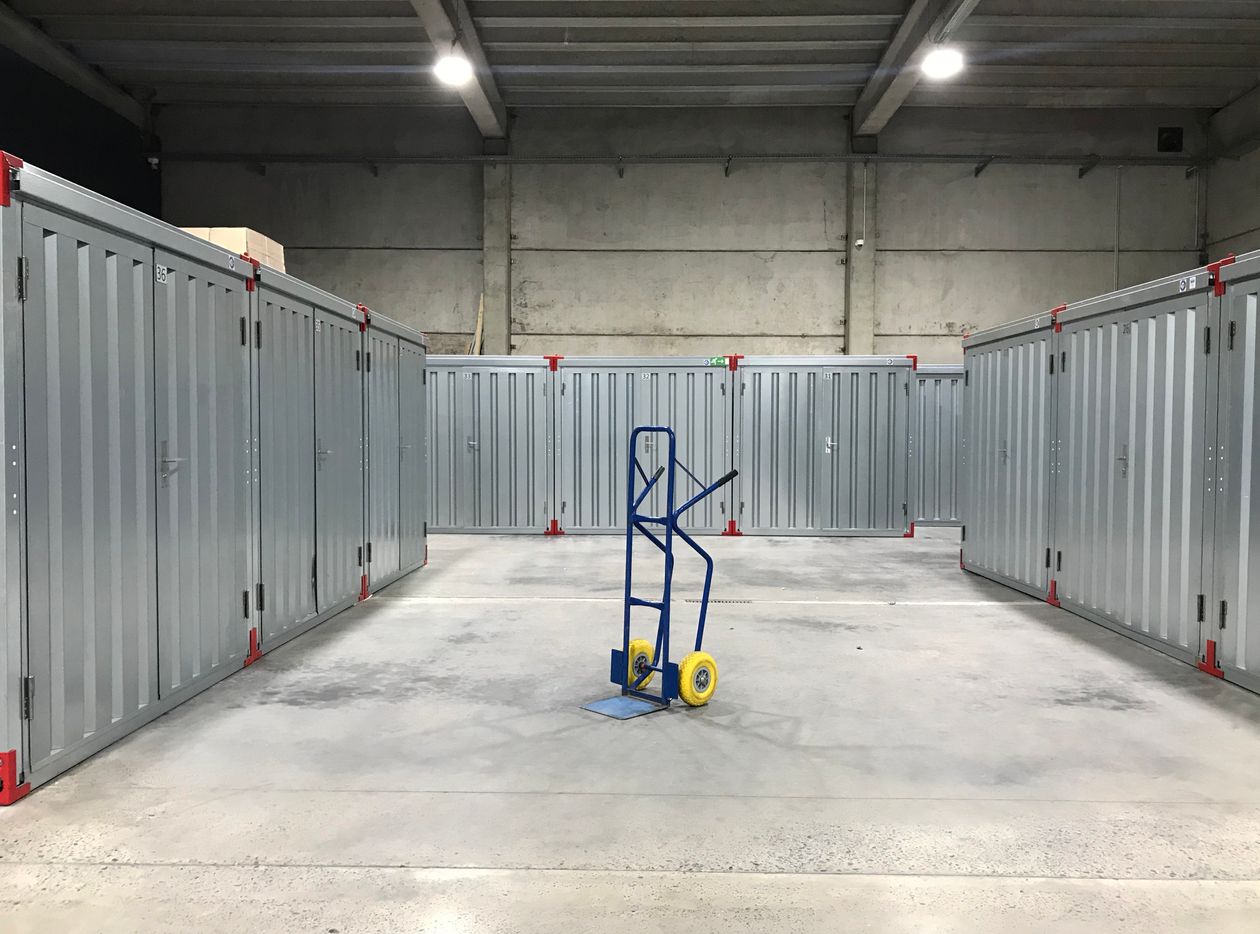
Photos: - Storage facility hallway — photo by David Slaager, https://www.pexels.com/photo/5759145/ - Warehouse interior with concrete floors — photo by Tiger Lily, https://www.pexels.com/photo/warehouse-with-concrete-floors-4483610/
More guides
- How to Hire a Moving Company That Won't Hold Your Furniture HostageMovers › Moving & Storage
- How Much Do Movers Cost? Local vs. Long-Distance Pricing ExplainedMovers › Moving & Storage
- Binding vs. Non-Binding Estimates: The Difference That Decides Your Final BillMovers › Moving & Storage
- Moving Insurance and Valuation: What 'Full Value Protection' Really CoversMovers › Moving & Storage
- Long-Distance Moving: A Start-to-Finish Guide for Household GoodsMovers › Household Goods Moving & Storage
- All Guides & ArticlesBrowse the full guides library