Movers › Containers Industrial
Containers Industrial for Seniors: Costs, Comfort and the Adjustments Worth Asking About
The complaint files teach a pattern. When an older customer has a bad container move, the failure is rarely that the box was too small or the truck was late. It is that a service designed around a single exhausting moving day — load it now, decide everything now, carry everything now — was sold to someone whose move needed the opposite: weeks instead of hours, ground level instead of a ramp, and decisions made one room at a time. Industrial containers — the steel portable containers delivered to a driveway by companies such as PODS, 1-800-PACK-RAT and U-Haul's U-Box — are, used properly, the one mainstream moving product built for that slower shape. Used carelessly, they reproduce every problem of a truck, with a steel door.
This guide is about using them properly after 65: what they cost, what genuinely changes for older customers, and the adjustments good providers make — many of them free, most of them only if you ask. It is written for people watching the budget, because in senior moves the container's real economic advantage is pacing: work you do slowly, at your own speed, is work you do not pay a crew to stand over.
What "containers industrial" actually means when you rent one
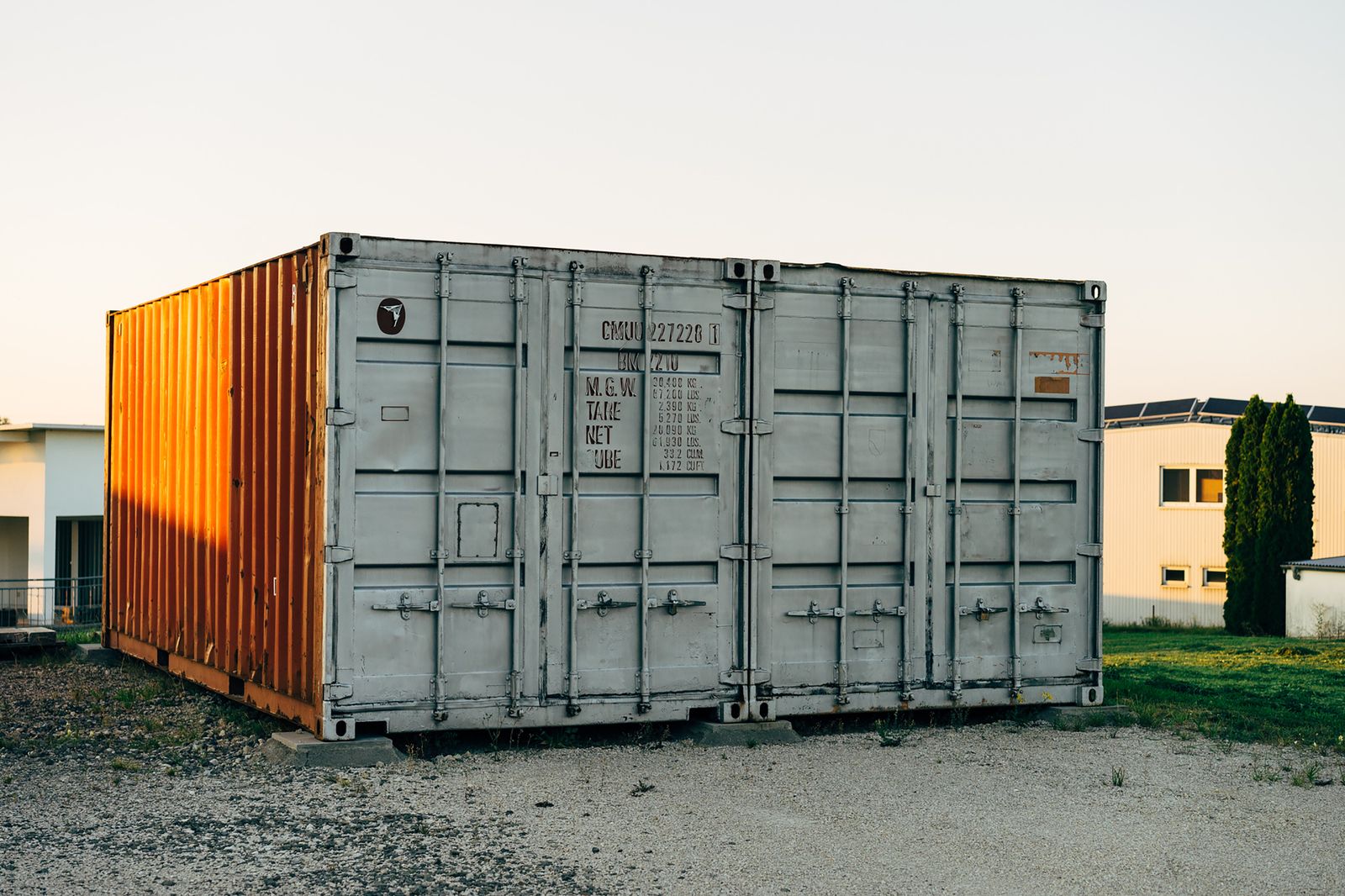
Forget the shipping yard for a moment. The product a senior household rents is a weatherproof steel or steel-framed container, typically in three sizes — about 8, 12 and 16 feet long — delivered by a specialised truck or lift system, set down on a driveway or parking area, and left with you. You load it, or labor you hire loads it. The provider then does one of three things: leaves it with you as on-site storage, takes it to a secure storage centre until you call for it, or transports it to your new home and sets it down again. U-Box containers are smaller wooden-and-vinyl units delivered by trailer, sometimes several at once; the big steel boxes are the classic form.
Two cousins of this product appear in the same conversations, and are worth separating. A purchased used shipping container — a retired 20- or 40-foot ISO box bought outright and set on your own land — is a different purchase entirely: no monthly rent, but delivery, ground preparation, and local rules about keeping it are all yours, and it does not travel to a new home unless you pay a carrier. And a storage-centre container you never see at your house is simply warehouse storage with extra steps. For a senior move — downsizing, a gap between selling and buying, a transition to a community — the rented portable container is almost always the relevant product, and it is the one priced below.
What it costs, honestly totalled
Container pricing is quoted in pieces, and complaint files are full of customers who budgeted for one piece. The pieces are: delivery, monthly rent, any transport to the new home or storage centre, storage-centre rent if it goes there (higher than at-home rent), final pickup, and contents protection. Published 2026 pricing for the largest national provider gives the shape:
| Container | Monthly rent at your home | Monthly rent at a storage centre | Delivery / pickup |
|---|---|---|---|
| 8-foot | about $139 | about $189 | about $80 each way |
| 12-foot | about $159 | about $210 | about $80 each way |
| 16-foot | about $175 | about $239 | about $80 each way |
Wider market guides put monthly rents at $150 to $359 depending on size and region, with delivery and pickup at $75 to $150 per trip. For a move rather than storage alone, local moves with one container commonly total in the $350 to $900 range in providers' own examples; a 16-foot container moved up to about 250 miles runs roughly $900 to $2,100 in third-party pricing data, and cross-country moves run into several thousand dollars per container. Contents protection is a separate monthly charge, priced by coverage level — in one published breakdown, from about $39 to over $500 a month at the highest levels, which is why the coverage decision deserves a minute's thought rather than a signature.
The senior-budget reading of those numbers: the container itself is rarely the expensive option. A 16-foot box at home for two months, with delivery and pickup, totals roughly $510 at the published averages — less than most full-service local moves, and spread across a pace you control. What makes container moves expensive in the files is duration drift (a third, fourth and fifth month at a storage centre at $239, because the new home was not ready and nobody priced that risk) and labor added late at premium rates. Price the pessimistic timeline when you book, not the optimistic one.
The comfort case: what genuinely changes for older customers
Ground-level loading is the headline, and it is real. A portable container sits on the ground. There is no truck ramp to climb with a box in your arms, no tailgate, no steps up into a cargo bed. U-Haul and PACK-RAT both make the point explicitly in their senior guidance, and it is the single largest physical difference between a container move and a rental-truck move. For anyone with a knee, a hip, a balance concern or a heart condition, ground level is not a convenience; it is the difference between participating in your own move and being exiled from it.
Pacing is the second advantage, and providers understate it. A container rented for a month converts moving from an event into a process. A few boxes a day. One cupboard at a time. Breaks when needed, pauses for a bad week, time to let family come at weekends and argue — lovingly — about the china. Senior-move guidance from U-Haul makes exactly this case: load a little at a time, revisit undecided items later, and let the container wait at your home or at the storage centre until you are ready. Downsizing decisions made at that pace are better decisions; the complaint files contain very few regrets from people who went slowly, and many from people rushed by a truck's return deadline.
No driving. The provider transports the loaded container. Nobody has to pilot a rental truck — a vehicle most older drivers have never operated — across town or across the state, and nobody has to return it by 9 a.m. on the third day.
One handling, not three. Loaded once at the old home, a container going to storage and then to the new home is not unloaded and reloaded in between. Every handling is a chance for damage and for a box to go astray; for a household full of fragile, sentimental things, fewer handlings is a genuine quality argument, not a slogan.
The honest limits: what a container does not solve
A consumer writer's duty is the other side of the brochure.
It does not lift anything. The container removes the ramp and the driving; the carrying remains. Loading and unloading are your job unless you hire labor separately — the most common and most expensive mistaken assumption in the complaint files is a family discovering, at the destination, that no unloading help was ever booked. Good providers will connect you with third-party labor; the booking, and its price, are still yours to arrange. For a senior household, arrange it at both ends when you book the container, at agreed rates.
Access at a storage centre is by appointment. Once your container is warehoused, retrieving one box is not a drive-up errand. Providers typically require scheduling — in one major provider's terms, access is arranged 24 to 48 hours ahead, and the container is brought out for you. If you will need things during the storage period, keep them out, or choose at-home storage where the box stays in your driveway.
It is not climate-controlled. A steel container follows outdoor temperature, with the same heat and humidity cautions as any standard storage. Medications, candles, electronics, instruments and photographs should not spend a summer inside one. Providers offer no meaningful climate option in a standard container; plan those items separately.
Placement is a negotiation with your street, your HOA and your city. A container needs a flat, clear space — typically the driveway — with room for the delivery system to work. Street placement occupies public right-of-way and commonly needs a city permit; many cities limit how long a temporary container may sit even on private property, with rules varying from no permit and a two-week cap in one suburb to formal permits in another, and HOAs and retirement communities frequently have their own restrictions or bans. At the destination — especially a senior community — confirm in writing that a container may be delivered and how long it may stay before the loaded box is on a truck. A container a community refuses is a crisis measured in hundreds of dollars a day.
The adjustments worth asking about
Good providers make these routinely. The difference between customers who get them and customers who do not is usually a phone call at booking.
- A longer first rental period, priced now. If there is any chance the move stretches — a closing that might slip, a community waitlist — negotiate the extra month's rate and the storage-centre rate at booking, when you have leverage, not in month three.
- Placement help. Ask the delivery driver to position the container for the shortest, flattest carry from the door you will actually use, with the doors opening the way you need. Providers' senior services commonly include placement assistance; a box set down thoughtlessly adds fifty feet to every trip for a month.
- Labor at both ends, booked through the provider's partners. Ask for the referral, get the labor quote in writing alongside the container quote, and confirm who brings dollies, sliders and blankets.
- A lock and protection decision made calmly. You supply your own lock — buy a good disc lock — and contents protection should be chosen by comparing its monthly cost and coverage cap against what is actually inside, and against whether your homeowner's or renter's policy already covers stored property. Do not let the highest tier be a default.
- Pickup flexibility in writing. What does it cost to move a pickup by a few days? What is the cancellation deadline — one major provider charges a fee if you cancel inside three days of delivery. On a fixed income and a shifting closing date, these small print items are the budget.
- A named human for problems. Ask who to call if the container leaks, the lock is cut, or the pickup truck does not come. Complaint files show that the customers who fare best are the ones who never had to fight a call centre tree to report a problem.

A senior container move, sequenced
Start six to eight weeks out if you can. Book the container for the pessimistic timeline, confirm placement permission at both addresses, and book labor for the heavy days at both ends. Load in layers of urgency in reverse: the things you will want first at the new home go in last, nearest the doors. Keep a "never in the box" bag — medications, documents, chargers, a change of clothes, the kettle — that travels in a car. Photograph the loaded container before it closes; if a protection claim is ever needed, that photograph and an inventory list are the claim. And schedule the destination labor before the container leaves the origin driveway, because a box arriving to an empty house and no help is the one failure mode this product cannot forgive.
This site lists 476 industrial container providers among its moving and storage listings — a thinner field than household movers, which is precisely why the questions above matter: in a market this size, the difference between providers is not the steel box, which is the same everywhere, but the pacing, placement and problem-solving wrapped around it. Choose the wrapper, not the box.

Sources
- Storage Unit Costs, "Pod Storage Cost (2026)" — establishes PODS monthly rents of about $139 to $175 at home and $189 to $239 at a storage centre by container size, with delivery and pickup of about $80 each.
- MoveBuddha, "How Much Does PODS Cost? (2026)" — establishes local move totals of $220–$813 per container, cross-country ranges, delivery and pickup fees of $75–$150 per trip, and a cancellation fee for cancelling inside three days of delivery.
- ShipSmart, "PODS Moving Cost 2026" — establishes providers' own local move examples, extra-month storage averages, and that long-distance transport is quoted separately from monthly rent.
- RecNation Storage, "Pod vs. Storage Unit: Which Is Cheaper? (2026)" — establishes comparative monthly rates and delivery and pickup fees across the major container providers, and worked one- and three-month totals.
- U-Haul, "8 Helpful Moving Tips for Seniors" — establishes that portable containers let seniors pack at their own pace and that U-Box containers load at ground level, with safety guidance on small boxes for heavy items and keeping walkways clear.
- 1-800-PACK-RAT, "Simplify Senior Moving and Relocations" — establishes that a portable container eliminates driving and ramp strain, allows packing at a comfortable pace, and that providers can connect customers with third-party labor for heavy lifting.
- The Mobile Storage Guy, "Storage Container in Driveway: LA Rules & Permits" — establishes that driveway placement on private property usually avoids street-use permits, while street placement occupies public right-of-way and commonly requires a city permit, with time limits varying by city.
- Photo by Markus Winkler, https://www.pexels.com/photo/18609057/
- Photo by Shane Eckert, https://www.pexels.com/photo/12393185/
- Photo by Steve A Johnson, https://www.pexels.com/photo/851305/
More guides
- How to Hire a Moving Company That Won't Hold Your Furniture HostageMovers › Moving & Storage
- How Much Do Movers Cost? Local vs. Long-Distance Pricing ExplainedMovers › Moving & Storage
- Binding vs. Non-Binding Estimates: The Difference That Decides Your Final BillMovers › Moving & Storage
- Moving Insurance and Valuation: What 'Full Value Protection' Really CoversMovers › Moving & Storage
- Long-Distance Moving: A Start-to-Finish Guide for Household GoodsMovers › Household Goods Moving & Storage
- All Guides & ArticlesBrowse the full guides library