Movers › Containers Industrial
Containers Industrial Prices Across the Country: Why the Same Job Costs Twice as Much Two States Away
Here is a quote I used to give in two versions. A 20-foot storage container, rented for a household move, delivered to a driveway: in one market, $130 a month with $199 delivery and $199 pickup, every fee printed on the rate card. In another, $150 a month — plus a $275 setup fee, plus a $500 refundable deposit, plus delivery and pickup quoted separately by location, plus tax. A third supplier, covering a wide rural territory, priced the same box at $75–$150 a month and then charged $450 to $1,000 each way to move it, depending on how far the truck had to travel. Same steel box. Same job. The difference was not the container, and it was not greed, exactly. It was geography — and if you are moving on a tight budget, geography is the line item you most need to understand, because it is the one you can actually do something about.
This guide explains why container prices are local in a way most prices are not: where the box physically sits before you rent it, how far the truck drives, what the local labor and land markets look like, and how demand cycles tighten one city's supply while the next city over has a yard full of boxes. It ends with the fairness test I would run on any quote, anywhere in the country.
A container is not shipped like a package
The root of it is simple: a container is never mailed to you from a national warehouse. It is sourced from a regional depot, loaded onto a flatbed or tilt-bed truck, driven a specific number of road miles to your specific site, and placed by a driver who has to get that truck in and out of your street. Every variable in that chain — how much inventory the depot holds, how far it drives, what the roads and site demand — is local. Industry analysis of price-by-city puts numbers on the result: two customers buying the identical used 20-foot container, same grade, same specification, can pay landed costs differing by 30 to 50 percent based entirely on where they live. Rental pricing breathes the same air, because the rental fleet lives in the same depots.
Force one: ports make boxes cheap
Shipping containers retire from ocean service at ports, and that is where the used supply pools. Cities adjacent to major container ports — Houston, Long Beach and Los Angeles, Newark, Savannah, Baltimore — draw directly on that retired stock, and abundant local inventory pushes prices down. Purchase data shows the pattern clearly: a used 20-foot wind-and-water-tight container runs about $1,400–$2,200 on the West Coast and $1,500–$2,400 on the Texas Gulf Coast, against $1,800–$2,800 in the Midwest and $2,000–$3,200 in the Mountain West and rural markets. Rental fleets buy from the same pools, so a port city's rental operator starts with cheaper boxes, more of them, and competitors on every corner making the same calculation. Inland, the box itself costs the operator more before it earns a dollar — and that cost is embedded in your rent whether it appears as a line item or not.
Force two: the truck ride is priced by the mile
Delivery is where geography stops being subtle. Suppliers price it in tiers: a flat fee inside a base radius — commonly about 50 miles — then a per-mile rate beyond it, typically $2–$5 a mile for a 20-foot container and $3–$7 for a 40-foot. The published breakdowns converge on the same ladder:
| Distance from depot | Typical delivery cost | What is happening |
|---|---|---|
| Under 50 miles | $200–$600 | Flat fee, tilt-bed, often same-week scheduling |
| 50–150 miles | $500–$1,000 | Base fee plus mileage; a day trip for the driver |
| 150–300 miles | $900–$2,000 | Overnight or relay delivery territory |
| 300+ miles | $1,500–$3,500+ | Long haul; buying or renting locally usually wins |
Now run that ladder against a rental. A 20-foot box at $130 a month is a bargain — until a $900 delivery and a $900 pickup turn a three-month rental into $390 of rent carrying $1,800 of trucking. This is why the same job costs twice as much two states away: in a depot-dense market the transport might be $400 total, and in a sparse one it is four times that, on identical rent. On a tight budget, the delivery radius matters more than the monthly rate. A supplier 30 miles away quoting more per month will routinely beat a cheaper supplier 200 miles away on the only number that counts, which is the total.
Force three: land, labor, and the local yard
Operators pay for the ground their inventory sits on, the drivers who move it, and the insurance they carry, and all three are local prices. A depot yard on industrial land outside Houston costs a fraction of the same acreage outside Newark or Seattle, and a market short of CDL drivers pays more for every mile in the ladder above. You can see the fingerprints in published rental cards. The Nevada supplier charging $130 a month for a 20-foot with flat $199 delivery runs a low-overhead desert-yard model and prints every fee upfront. The Central Florida operator at $150 a month adds a $275 setup fee and a $500 deposit — a different cost structure and a different risk model, in a market where hurricane-season demand and storm-removal obligations are part of doing business. Neither is cheating. They are pricing their own geography, and the customer's job is to read the whole card, not the monthly number.
Force four: demand cycles tighten one city at a time
Container demand is construction demand, moving demand, and disaster demand, and none of those move nationally in step. High-growth construction markets — Dallas, Charlotte, Nashville, Denver are the ones industry trackers name — can tighten local inventory during building booms until lead times stretch and rates firm up, while a slower market two states away sits on surplus boxes. Hurricane recovery does the same thing faster: after a Gulf or Florida storm, every contractor, insurer, and displaced household in the region wants a box in the same fortnight. Seasonal moving demand layers on top — the summer peak that fills moving trucks fills container yards too. A quote is a photograph of one city's supply and demand on one week. That is why the honest answer to "is this price fair?" is never a national average. It is a comparison against the same week's prices inside your delivery radius.
The fairness test: how to judge your local price
Run any quote through these five checks before you decide it is expensive or cheap.
- Compare totals, never rates. Total = delivery + (rent × months) + pickup + setup or admin fees + deposit handling + tax. The Florida card above beats the Nevada card on no reading of the monthly rate, and loses or wins on the total depending on how the separately-quoted delivery comes back. Get every quote as a total for your term, to your address.
- Ask which depot the box ships from, and how far that is. This one question explains most price gaps between competing quotes, and a supplier who will not answer it is asking you to pay for distance blind.
- Check your distance band. If you are inside 50 miles of a depot, delivery should be in the $200–$600 band for a standard placement. Far above that, you are paying for something — a crane placement, a difficult site, a relay — and you are owed its name. Crane placement, when a site truly needs it, legitimately adds $800–$2,500; it should never appear unexplained.
- Get three quotes inside the radius, in the same week. Prices are local and current or they are nothing. Three same-week totals within your radius define your market; if one is far below the other two, ask what is missing from it (pickup fees and setup fees are the usual hiding places — end-of-rental pickup charges are a documented, recurring dispute in this industry).
- Price the alternative honestly. For a short job far from a depot, compare against a storage unit plus a rental truck, or a portable-storage service whose network is denser where you live. Geography sometimes rules the container out, and knowing that before the deposit is the savings.

The tight-budget playbook
If the money is tight, geography gives you three levers that negotiation alone does not. Shrink the distance: choose the supplier by depot location, not by headline rate, and ask about depots just across the state line — state borders mean nothing to a tilt-bed truck, and a depot 40 miles away in the next state beats one 150 miles away in yours. Shrink the term: because delivery and pickup are fixed, the way to cut total cost is fewer rental months at the other end — load fast, unload faster, and never let a box sit "just in case" at a monthly rate. Shrink the size honestly: a 20-foot holds a few rooms packed with discipline, and stepping down from a 40 saves rent on every month of the job. What does not work is arguing a Nevada price into a Florida invoice. The dispatcher has heard it, the yard's costs are what they are, and the customer who understands why the number is the number is the one who finds the lever that actually moves it.
This site lists 476 industrial container providers. Spread across the country the way depots actually are — thick near ports and metros, thin in between — they are not one market with one price, and they never will be. Shop your radius, total the whole job, and judge the quote against its own geography. That is how the same job stops costing twice as much.
Sources
- YES Containers, container price by city study — establishes that landed costs for the identical used 20-foot container can differ by 30 to 50 percent by location, and identifies port proximity, depot density, delivery distance, and local demand as the structural forces.
- ContainerCompass, shipping container cost and delivery cost guides — establishes regional purchase ranges for a used 20-foot container (West Coast $1,400–$2,200; Texas Gulf $1,500–$2,400; Midwest $1,800–$2,800; Mountain West/rural $2,000–$3,200), delivery tiers by distance ($200–$600 under 50 miles up to $1,500–$3,500+ beyond 300 miles), per-mile rates beyond the base radius, and crane placement at $800–$2,500 extra.
- Western Elite, storage container rate card — establishes the Nevada example: 20-foot at $130 a month, delivery $199, pickup $199, all fees published upfront.
- ContainRent, Central Florida container rentals — establishes the Florida example: 20-foot from $150 a month, plus a $275 one-time setup fee and $500 refundable deposit, with delivery and pickup quoted by location.
- On-Site Storage Solutions, conex rental cost guide — establishes delivery and pickup fees of $450–$1,000 each depending on travel distance from the depot.
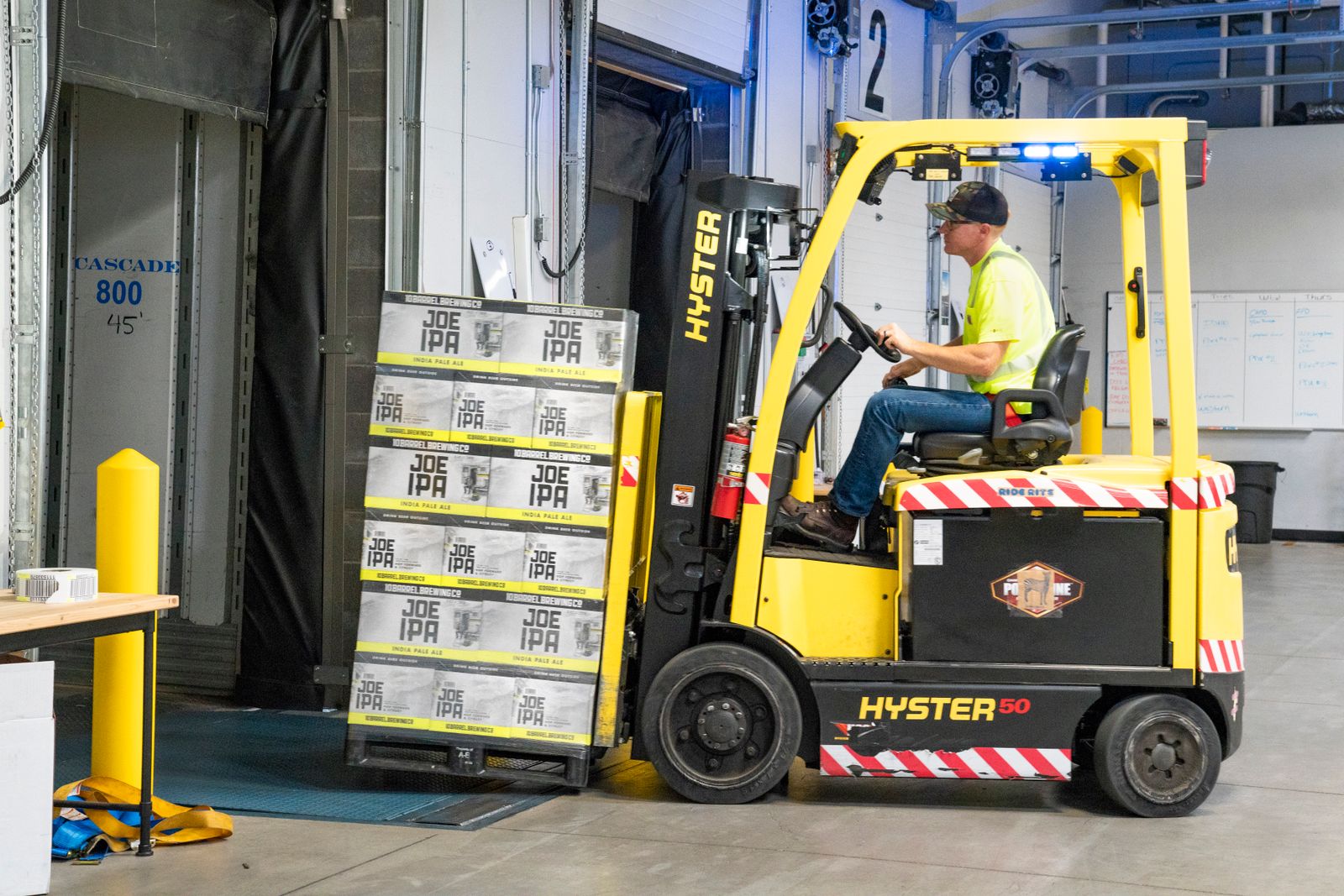
Photos: forklift lifting boxes — photo by ELEVATE, https://www.pexels.com/photo/man-riding-a-yellow-forklift-lifting-boxes-1267324/ ; semi trucks on a road — photo by Quintin Gellar, https://www.pexels.com/photo/white-volvo-semi-truck-on-side-of-road-2199293/
More guides
- How to Hire a Moving Company That Won't Hold Your Furniture HostageMovers › Moving & Storage
- How Much Do Movers Cost? Local vs. Long-Distance Pricing ExplainedMovers › Moving & Storage
- Binding vs. Non-Binding Estimates: The Difference That Decides Your Final BillMovers › Moving & Storage
- Moving Insurance and Valuation: What 'Full Value Protection' Really CoversMovers › Moving & Storage
- Long-Distance Moving: A Start-to-Finish Guide for Household GoodsMovers › Household Goods Moving & Storage
- All Guides & ArticlesBrowse the full guides library