Movers › Packing & Crating
DIY or Professional for Packing and Crating Services? The Honest Decision Guide
From the dispatch desk, packing arguments were never really about cardboard. They were about a box that arrived with the dishes broken, a customer certain the crew had dropped it, and an inventory sheet with three letters next to that box: PBO — Packed By Owner. Once those letters were on the sheet, the conversation was basically over, and everybody in it knew why.
That is the honest frame for the DIY-versus-professional decision. It is not mainly a question of money, or even of skill. It is a question of who carries the risk for each box, and what your time is worth. Here is the decision the way dispatch would give it to you, category by category, with the real numbers.
The rule that decides more claims than any other
When a moving company packs a box, the company is responsible for what's inside it (within the valuation you chose). When you pack it, you are. This is not a company policy that varies by mover; it is written into tariffs. A Massachusetts household-goods tariff filed in 2026 puts it in so many words: the carrier "shall not be responsible for loss of or damage to the contents of cartons… packed, loaded, sealed, or prepared by the Customer," including damage from "inadequate packing, insufficient cushioning, overpacking [or] concealed damage." United Van Lines' own claims guide tells customers the same thing from the other side: for owner-packed boxes, "liability for internal damage may be limited" because the mover cannot verify how the contents were packed.
The one exception proves the rule: if the outside of your box shows clear crush or impact damage — evidence the crew mishandled the carton itself — a claim for the contents can still be reviewed. Intact box, broken plates, PBO on the inventory: denied, essentially every time.
So every packing decision is really two decisions: can I pack this as well as a pro, and am I willing to own the loss if I'm wrong? For most of a household, the honest answer to both is yes. For a short, specific list of things, it isn't.
What each route actually costs
| Home size | Pro packing (labor + materials) | DIY materials only | The catch |
|---|---|---|---|
| 1 bedroom | $280–$650 | $180–$250 | DIY adds 2–4+ hours of your labor per room, spread over days |
| 2 bedrooms | $530–$1,000 | $350–$500 | Kitchens dominate both columns |
| 3 bedrooms | $1,030–$2,200 | $500–$750+ | Pro crews finish in a day; DIY typically takes 2–6 weeks of evenings |
Those are the ConsumerAffairs/HomeAdvisor national ranges, and they hide the real spread, which is what's in the rooms. Packers charge by the hour per packer (published estimates run from $25–$40 up to $60–$80 depending on source and market) or by the box — Thumbtack's data prices a packed fine-china box at about $18 against $10 for a linen box and $5 for a book box, materials and labor in. A minimalist three-bedroom can pack for less than a collector's one-bedroom. And note the asymmetry in the table: professional packing costs roughly three to four times the materials-only route, not the ten times people assume, because mover-grade materials bought retail are genuinely expensive — while the pro's price quietly includes the liability transfer described above.
Time is the other currency. A two-packer crew packs about 100 square feet an hour and does a whole home in a day, usually the day before the move. Doing it yourself is the same work at amateur speed, in the evenings, for weeks — and the last boxes, packed at midnight before the truck arrives, are the ones that break. Dispatch could set a watch by it.
The decision, category by category
Pack it yourself, no hesitation: clothing, linens, towels, books, toys, tools, pantry dry goods, and anything unbreakable. These are the bulk of most homes by box count. Pros add nothing here except speed. Use small boxes for books (a large box of books defeats everyone, including the crew), and hang clothes in wardrobe boxes the movers supply.
Pack it yourself, carefully: the everyday kitchen. Millions of people pack their own dishes successfully, and the technique is learnable in one video: a proper dish-pack box with cell dividers, plates on edge (never flat), two inches of crumpled paper cushioning top and bottom, no voids, nothing rattling. If you use grocery-store boxes and newspaper, you are not saving money, you are pre-breaking crockery. Electronics with their original boxes and foam are also a safe DIY; the manufacturer engineered that packaging for freight.
Pay for packing: fine china and crystal you actually care about, the good stemware, and any kitchen where "everyday" is doing a lot of work. A fragile-only partial pack — kitchen, china cabinet, artwork — typically runs $200–$700, and it converts the highest-risk boxes in the house from PBO to the mover's responsibility. This is the hybrid most dispatchers quietly recommended: you pack the unbreakable 80 percent, the crew packs the fragile 20, and the bill lands closer to DIY than to full service.
Don't pack it at all — crate it: some things should not travel in cardboard no matter who packs them. A custom crate is a wooden box built to the item's measurements, lined and braced so the piece never takes a load. The genuine list:
| Item | Typical custom crate | Why a box isn't enough |
|---|---|---|
| Small art, mirror or TV | $150–$300 | Glass and frames fail at corners |
| Large painting or mirror | $250–$550 | Flex and point impacts |
| Glass or marble tabletop | $300–$700 | Stone snaps under its own weight if unsupported |
| Chandelier or sculpture | $350–$900 | Irregular shapes need internal bracing |
| International shipment | Add ~15–25% | Export crates need heat-treated ISPM-15 wood |
Crating specialists treat a declared value above roughly $2,500, oil paintings, glass sculpture and oversized framed pieces as automatic crate candidates. The arithmetic is the argument: a $500 crate is 2.5 percent of a $20,000 painting's value, and it is the difference between "protected" and "wrapped in a blanket and hoped." Pianos are their own specialty — they are moved by piano crews, not crated by general packers, and priced as a separate handling job. One more DIY warning that belongs here: building your own crate is a false economy unless you genuinely know carpentry. A bad crate is worse than a good box, because it inspires confidence it hasn't earned.

What the calendar does to the price
One negotiation-free variable decides more packing bills than any other: when the packing happens relative to the move. Crews pack fastest and cheapest when the home is ready — boxes staged, closets sorted, the "not going" pile already gone. A crew that spends its first hour waiting while you decide what to do with the garage is billing you packer-hours for project management. Dispatchers see the same pattern from the other side: the customers who swore they would be "mostly packed" and weren't are the ones whose final invoice bore no resemblance to the estimate, because a partial pack quoted over the phone became a full pack performed at hourly rates on the day.
The practical translation: if you are going hybrid, finish your share completely before the crew arrives, and have the fragile list — the rooms and cabinets the pros are taking — physically identifiable. Walk it with the lead packer before they open a box. Ten minutes of pointing saves the two most common billing disputes in packing: "we never asked them to pack that" and "they were supposed to pack this." Get the scope on the written estimate as rooms and categories, not as a verbal understanding with the person who answered the phone.
The valuation fine print nobody reads until dispatch reads it to them
Two more things follow from who packs. First, high-value items: on interstate moves, anything worth more than $100 per pound — jewelry-grade items, art, antiques — needs to be declared on the high-value inventory form, or your recovery is capped regardless of who packed it. Second, the valuation tier itself: the free default, Released Value, pays 60 cents per pound per article. A ten-pound vase is a six-dollar vase under Released Value whether a pro packed it or you did. Professional packing plus Full Value Protection is the combination that actually transfers risk; professional packing under Released Value mostly transfers blame. And keep the claim clock in mind: for interstate moves you have at least nine months from delivery to file in writing, but concealed damage in a box you open in month seven is a harder conversation than damage reported in week one — another argument for letting pros pack the boxes you'd otherwise leave sealed longest.
If you DIY the fragile stuff anyway
Some readers will, and some should — a careful amateur with real materials beats a rushed crew. The non-negotiables from every claims file I ever saw: buy new, mover-grade boxes (used boxes fail at the seams); dish packs for dishes, with dividers; plates vertical; fill every void so nothing can move — movement, not impact, is what breaks things in a well-loaded truck; keep boxes under roughly 50 pounds; tape the bottom like you mean it; and label the room and contents on two sides, because the box you can't identify is the box that gets stacked under the toolbox. Then accept, with eyes open, that the inventory will say PBO and the risk is yours.
The short version
Pack the soft, the sturdy and the simple yourself. Pay professionals to pack whatever is fragile, expensive or irreplaceable — at minimum as a fragile-only partial service. Crate whatever is valuable and rigid: art, mirrors, glass and stone tops, chandeliers. Declare high-value items in writing, and pick a valuation tier that matches what your things are worth, because who packed the box decides who pays when it breaks. This site's directory lists 186 packing-and-crating specialists among its moving listings — get the fragile list quoted as a line item, in writing, before moving day. From the dispatch desk, that one page of paper was the difference between a bad day and a paid claim.

Sources
- HomeAdvisor / ConsumerAffairs packing-cost data (2026), via College Bound Movers, "Do Movers Pack for You? Packing Service Costs Explained" — https://collegeboundmovers.com/do-movers-pack-for-you/
- Thumbtack, "2026 Packing & Unpacking Services Cost" (per-box packed prices, hourly crew rates) — https://www.thumbtack.com/p/packing-cost
- Jordan River Moving, "Full Service vs DIY Packing: A 2026 Cost and Time Comparison" (partial-packing tiers, DIY timelines) — https://jordanrivermoving.com/full-service-vs-diy-packing-a-2026-cost-and-time-comparison/
- LegalClarity, "What Happens If Movers Break Something" (PBO claim treatment, Released Value at 60¢/lb, nine-month filing window) — https://legalclarity.org/what-happens-if-movers-break-something/
- United Van Lines, "What to Do If Something Breaks: How Moving Company Damage Claims Work" (PBO as a common denial reason) — https://www.unitedvanlines.com/moving-tips/blog/how-moving-claims-work
- Massachusetts Household Goods Tariff, Nomad Relocation Co. (2026), §5.3 Customer Packed Articles — http://mass.gov/doc/nomad-relocation-tariff-2026-cert-26hg28-tpd/download
- JT Melia Moving & Storage, "Custom Crating Services" (crate pricing by item and cubic footage, ISPM-15 export premium) — https://jtmeliamoving.com/services/crating/
- SafeBound Moving, "Custom Crating for Fine Art: Cost and When Required" (value thresholds for crating) — https://www.safeboundmoving.com/blog/custom-crating-for-fine-art-cost-and-when-required
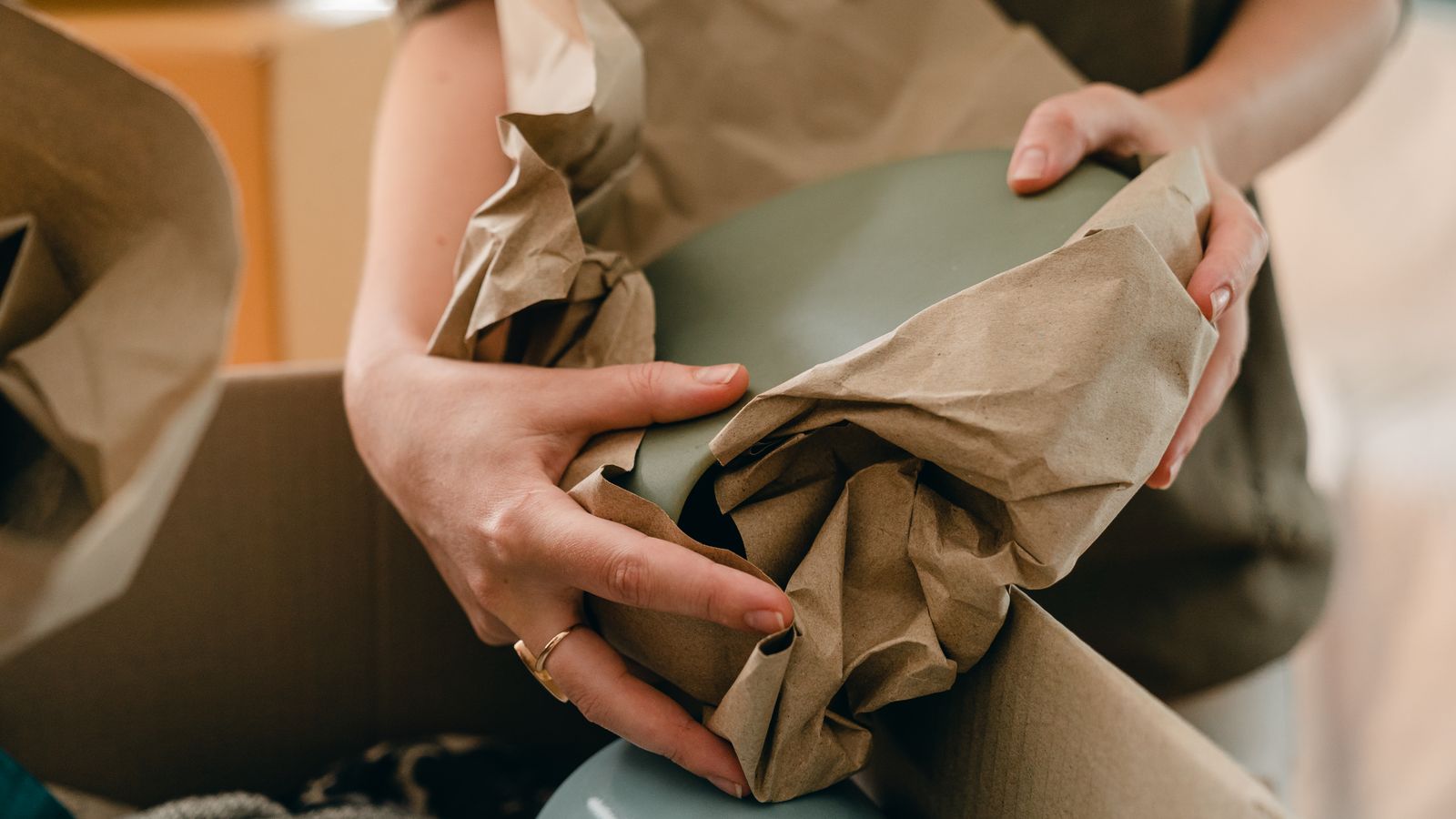
- Photos: hands wrapping a bowl in packing paper — photo by Ketut Subiyanto, https://www.pexels.com/photo/4246183/ ; packing plates in a kitchen — photo by Blue Bird, https://www.pexels.com/photo/7217890/ ; woman among moving boxes — photo by RODNAE Productions, https://www.pexels.com/photo/7464430/
More guides
- How to Hire a Moving Company That Won't Hold Your Furniture HostageMovers › Moving & Storage
- How Much Do Movers Cost? Local vs. Long-Distance Pricing ExplainedMovers › Moving & Storage
- Binding vs. Non-Binding Estimates: The Difference That Decides Your Final BillMovers › Moving & Storage
- Moving Insurance and Valuation: What 'Full Value Protection' Really CoversMovers › Moving & Storage
- Long-Distance Moving: A Start-to-Finish Guide for Household GoodsMovers › Household Goods Moving & Storage
- All Guides & ArticlesBrowse the full guides library