Movers › Heavy Equipment Movers
Green Heavy Equipment Movers: The Lower-Impact Options, Their Real Costs and the Greenwash to Avoid
Heavy equipment moving is, by household standards, an industrial act: a diesel tractor, a multi-axle trailer, pilot cars, permits, and a machine that may weigh more than a house's entire contents times twenty. Families end up hiring it more often than they expect — a parent's tractor collection, a small business's forklift and racking, the excavator bought with a piece of land. And when they do, some of them ask a fair question: is there a lower-impact way to do this, and what does it cost?
There is — in specific places, for specific loads. There is also a thriving trade in green language wrapped around entirely ordinary diesel trucking. This site lists 2,791 heavy equipment movers, and their eco claims range from engineering to poetry. This guide separates the two: the options that measurably cut fuel and emissions, what they cost against a standard move priced at roughly $3.50 to $8.00 a mile all-in for heavy haul work, and the claims that dissolve under one follow-up question.
First, the honest baseline
A standard heavy haul burns diesel at a rate household movers never see. General trucking cost data puts a carrier's all-in operating cost around $2.93 a mile before oversize work adds permits ($15 to $150 per state crossed), pilot cars (roughly $1.50 to $3.00 a mile per car), and daylight-only routing. Market rates follow: lowboy and RGN trailers commonly run $3.50 to $6.00 a mile for legal loads and $5 to $15 a mile for oversize or overweight work. Fuel is the single largest variable line in that stack, which is why every genuine green option in this business is, at bottom, a way to burn fewer gallons per ton-mile — and why every fake one is a way to avoid saying how many gallons were burned.
Keep one number in your pocket for everything that follows: freight rail moves a ton of freight roughly 500 miles on a gallon of diesel — about four times the fuel efficiency of trucking — and the railroads' own accounting credits rail shipping with up to 75 percent lower greenhouse gas emissions than the same freight on trucks. That gap is so large that mode choice dwarfs every other decision in this guide.
Option 1: Intermodal — rail for the long leg, truck for the ends
For a machine traveling a long distance on a corridor with rail service, the lowest-impact route is usually not a greener truck. It is a train. The load rides a truck to a rail terminal, travels the long leg by rail, and trucks the final miles. An EPA-cited assessment of freight practices found that shifting freight from truck to rail can cut greenhouse gas emissions per ton-mile by as much as 85 percent once the truck legs at both ends are counted.
The costs are real and specific. Intermodal adds terminal handling at both ends, which for heavy equipment means crane or ramp loading and the labor to do it. It adds time: rail legs run on railroad schedules, not yours, and heavy equipment that needs permits on the road legs still needs them. And it adds a size filter — the machine must fit rail clearances and be securable to a flatcar or fit in an intermodal well. Where it fits, the long-haul economics often favor rail anyway, because the railroad's fuel advantage is also a cost advantage at distance. Where families get quoted "intermodal" for a 200-mile move, be skeptical: below a few hundred miles, the two truck legs and two handlings usually eat the entire benefit, in money and emissions alike.
Option 2: Backhaul matching — the empty trailer is the emission
The dirtiest mile in heavy haul is the empty one. A tractor that delivers your excavator and deadheads 400 miles home has burned nearly the same fuel returning as it did loaded. Carriers know this and price round trips into one-way jobs; load-matching — pairing your move with another shipper's load traveling the opposite way — is the industry's oldest efficiency practice, now formalized by freight platforms and brokers who specialize in it.
For the customer, this is the rare green option that pays you. A carrier with a confirmed backhaul can quote a one-way move meaningfully below a carrier pricing in an empty return, and the emissions saving is genuine: the return trip's fuel gets charged to freight that needed moving anyway. The cost is flexibility. Backhaul pricing appears when the matching load appears, which rewards customers who can offer a window of dates and punishes anyone moving on a fixed Saturday. When a mover quotes you a suspiciously good one-way price and explains it with a backhaul, that is not greenwash — that is the market working. Ask what happens to the price if the backhaul falls through, and get the answer in writing.
Option 3: Renewable diesel and newer iron
Where the truck is unavoidable, the fuel and the fleet are the levers. Renewable diesel — a drop-in fuel made from waste fats and oils rather than petroleum — is in real fleet use: BNSF reports using more of it across its locomotive fleet, crediting it with up to 35 percent lower particulate matter and up to 10 percent lower nitrogen oxides, and trucking fleets running it report lifecycle carbon reductions that depend entirely on the feedstock accounting. It requires no new truck, which is precisely its appeal and its limitation: the tailpipe looks similar, the lifecycle ledger differs, and the fuel typically costs more than standard diesel where it is available at all. Availability is regional — strong on the West Coast, spotty inland — so "we run renewable diesel" is a claim to verify by asking where the truck will actually fuel on your route.
Newer diesel iron helps at the margins: current-generation engines with idle-reduction, aerodynamic trailers, and trip-optimization software deliver the steady single-digit efficiency gains the railroads report from the same playbook. Battery-electric heavy haul, by contrast, is not yet a real option for this work — battery-electric trucks make up well under one percent of registered power units nationally, and none of that sliver is pulling multi-axle oversize loads across states. A mover marketing an "electric heavy haul fleet" for an interstate equipment move is selling a photograph, not a service.
Option 4: Fewer, fuller, slower trips
The unglamorous options save the most fuel per dollar spent. Consolidating two machines onto one permitted load where dimensions allow; scheduling to avoid the daylight-only, stop-and-start routing that oversize restrictions impose on badly timed moves; accepting a route that is longer in miles but steady in speed over a shorter route through congestion — carriers running trip-optimization tools make these choices for cost reasons, and the emissions follow the fuel. For the customer, the actionable version is simple: ship machines together, ship them ready (a machine that cannot be loaded on arrival burns everyone's diesel idling), and do not pay rush premiums that force the least efficient routing on the board.
| Option | Real impact | Typical cost vs. standard | Watch out for |
|---|---|---|---|
| Intermodal rail, long leg | Largest — up to ~75–85% lower GHG per ton-mile on the rail portion | Often competitive at long distance; handling fees at both terminals | Pointless under a few hundred miles; clearance and schedule limits |
| Backhaul matching | High — eliminates an empty return | Often cheaper than standard one-way | Date flexibility required; get the fallback price in writing |
| Renewable diesel | Moderate — lifecycle carbon and particulate reductions, feedstock-dependent | Fuel premium where available; regional supply | "Runs renewable" claims on routes with no supply |
| Newer fleet, idle reduction, routing software | Small but real — single-digit efficiency gains | Usually priced in, not a surcharge | Vague "modern eco fleet" claims with no specifics |
| Consolidation and readiness | Moderate — fewer trips, less idling | Cheaper | Requires your machines ready and shippable together |
The greenwash field guide
Against those, here are the claims that should raise your pencil:
"Carbon neutral" via offsets alone. A mover who burns the standard diesel on the standard route and buys offsets has changed his accounting, not his emissions. Offsets vary enormously in quality, and the phrase tells you nothing about the fuel burned on your job. Ask instead: how many gallons will my move burn, and how is that lower than the standard route?
"Eco-friendly fleet" with no model years, no fuel, no numbers. Real efficiency claims come with specifics — engine tier, idle policy, fuel type, average fleet age. Adjectives are free; specifications cost money, which is why honest operators quote them.
"Green" packing and paperwork as the headline. Recycled blankets and paperless billing are fine and trivial. On a job whose footprint is hundreds of gallons of diesel, leading with the blankets is misdirection.
Electric claims beyond the technology. As noted, battery-electric heavy haul across distance does not yet exist at commercial scale. Neither do hydrogen heavy-haul fleets. Any quote implying otherwise is borrowing the future.
Percentages with no baseline. "40 percent greener" than what — than their own last truck, than air freight, than a number invented for the brochure? The follow-up question from the byline applies: compared to what, measured how?

What to ask before you book
Five questions sort the operators from the adjectives. What mode or modes will my machine actually travel, and for how many miles each? Is this price built on a backhaul, and what is the price if it falls through? What fuel will the truck burn on my route, and where? What is the fleet's average age and idle policy? And: can you put the answers on the quote? A genuinely lower-impact mover — and among 2,791 heavy equipment movers listed on this site, they exist — will treat those questions as the easiest part of the sale. The greenwash operator will treat them as an attack. That difference, more than any leaf on any brochure, is the review that matters.
Sources
- BNSF, "Fueling the Future" — rail fuel efficiency (a ton of freight ~500 miles per gallon), up to 75% lower GHG than trucking, renewable diesel particulate and NOx reductions.
- GoRail, "Freight Rail's Role in Cutting Carbon Emissions" — rail versus truck efficiency, CSX's 528 ton-miles per gallon, and modal-shift estimates.
- U.S. EPA freight assessment (Frey) — truck-to-rail modal shift reducing GHG per ton-mile by up to 85% including end legs.
- HTS Logistics, "Heavy Equipment Transport Cost" — heavy haul rate build-up: per-mile rates, permits, pilot cars, fuel surcharges.
- OversizeOps, "Oversize Load Shipping Cost Calculator" — ATRI-based carrier cost floor of ~$2.93 per mile and oversize cost components.
- FleetOwner, "Trucking by the Numbers 2026" — alternative-powertrain share of registered trucks, including battery-electric at 0.43%.
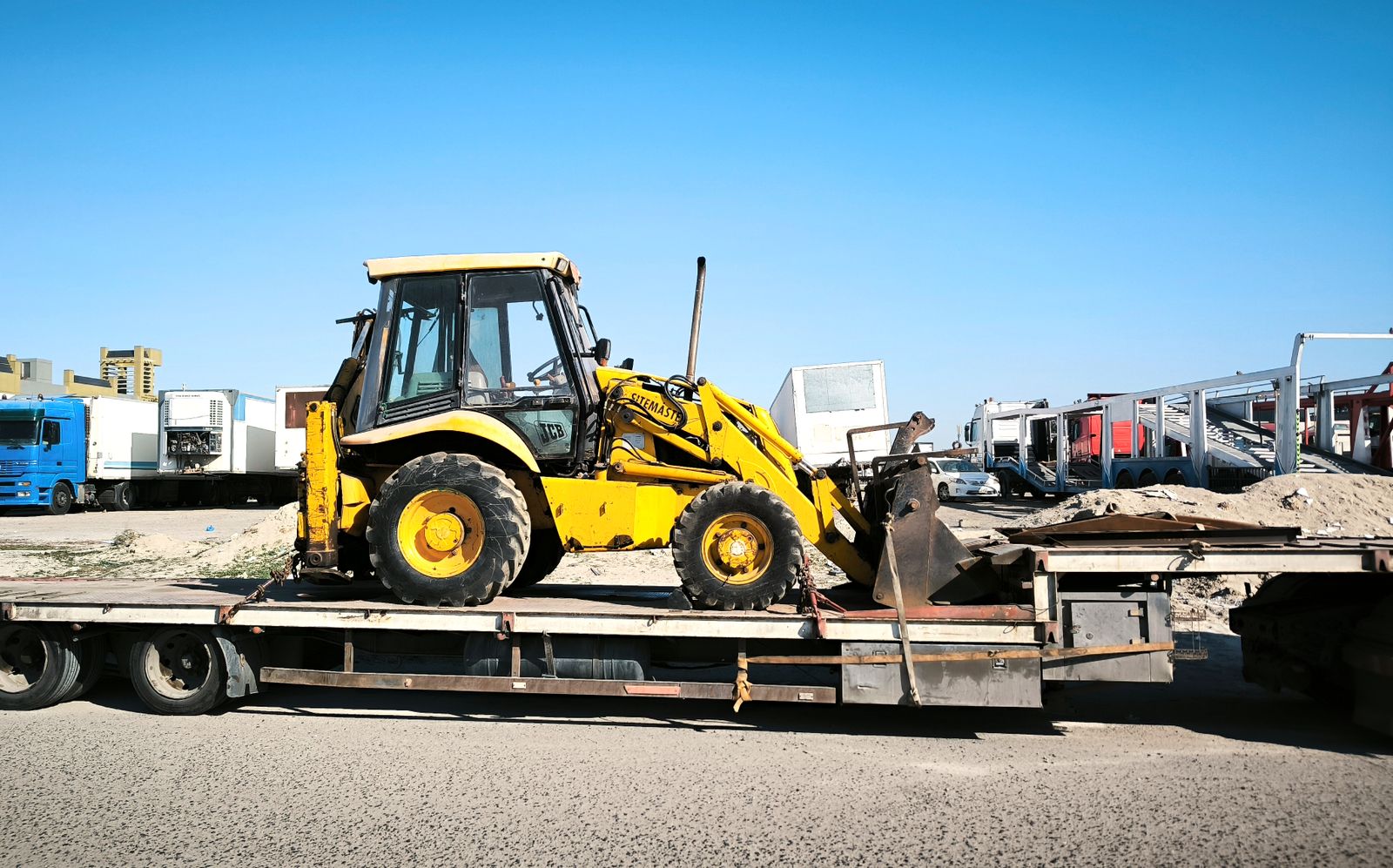
Photos: construction vehicle on a flatbed trailer — photo by Tayssir Kadamany, https://www.pexels.com/photo/38095094/ ; excavator loaded onto a truck — photo by Sóc Năng Động, https://www.pexels.com/photo/34480907/
More guides
- How to Hire a Moving Company That Won't Hold Your Furniture HostageMovers › Moving & Storage
- How Much Do Movers Cost? Local vs. Long-Distance Pricing ExplainedMovers › Moving & Storage
- Binding vs. Non-Binding Estimates: The Difference That Decides Your Final BillMovers › Moving & Storage
- Moving Insurance and Valuation: What 'Full Value Protection' Really CoversMovers › Moving & Storage
- Long-Distance Moving: A Start-to-Finish Guide for Household GoodsMovers › Household Goods Moving & Storage
- All Guides & ArticlesBrowse the full guides library