Movers › Moving Companies
Green Moving Companies: The Lower-Impact Options, Their Real Costs and the Greenwash to Avoid
Corporate relocation taught me the green-moving conversation in its least sentimental form. A company would ask for an "eco-friendly move," and the honest work began when we priced the options line by line: some of them cut real waste for almost no money, some cost more and delivered less than their brochures claimed, and one or two were pure vocabulary. Families planning a move face the same menu without a sustainability department to audit it. This guide is the audit. It surveys the lower-impact options inside a normal move — reusable crates, used and recycled materials, consolidation, donation, fuel and routing — with their real costs against the standard route, and it names the greenwash patterns using the standard the Federal Trade Commission itself applies to environmental claims.
The short version, before the detail: the greenest move is usually not a premium product. It is the standard move with its waste designed out — and the biggest single saving is measured not in carbon but in the roughly 30 to 50 pounds of cardboard and packing material a typical household move sends toward disposal, most of it used for a few hours.

Option one: reusable crates instead of new cardboard
This is the flagship green option, and unusually for this industry, the claim survives scrutiny. Rental companies deliver rigid plastic crates with attached lids — no tape, no assembly — collect them after unpacking, and put each crate back into service. Industry comparisons put a crate's working life at roughly 400 to 500 uses before it is itself recycled, against one to three uses for a cardboard box. The crates are waterproof and crush-resistant, stack uniformly, and one comparison credits them with 40 to 60 percent less breakage — plausible, given rigid walls versus soft cardboard, and worth something real on a truck full of dishes.
The cost is the surprise: for a two-bedroom move, one detailed comparison priced crate rental at $170 to $285 against $160 to $280 to buy the equivalent cardboard, tape, and wrap — a wash. Other rental pricing runs lower for smaller jobs: about $75 to $200 for a one-to-two-bedroom set rented for a week or two, and $150 to $350 for a three-to-four-bedroom house. Against buying new boxes, crates are cost-competitive now, not a luxury. Against free used boxes, they cost more — see below.
The limits are geographic and logistical. Crate rental is a local, metro-area service: the crates must come back, so the model works for local moves and collapses for interstate ones, where cardboard — ideally used or high-recycled-content — remains the container. Crates also come in a few standard sizes, so wardrobes, TVs, and artwork still travel in specialty cardboard. A company that offers crates as an add-on, or works happily with a crate service you book yourself, is showing you a genuine option. A company that markets itself as green and offers only new cardboard and plastic wrap is showing you a logo.
Option two: used boxes and paper instead of plastic
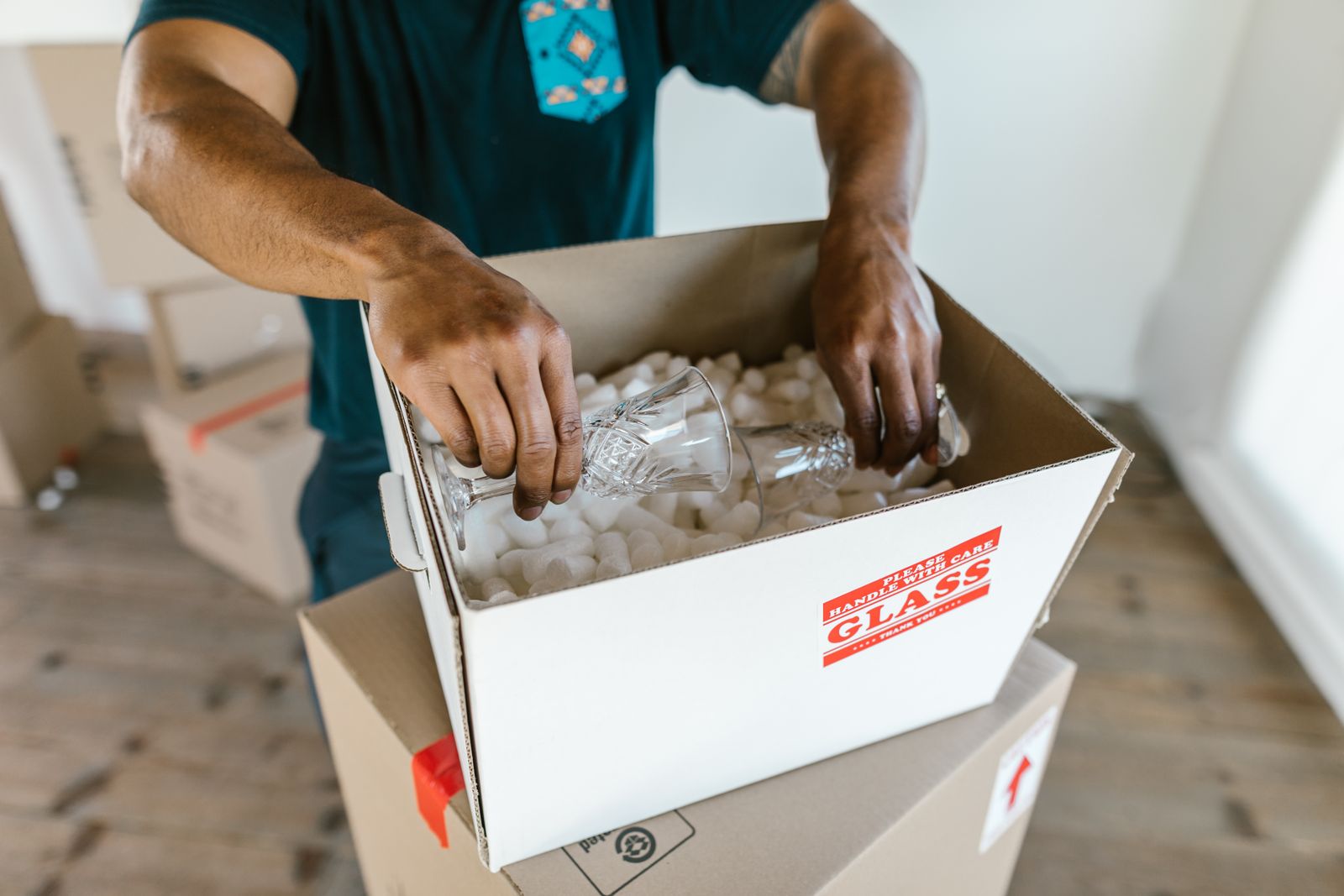
The cheapest green option is also the least marketed, because nobody can sell it to you at a premium: boxes on their second or third use. Box-exchange programs — U-Haul's Customer Connect is the best known — pass used boxes free between people who have just moved and people about to. A move packed in secondhand boxes and plain packing paper, with the household's own towels, blankets, and clothing doing the work that bubble wrap usually does, approaches the crate move's waste profile at close to zero materials cost. Packing paper itself — plain, ink-free newsprint — is already one of the most sustainable materials in the standard kit: recyclable, effective, and what professional crews primarily use for dishes and glassware anyway.
Where plastic genuinely earns its place, use it without guilt: mattress bags protect against real risks, and stretch wrap keeps doors and drawers shut in transit. The green failure is not any single item; it is the default bundle — new boxes, new bubble wrap, foam peanuts — bought unexamined for a one-day job. Biodegradable cornstarch peanuts, which dissolve in water, exist for the cushioning cases that need them, at a modest premium of roughly $10 to $15 over standard materials in one mover's pricing. That is the honest shape of most green upgrades: small, specific, and priced in tens of dollars.
Option three: the move itself — consolidation, distance, and donation
The truck is the largest energy item in any move, and the greenest decisions about it are scheduling decisions. A consolidated long-distance load — your household sharing a trailer with others headed the same way, the standard van-line model — uses far less fuel per household than a dedicated small truck driven the same miles, at the price of a delivery window rather than a delivery day. Locally, the equivalent is unglamorous: an accurately sized truck making one trip instead of an undersized one making three. When you get quotes, the company that asks detailed inventory questions is, among other things, the company least likely to send the wrong vehicle twice.
The other large saving happens before the truck arrives: not moving things at all. Every hundredweight you donate, sell, or recycle is weight the truck does not carry and boxes you do not buy — on a weight-priced long-distance move, it is also money off the linehaul. Furniture donation pickup, scheduled a week before the move rather than the night before, is the single greenest line item available to most families, and it costs nothing. Green moving, at its most effective, is mostly this: fewer things, reused containers, one well-planned trip.
What it costs, side by side
| Choice | Standard route | Lower-impact route | Real difference |
|---|---|---|---|
| Boxes for a 2-bedroom move | $160–$280 new cardboard, tape, and wrap | $170–$285 crate rental; near $0 for used boxes via exchange programs | Crates: a wash, with less breakage and no disposal. Used boxes: cheaper than both |
| Cushioning | Bubble wrap and foam peanuts in the standard bundle | Packing paper, household textiles, cornstarch peanuts where needed | Paper and textiles cost no more; biodegradable peanuts add roughly $10–$15 |
| Long-distance transport | Dedicated truck or standard household pricing | Consolidated van-line load, delivery window instead of a day | Consolidation is the standard model, not a premium — flexibility is the price |
| Furniture pads | Disposable or none | Reusable quilted pads, rented at about $5 per half-dozen per day | Already the industry norm — a "green" claim for this is decoration |
| The load itself | Everything you own, moved | Donation and sale first; less weight, fewer boxes | Saves money on weight-priced moves; the only option that pays you |
The greenwash, named
The FTC's Green Guides — its published standard for environmental marketing — give consumers a usable test, because they state plainly what marketers may not do. Broad, unqualified claims like "green" or "eco-friendly" should not be made at all, the FTC says, because they are difficult if not impossible to substantiate; a claim should name a specific benefit, clearly and prominently. Certifications and seals must convey what they actually certify, and a marketer's own invented seal conveys nothing. Carbon offset claims require competent and reliable scientific evidence, and an offset should not be advertised if the activity behind it was already required by law. And a "recyclable" claim should be qualified unless recycling facilities are available to at least 60 percent of the communities where the product is sold — the clause that quietly invalidates most "our materials are recyclable" marketing in places with no facility that takes them.
Translated into moving-company language, the patterns to avoid are these. The unqualified label: "eco-friendly movers" with no specific practice named anywhere on the site. The house-brand seal: a leaf logo and a certification issued by the company to itself. The offset-only claim: a standard diesel move, unchanged in every operational detail, with a small offset purchase doing all the environmental work — ask what the offset costs and what it funds, and notice how rarely the answer is published. The trivial truth: advertising reusable pads, recycled-content boxes, or paperless invoices as a green identity, when the first two are industry norms and the third is an accounting preference. The premium without the practice: a green surcharge attached to a move you cannot distinguish from the standard one. In each case the tell is the same — the claim is about the company's image, and the specifics, when requested, are not available.
The companies doing this properly are easy to spot by contrast, because their claims are boring: crates available in these sizes at this price; used-box and take-back programs; a stated share of loads consolidated; donation partnerships named. Boring and checkable beats beautiful and vague in environmental claims exactly as it does in quotes — a lesson relocation work teaches about every document a moving company produces.
How to book the greener move
Ask the questions that force specifics. Do you offer reusable crates, or will you work with a crate rental I book? What share of your packing material is reused or recycled-content, and what happens to boxes after the move — is there a take-back? For a long-distance move, is my load consolidated, and what delivery window does that mean? What do you charge for the green options you advertise — in dollars, on the quote? A real program has prices and logistics. Greenwash has adjectives.
Then build the move in the order that saves most: donate and sell first; source used boxes or rent crates; pack in paper and textiles; size the truck once, correctly. This site lists 1,770 moving companies, and the green filter is best applied after the competence filter — licensed, insured, itemized quote — because a careless green move that breaks your furniture and sends it to landfill has achieved the opposite of its branding. The lower-impact move and the well-run move are, in the end, nearly the same move: planned, consolidated, and packed in things that will be used again. Book that one, and let the leaf logos fend for themselves.
Sources
- We Move Everywhere, "Reusable Moving Crates vs Cardboard Boxes" — crates reused roughly 400–500 times before recycling, 40–60 percent less breakage, two-bedroom crate rental at $170–$285 against $160–$280 for purchased cardboard and supplies, and 30–50 pounds of cardboard waste from a typical move.
- SOS Moving LA, eco-friendly moving guide — crate rentals of about $75–$150 for 25 bins over two weeks, packing paper as a primary professional material, and cornstarch packing peanuts at roughly $10–$15 more than standard materials; crate services are local-only, so interstate moves rely on used or recycled cardboard.
- Federal Trade Commission, Green Guides summary — marketers should not make broad unqualified claims such as "green" or "eco-friendly"; certifications must convey their basis; carbon offset claims need competent and reliable scientific evidence and cannot rest on legally required activity; "recyclable" claims should be qualified unless facilities are available to at least 60 percent of consumers or communities.
Photos: stacked cardboard boxes — photo by cottonbro studio, https://www.pexels.com/photo/4568693/ ; packing glassware — photo by cottonbro studio, https://www.pexels.com/photo/7464230/
More guides
- How to Hire a Moving Company That Won't Hold Your Furniture HostageMovers › Moving & Storage
- How Much Do Movers Cost? Local vs. Long-Distance Pricing ExplainedMovers › Moving & Storage
- Binding vs. Non-Binding Estimates: The Difference That Decides Your Final BillMovers › Moving & Storage
- Moving Insurance and Valuation: What 'Full Value Protection' Really CoversMovers › Moving & Storage
- Long-Distance Moving: A Start-to-Finish Guide for Household GoodsMovers › Household Goods Moving & Storage
- All Guides & ArticlesBrowse the full guides library