Movers › Heavy Equipment Movers
Heavy Equipment Movers Jargon, Translated: The Terms Providers Use and What They Mean for Your Bill
The first quote I ever received for moving heavy equipment read like a dispatch log from another trade: linehaul, RGN, deadhead, detention, a pilot car — and a total twice what I had budgeted, with no line explaining why. Nothing on it was dishonest. Every term meant something specific, and almost every term carried money.
Heavy-equipment jargon is pricing in code. If you cannot translate it, you cannot tell a fair quote from a padded one, or a cheap quote from one that will grow at pickup. This guide translates it term by term — plain meaning, and what each word does to your bill. It is written for families as much as businesses, because families move tractors, skid steers and small excavators too, usually with less warning than a company relocation gives you.
The money words: how the price itself is built
Linehaul is the base transport charge: the carrier's rate per mile multiplied by the miles. It is the largest single line on most quotes, and it is not one national number. Published heavy-haul pricing puts legal-size loads on lowboy-type trailers at roughly $3.50 to $6.00 a mile, and oversize or overweight loads at $5 to $15 a mile, depending on trailer, route and season. When a provider says "the linehaul went up," they mean the per-mile rate or the routed miles changed — ask which.
Fuel surcharge is a percentage added on top of linehaul to cover diesel price movement, commonly in the 15 to 25 percent range in recent published guides. It should be stated as a percentage and tied to an index or a date. A surcharge quoted as a flat mystery fee is negotiable in a way an indexed one is not.
Deadhead is the empty miles a truck drives to reach your machine, or away after delivery. Some carriers absorb a short deadhead; on rural pickups you may be billed for it. Deadhead disclosed on a quote is not a scam. Deadhead appearing first on the final bill is a conversation to have before you sign.
Accessorials is the umbrella word for everything that is not linehaul: permits, escorts, loading help, waiting, special crossings. A cheap-looking quote is often cheap because its accessorials are "TBD" or "at cost." Ask for the list by name before comparing totals.

Legal, oversize, overweight, superload: the four size words
These four words decide whether your move is a routine booking or a permitted operation, and the thresholds behind them are law, not provider preference.
A legal load fits inside the standard limits: no more than 8 feet 6 inches wide, gross vehicle weight no more than 80,000 pounds on Interstate highways, no more than 20,000 pounds on a single axle and 34,000 pounds on a tandem axle, and height within the state's limit — there is no federal height limit, and states commonly set 13 feet 6 inches to 14 feet. A legal load needs no special permit and usually no escort. It is the cheapest way a machine can travel.
An oversize load exceeds a dimension — width, height or length — without necessarily exceeding weight. A tractor with a wide mower deck can be oversize and light at the same time.
An overweight load exceeds a weight limit, gross or per axle, without necessarily being big. A dense piece of shop equipment can be overweight on a small footprint, which is why providers ask about axle weight and not just total weight.
A superload is the category above oversize and overweight, for loads that exceed a state's routine permit limits by a wide margin. There is no single national definition — each state draws its own line, in some states around 16 feet wide or 200,000 pounds and up. Superloads can require route surveys, engineering review of bridges, and police escorts, and their permits can take days or weeks rather than hours. If a provider uses the word superload about your machine, your timeline, not just your price, has changed.
The cost implication is blunt: crossing from legal to permitted adds a permit in every state on the route, possible escorts, and travel restrictions. Crossing into superload adds engineering time. The cheapest heavy move is often the one where a blade, bucket or counterweight comes off so the load drops back under a threshold — a point we return to below under disassembly.
Permit, route survey, pilot car: the permission words
A permit in this trade is not one document. There is no national oversize permit. Each state the load crosses issues its own, for a specified load, route and travel window. Single-trip permit fees are usually the small part of the bill — published state schedules run from roughly $15 to $500 per state depending on size and weight, with some states adding per-mile or ton-mile charges. Providers normally obtain the permits and pass the cost through. Ask whether permits are itemized or buried in the rate; itemized is better, because it shows you whether a competing quote is cheaper or simply quieter.
A route survey is a check — a desk review of clearances, or a vehicle driving the route with a height pole — that the road can take your load: bridges, wires, tight turns, weight-restricted roads. Tall, wide and superload moves need one, billed as planning time. It buys out the most expensive sentence in heavy haul: the truck cannot get through.
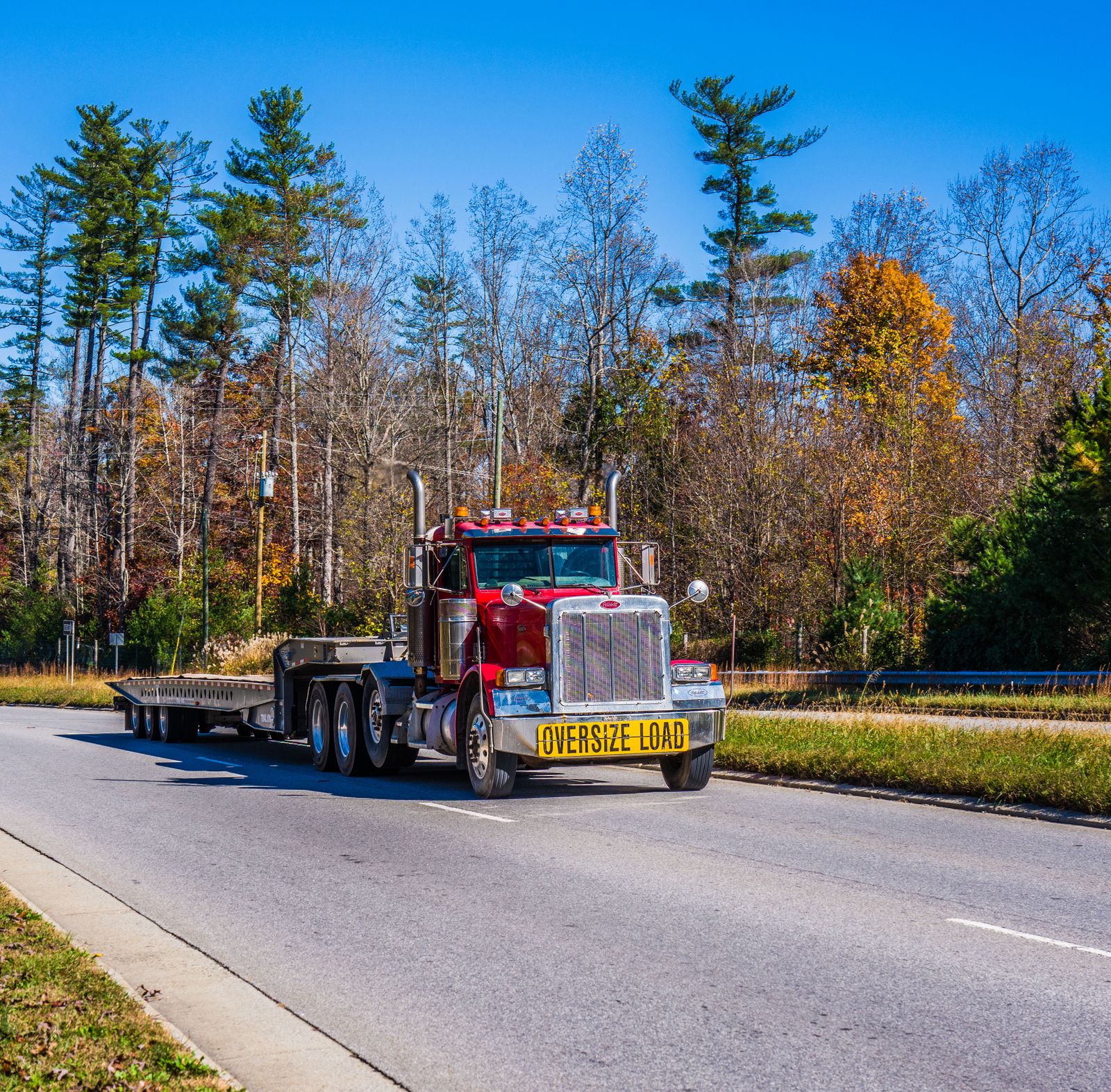
A pilot car, or escort vehicle, travels ahead of or behind an oversize load to warn traffic and watch clearances. States trigger escorts at different thresholds, typically around 10 to 12 feet wide, and a wide load may need two. Escorts are where permission gets expensive: published 2026 rates run about $1.50 to $3.00 per loaded mile per car, or $500 to $1,500 per day. A high-pole car is the tall-load variant, its pole set to the load's height so it finds a low wire first. A police escort, required for the largest loads in some places, is billed hourly and is not negotiable.
Escorts also impose a calendar. Permitted loads commonly travel daylight only, avoid city rush-hour curfews, and stop for some weekends and holidays. A two-day legal drive can become four permitted days — billed across all four.
| Term on the quote | Plain meaning | What it does to the bill |
|---|---|---|
| Linehaul | Per-mile rate × miles for the loaded trip | The base price; roughly $3.50–$6/mile legal, $5–$15/mile oversize in published pricing |
| Permit | State permission to run oversize/overweight on a set route | Usually $15–$500 per state; small line, but required in every state crossed |
| Pilot car / escort | Vehicle running ahead or behind the load | About $1.50–$3.00 per mile per car; often the largest accessorial |
| Detention | Truck and crew waiting because the site or machine is not ready | Hourly charge; can also cost a full day if a travel window is missed |
| Deadhead | Empty miles to pickup or from delivery | Sometimes absorbed, sometimes billed — confirm before signing |
RGN, lowboy, step deck, flatbed: the trailer words
Providers name trailers as if everyone knows the fleet. Four names cover most machinery moves, and the difference that matters is deck height — how low the machine sits — and how it gets on.
A flatbed is the standard open trailer, deck about five feet up. Freight on it can be about 8 feet 6 inches tall before it needs a height permit. It is the cheapest trailer, and right when the machine is short enough.
A step deck, or drop deck, has a lower main deck, roughly three feet up, so freight can run about 10 feet tall without a height permit. Smaller machines can drive up rear ramps. It is the everyday choice for tractors and taller shop equipment.
A lowboy drops its deck into a low well, about 18 to 24 inches up, carrying freight up to about 11 feet 6 inches to 12 feet tall — what keeps a tall excavator under permit height on many routes.
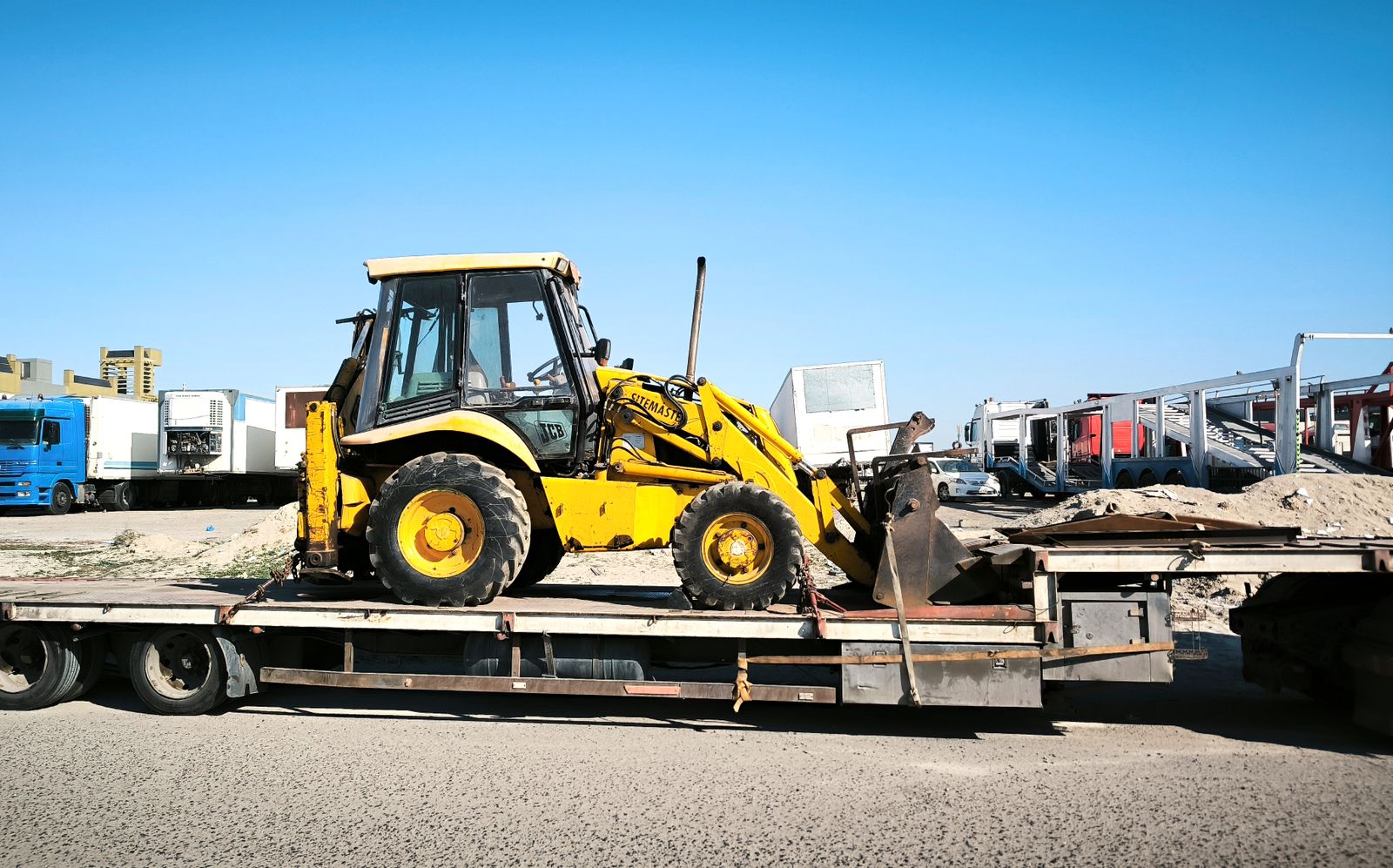
An RGN — removable gooseneck — is a lowboy whose front neck detaches. The deck settles to the ground, the machine drives straight on, and the neck reconnects. No crane is needed at either end. That is why RGNs are the default for excavators, dozers and loaders, and why an RGN quote can beat a cheaper trailer once you price the crane that trailer would require at a site that has none. Extra axles added to spread weight — a multi-axle configuration — raise the rate but keep axle weights legal.
The well is that low central section, usually about 25 to 29 feet long; your machine must fit its length as well as its height. A stretch trailer lengthens for an over-long load, at a premium.
Rigging, critical lift, WLL: the lifting words
Not every machine drives onto a trailer. When it must be lifted, a second vocabulary takes over.
Rigging is both the hardware — slings, shackles, hooks, spreader bars — and the work of calculating weight and center of gravity and attaching that hardware safely. Rigging and setting on a quote means the crew does not just deliver the machine to the curb; they lift it, move it into position and set it where it will work. That is a different, more expensive service than transport alone, and confusing the two is a common source of a delivery-day argument.
A critical lift has a formal meaning. Under OSHA's steel-erection definition, a lift is critical when it exceeds 75 percent of the crane's rated capacity for its configuration, or requires more than one crane. Wider industry practice also treats lifts over occupied areas, lifts the operator cannot fully see, and lifts of unusually valuable or awkward loads as critical. A critical lift requires a written lift plan, named roles and a pre-lift meeting. If your machine needs one, expect planning charges — and be wary of a provider who proposes a near-capacity, multi-crane lift with no plan at all.
WLL, working load limit, is the maximum load a piece of rigging or a tie-down is rated to carry in use, as distinct from breaking strength. Federal securement rules require tie-downs' combined WLL to equal at least half the article's weight. A provider explaining a securement charge in WLL language is explaining a legal requirement, not inventing an upgrade.
Center of gravity is the machine's balance point, around which rigging and trailer placement are built. A machine with a boom at one end and a counterweight at the other takes longer to load and secure, and honest providers price that time.
Detention, demurrage, disassembly: the waiting and wrench words
Detention is waiting time at pickup or delivery: the truck and crew are there, the machine or the site is not ready, and the clock is billed, usually hourly after a short free window. On a permitted load, detention can cost more than hours — miss a daylight travel window and the move slips a full day, with escorts and crew carried over.
Demurrage, borrowed from rail and port shipping, charges for keeping equipment — a container, a railcar, sometimes a trailer — beyond the agreed time. If it appears, ask which equipment and what daily rate. Providers sometimes use detention and demurrage loosely; the rate and trigger should never be loose.
Disassembly means removing parts — a bucket or counterweight, a dozer blade, a combine header — so the load fits a cheaper permit class, then reassembling at delivery. The labor often costs less than the permits and escorts a fully assembled load would need. Ask for both prices; a provider who quotes only the assembled move has not finished quoting.
Running versus dead describes the machine, not the truck. A running machine drives onto an RGN under its own power. A dead machine — no start, no keys, seized brakes — needs a winch, crane or extra crew. Say which yours is before dispatch; discovering it at pickup is the expensive version.
How to use the translation
Read any quote in three passes. First, the size words — legal, oversize, overweight or superload — tell you which pricing machine you are in. Second, the permission words — permits by state, escorts by mile or day, any route survey — tell you how much of the total is set by states, not the provider. Third, the service words — rigging and setting or transport only, running or dead, detention terms — tell you what the crew will actually do on arrival.
Then get the same machine, described identically — make, model, year, operating weight, dimensions as it will sit for transport, exact addresses — quoted by a competitor. This site lists 2,791 heavy equipment movers, so for a legal-size or routine permitted load there is a real market to compare. For a superload, the field narrows to specialists and the premium is real.
The jargon will not disappear from the next quote. It does not need to. Once each word is attached to its cost, the quote becomes arithmetic you can check.
Sources
- Federal Highway Administration size and weight limits, as summarized in Arnold & Itkin, "Overweight & Oversize Load Permits" — establishes the 80,000-pound gross, 20,000-pound single-axle and 34,000-pound tandem limits, the 102-inch width limit, and that there is no federal height limit.
- HTS Logistics, "Heavy Equipment Transport Cost" — establishes how a heavy-haul quote is built from linehaul, fuel, permits, escorts, crossings and accessorials, and published per-mile ranges for lowboy work.
- Revolution Trucking, "Oversized and Overweight Loads: Permits, Planning, and What Shippers Need to Know" — establishes that there is no single federal oversize permit and that each state issues its own, with single-trip fees varying by state.
- Open Deck Loads, "Do You Need a Pilot Car for Heavy Haul Loads?" — establishes typical escort triggers and 2026 pilot-car pricing of $1.50–$3.00 per loaded mile or $500–$1,500 per day.
- OSHA critical-lift definition in 29 CFR 1926.751, as summarized by American Crane & Safety — establishes a critical lift as one exceeding 75 percent of rated capacity or requiring more than one crane.
- Fello Logistics, "Step Deck, Double Drop, or RGN: Which Trailer Fits?" — establishes deck-height and loading differences between step deck, double drop and RGN trailers.
- Long Road Transportation, "RGN Trailer Transport" — establishes RGN deck heights and that a removable gooseneck lets drivable machinery load at ground level without lifting gear.
- Photo by mali maeder, https://www.pexels.com/photo/yellow-and-black-excavator-69483/
- Photo by Tayssir Kadamany, https://www.pexels.com/photo/38095094/
- Photo by R9 Media Photo Collective, https://www.pexels.com/photo/40840366/
More guides
- How to Hire a Moving Company That Won't Hold Your Furniture HostageMovers › Moving & Storage
- How Much Do Movers Cost? Local vs. Long-Distance Pricing ExplainedMovers › Moving & Storage
- Binding vs. Non-Binding Estimates: The Difference That Decides Your Final BillMovers › Moving & Storage
- Moving Insurance and Valuation: What 'Full Value Protection' Really CoversMovers › Moving & Storage
- Long-Distance Moving: A Start-to-Finish Guide for Household GoodsMovers › Household Goods Moving & Storage
- All Guides & ArticlesBrowse the full guides library