Movers › Heavy Equipment Movers
Heavy Equipment Movers Red Flags: The Warning Signs Most People Walk Straight Past
A household move gone wrong costs you a couch. A heavy equipment move gone wrong costs you a machine that earns its living standing still on a job site, a crew paid to wait for it, and sometimes a load that cannot legally cross the next state line. I dispatched trucks for a regional moving company, and the pattern never changed: the disasters were almost never surprises. The warning signs were there in the first phone call, the first quote, the first piece of paper. People walked straight past them because a 40,000-pound excavator feels like a specialist problem, and specialists are supposed to handle it.
They do — the real ones. This guide is about the ones who don't. Heavy equipment moving has its own red flags, distinct from the household-goods scams the FBI warns about, layered on top of them. Learn the shape of both and you can vet a carrier in about twenty minutes. This site lists 2,791 heavy equipment movers, so you are never choosing between one operator and nobody. You are choosing between operators who can prove themselves and operators who ask you not to check.
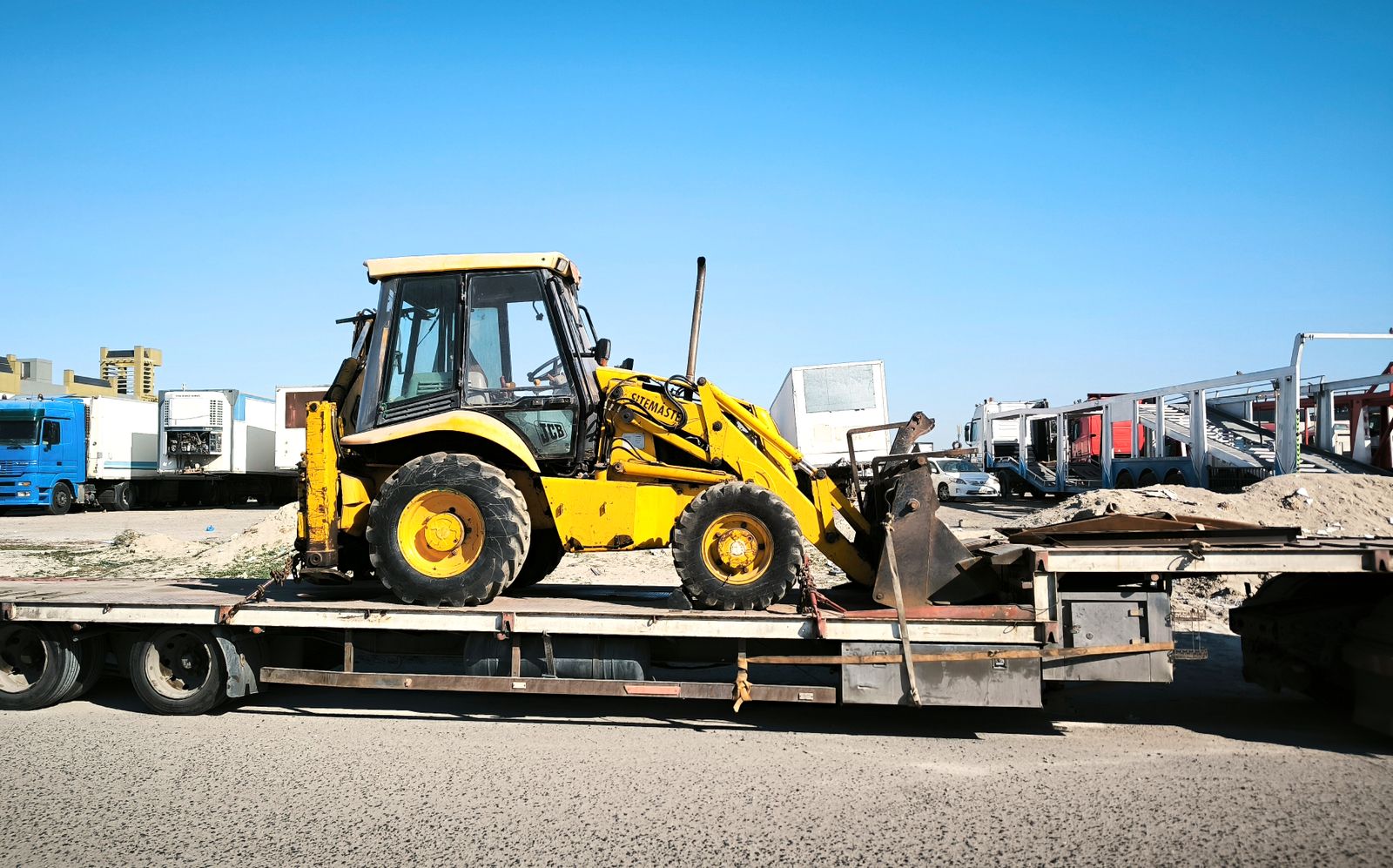
Why heavy equipment is a different risk
Three things make this category unforgiving. First, the legal envelope is small. A load needs an oversize or overweight permit from every state it crosses the moment it exceeds 8 feet 6 inches wide, roughly 13 feet 6 inches high, or 80,000 pounds gross — and most working machines on a trailer exceed at least one of those. Permits are state-by-state; there is no federal oversize permit. Second, the money is bigger and less standardized: published heavy-haul estimates run roughly $3.50 to $6.00 a mile for legal loads on a lowboy and $5 to $15 a mile for oversize work, before permits, escorts and loading. Third, the damage question is not a scratched table. It is whether cargo insurance — which federal law largely does not require for general freight — actually covers your machine's value on that trailer.
Every red flag below exploits one of those three facts.
Red flag 1: A firm price before anyone asks the machine's numbers
A legitimate heavy equipment quote starts with questions that feel almost nosy: make, model and year; operating weight, not shipping weight; width across the tracks; height with the boom lowered; whether it runs and drives; fuel and fluid levels; pickup ground conditions. Weight and dimensions decide the trailer — flatbed, step deck, or a removable gooseneck lowboy — and decide whether the load is legal, oversize, or a superload needing route surveys and bridge analysis.
A quote offered in five minutes, from a photo or less, is not efficiency. It is a number invented to win the job, to be corrected later — after your machine is chained down and your schedule has no slack left. That is the heavy-equipment version of the oldest moving scam in the federal file: the FBI's Washington Field Office describes fraud that begins with an enticingly low estimate and turns, once goods are loaded, into inflated charges and delivery withheld until they are paid. Iron bends the same way leverage does. If the estimator does not need your machine's weight, the estimator is not estimating your move.
Red flag 2: Permits treated as a detail — or a surprise
Ask one question early: "Which permits will this load need, and who files them?" A real carrier answers in specifics — single-trip permits per state, typical fees in the $15 to $500 range per state, escorts once a load passes roughly 10 to 12 feet wide at around $1.50 to $3.00 a mile per escort, daylight-only travel in many jurisdictions, and processing that runs from same-day for standard permits to two to four weeks for superloads.
Walk-away answers sound like this: "We run this route all the time, we don't bother." "Permits are included" — with no line item and no state named. Or the opposite ambush, permits appearing as a brand-new charge after loading. The carrier operating the truck is legally responsible for valid permits in the cab even when a permit service files them, so a carrier casual about permits is telling you who will be standing next to your machine when a scale house or trooper stops it. An unpermitted oversize load does not get waved through. It gets parked, fined, and re-permitted on your clock.
Red flag 3: You cannot tell who actually owns the truck
Heavy equipment work is full of brokers, and brokering is legal. What is not acceptable is not knowing. A broker books your job and hands it to a carrier you never vetted; a carrier runs its own trucks. The FBI's red-flag list includes paperwork whose names and addresses do not match the company you thought you hired, and USDOT numbers that do not match the company name. In heavy haul the version of this I watched from the dispatch desk was the double hand-off: the name on the quote, the name on the truck door, and the name on the insurance certificate were three different companies, each able to blame the other two.
Settle it in writing before money moves: the carrier's legal name, USDOT number and MC number, and whether the company you are paying is that carrier or a broker arranging one. Then check the numbers yourself in FMCSA's SAFER system, where a Company Snapshot shows whether the USDOT record is active, whether operating authority covers property, and what cargo the carrier is set up to haul. Two minutes. Any resistance to giving you the numbers is the answer to the question you were asking.
Red flag 4: Insurance that is a word, not a number
"Fully insured" is the most meaningless phrase in this trade. Federal rules require interstate for-hire carriers to carry public liability coverage — $750,000 minimum for general freight under 49 CFR Part 387 — but liability pays for harm the truck does to others. It does not pay for your excavator. Federal cargo coverage minimums apply to household goods carriers, at $5,000 per vehicle and $10,000 per occurrence; for general freight, cargo insurance is a market practice, not a federal mandate, and typical limits run $100,000 to $250,000 per load. Plenty of working machines are worth more than that.
So ask for the certificate of insurance, read the cargo line, and compare the limit against a number you can defend — what the machine would cost to replace or repair. Then verify it the way insurance professionals do: a certificate alone can be outdated or list the wrong company, so confirm through FMCSA's licensing and insurance records and, for high-value loads, with the insurer or agent named on the certificate. A carrier whose cargo limit is $100,000 hauling your $280,000 dozer is not insured for your move in any sense that matters, whatever the website says. Ask, too, about rigging and loading: if the machine cannot drive onto the trailer and needs a crane or winch, who supplies it, and whose policy covers the lift itself?
Red flag 5: A big deposit, in a hurry, by an untraceable method
The FBI and FMCSA flag the same household-goods pattern, and it ports directly: a large down payment demanded to "lock in" the price, pressure to sign quickly, and payment steered toward cash or instant-transfer apps. Heavy equipment jobs do legitimately involve money earlier than household moves — permits must be bought, escorts scheduled, a specialized trailer positioned — so a modest, documented deposit against named costs is normal. What is not normal is a large share of the total, before a survey of the machine, payable in a way you cannot reverse or trace, to a name that does not match the carrier of record. Money follows paperwork. If the paperwork is thin and the payment demand is thick, you have the proportions exactly backwards.
Red flag 6: No plan for loading day
Dispatch taught me to judge a carrier by its questions about the ground. A professional asks where the machine sits, whether the surface holds a loaded lowboy, who operates the machine onto the trailer, what happens if it will not start, and how much free loading time is included before detention charges begin. Loading and waiting time are real cost lines in every honest heavy-haul quote — crane or forklift help when a machine cannot drive on, waiting time, overnight layovers. A quote silent on all of it is not cheaper. It is unfinished, and it will finish itself on your invoice.
The mirror-image flag appears at the site: a different trailer than quoted — a flatbed where the height needed a lowboy — ramps or winches improvised for a machine that was supposed to drive on, securement that looks decorative. Stop the load. A machine that leaves badly rarely arrives well, and your leverage is never higher than while it is still on your ground.

Red flag 7: The contract cannot survive simple questions
You do not need to be a lawyer. You need the document to answer five questions plainly: What exactly is included — permits, escorts, fuel surcharge, loading time? What is the total, and which lines can change, by how much, on whose say-so? What are the pickup and delivery windows, and what happens — in dollars — if the carrier misses them? What is the claim process and deadline if the machine arrives damaged? Whose name is on the bill of lading, and does it match the carrier you checked?
Vague answers, blank spaces you are asked to sign around, or a refusal to put the estimate in writing are each disqualifying on their own. Federal household-goods rules require written estimates based on an actual survey of the goods; heavy freight runs on commercial contracts rather than that rulebook, which makes your own paper the only rulebook there is. If it is not written, it was not promised.
| Check | What good looks like | What to do if it's missing |
|---|---|---|
| USDOT / MC lookup | Active record, authority for property, name matches your paperwork | Stop — do not load |
| Cargo insurance | Certificate with a cargo limit at or above the machine's value, verified with the insurer | Get the limit raised or change carrier |
| Permits | Named per state, priced as line items, filed by the carrier | Treat the quote as incomplete |
| Estimate basis | Built from the machine's weight and dimensions, in writing | Re-price before signing anything |
| Payment | Modest documented deposit, traceable method, carrier's name | Walk away from cash-only urgency |
What to do the moment a flag appears
Before loading, the remedy is boring and total: pause, and do not let schedule pressure convert a question into a regret. Verify the carrier in SAFER, demand the certificate, get the permit plan in writing, and be willing to re-book — with 2,791 heavy equipment movers listed on this site, a second quote is a phone call, not a project.
After loading, if the price suddenly changes or delivery is withheld, know the shape of the law even though heavy freight differs from household goods: holding a household shipment hostage carries a federal civil penalty of at least $10,000 per violation, and FMCSA's complaint database shows hostage-load complaints running at roughly a fifth of all moving complaints in recent years — which is to say, regulators take the pattern seriously in every segment. Document everything, communicate in writing, file a complaint with FMCSA, and involve your insurer early if the machine itself is at risk. And whatever the pressure of the moment, never sign a revised document you have not read to make a truck driver go away. The signature is the one thing that can turn their problem into yours.
The through-line from the dispatch desk is simple: good carriers welcome every check on this page, because the checks are how they beat the other kind. The moment a company treats your diligence as an insult, it has told you exactly which kind it is.
Sources
- FBI, Washington Field Office warning on moving extortion fraud — establishes the low-estimate, inflated-charge, withheld-delivery pattern and the pre-move red flags around deposits, cash payment and mismatched USDOT numbers.
- FMCSA, SAFER Company Snapshot — establishes what a carrier lookup shows: active USDOT status, operating authority and cargo carried.
- Federal motor carrier insurance rules, 49 CFR Part 387 — establishes the $750,000 public liability minimum for general freight and the household-goods-only federal cargo minimums.
- RGN trailer permit guidance — establishes the legal limits (8 ft 6 in wide, 80,000 lb gross), per-state single-trip permit costs, escort thresholds and superload processing times.
- Heavy equipment transport cost guides — establish per-mile lowboy and oversize rate ranges and the cost lines for permits, escorts and loading.
Photos: photo by Tayssir Kadamany, https://www.pexels.com/photo/yellow-construction-vehicle-on-flatbed-trailer-38095094/ ; photo by Sóc Năng Động, https://www.pexels.com/photo/construction-equipment-on-truck-in-urban-setting-34480907/
More guides
- How to Hire a Moving Company That Won't Hold Your Furniture HostageMovers › Moving & Storage
- How Much Do Movers Cost? Local vs. Long-Distance Pricing ExplainedMovers › Moving & Storage
- Binding vs. Non-Binding Estimates: The Difference That Decides Your Final BillMovers › Moving & Storage
- Moving Insurance and Valuation: What 'Full Value Protection' Really CoversMovers › Moving & Storage
- Long-Distance Moving: A Start-to-Finish Guide for Household GoodsMovers › Household Goods Moving & Storage
- All Guides & ArticlesBrowse the full guides library