Movers › Heavy Equipment Movers
Heavy Equipment Moving Rules, Licenses and Regulations, Explained in Plain English
Moving heavy equipment is not ordinary moving with a bigger truck. The moment a machine crosses certain size and weight lines, an entirely separate rulebook switches on: federal carrier licensing, state-by-state permits, escort cars, restricted travel hours, and insurance minimums that dwarf anything in household moving. If you are arranging one of these moves — a workshop relocating, a contractor repositioning an excavator, a small manufacturer shifting a production line — you do not need to memorise that rulebook. You need to understand it well enough to tell, before you pay anyone, whether the company in front of you is actually allowed to do the job.
That is what this guide does. It translates the rules into plain English, in the order they apply to a real move, and ends with the checks you can run yourself, for free, in about twenty minutes.
First, the line that changes everything: legal versus oversize
A load travels freely, with no special permit, only while it stays inside the standard legal envelope used on interstate highways:
| Dimension | Standard legal limit | What happens past it |
|---|---|---|
| Width | 8 ft 6 in (102 in) | Oversize — state permit required |
| Height | 13 ft 6 in in most states (some allow 14 ft) | Oversize — permit and route clearance required |
| Trailer length | 53 ft for a semitrailer on the National Network | Oversize — permit required |
| Gross vehicle weight | 80,000 lb, truck, trailer and load combined | Overweight — permit required |
| Single axle | 20,000 lb | Overweight, even if gross weight is legal |
| Tandem axle group | 34,000 lb | Overweight, even if gross weight is legal |
Cross any one line — width is the one machinery crosses most often — and the load is no longer routine freight. It needs permits, an approved route, and often escorts. Cross several lines by a lot and you reach what states call a superload: commonly loads wider or taller than about 16 feet, longer than roughly 120–150 feet, or heavier than about 200,000 pounds, which trigger engineering review of bridges and routes before anyone issues a permit at all.
Two consequences matter for your wallet. First, weight is judged per axle as well as in total, which is why the trailer matters: a lowboy or multi-axle trailer spreads the same machine over more axles and can make a load legal, or permittable, that a standard flatbed cannot carry. Second, there is no national oversize permit. Every state on the route issues its own, with its own fees, thresholds and conditions.
Layer one: the company's federal licence to operate
Before permits for a specific load, the carrier itself must be legal. For a for-hire company hauling equipment across state lines, that means three things, all verifiable.
A USDOT number. This is the carrier's federal safety identity — the number tied to its inspections, crashes and audits. It is required for interstate carriers and for many intrastate carriers operating vehicles over 10,001 pounds. No USDOT number, no legal interstate move.
Operating authority — the MC number. Hauling other people's property for pay across state lines requires FMCSA operating authority, separate from the USDOT number. A company can hold a USDOT number and still lack the authority to take your job. Brokers are a different licence again: a broker arranges transport, owns no trucks, and needs its own authority backed by a $75,000 surety bond. Knowing which of the three you are hiring — carrier, broker, or a carrier pretending a broker's paperwork is its own — is the first consumer-protection check in this industry.
Insurance on file. FMCSA will not activate operating authority until the insurer files proof of liability coverage. The federal floor for for-hire freight in vehicles of 10,001 pounds or more is $750,000 in bodily injury and property damage liability; certain hazardous materials raise it to $1 million, and the most dangerous categories to $5 million. Note what federal law does not generally require for equipment freight: cargo insurance. Unlike household-goods movers, who must file a small cargo policy, general freight carriers face no federal cargo-insurance mandate — the cargo cover in your contract is whatever you negotiate. On a machine worth six figures, that sentence is worth reading twice, and it is why serious shippers ask for a certificate of insurance naming the cargo limit, rather than assuming it exists.
Layer two: the driver's licence
The person driving your machine's trailer needs a Commercial Driver's License matched to the rig. A combination vehicle with a gross combination weight rating over 26,001 pounds, towing a unit over 10,000 pounds, requires a Class A CDL — which describes essentially every real heavy-equipment move. Because almost all heavy-haul trailers use air brakes, the driver must also have passed the air-brake tests; an "L" restriction on the licence means they have not, and cannot legally drive that rig.
Beyond the licence itself, federal hours-of-service rules govern the day: an 11-hour driving limit inside a 14-hour on-duty window, logged electronically. When a quote assumes a schedule no legal driver could keep — a permitted load crossing three states in a day that daylight-only travel rules make impossible — the quote, not the driver, is the problem. Experienced carriers also matter here in a way no licence captures: reputable heavy-haul firms typically want drivers with at least one to three years of safe commercial experience before putting them on oversize work, because the load, the permits and the escorts all have to be managed at once.
Layer three: permits for this load, this route, this week
Permits are where heavy moving gets genuinely complicated, and where a competent carrier earns its fee.
A single-trip permit — the standard for equipment moves — authorises one load, on one specified route, between a defined origin and destination, within set dates. It states the load's exact dimensions and weight, the approved roads, travel conditions and any escort requirements. Fees vary widely by state and load, from around $15 to $500 or more per state; a cross-country oversize move stacks one permit per state crossed. Annual permits exist for carriers making repeated similar moves within one state, and superload permits add route surveys and engineering analysis for the biggest loads.
The permit, not the driver's preference, dictates the journey:
- Route. The load must follow the approved roads. A bridge with a low rating or a tight clearance can add a hundred miles, legally.
- Travel windows. Most states restrict oversize travel to daylight hours, often ban it during rush hours, holidays and bad weather, and wide loads are commonly prohibited from night travel altogether.
- Escorts. Past state-specific width thresholds — often somewhere in the 10- to 12-foot range — one or more pilot/escort vehicles are required, front, rear, or both; the widest loads can require police escorts. Escort costs are a legitimate, visible line item, not a surprise fee.
- Marking. Oversize loads travel with banners, flags and amber warning lights as the permit conditions specify.
If a company quotes your oversize move without asking for the machine's exact dimensions and weight, it has not started the permit process — and a quote built without permits is a guess with your deposit attached.


Layer four: securement and the rules nobody quotes
Federal cargo-securement regulations — Part 393 of the Federal Motor Carrier Safety Regulations — prescribe how equipment must be restrained: the number and strength of tie-downs, working load limits of chains and binders, and extra requirements for wheeled and tracked machinery, which must be restrained against movement in every direction, with accessories lowered and secured. This is the layer a pre-move conversation can actually test. A carrier that can tell you, specifically, how your machine will be loaded, positioned for axle weight, and chained down is describing its own daily practice. One that waves the question away is telling you something too.
Site rules complete the picture: who provides the forklift or crane at each end, ground conditions for the trailer, and clearance at gates and doors are usually the customer's responsibility to arrange and the carrier's to confirm. Put those responsibilities in the written contract, because "we assumed you had a crane" is an expensive sentence at 7 a.m. on a loading dock.
What all this does to the price — honestly
For a reader watching a tight budget, the useful insight is that most of a heavy-equipment quote is not negotiable fat; it is regulated cost passed through. Permits per state, escorts per mile, a multi-axle trailer instead of a flatbed, a second day because daylight rules end the first one — each maps to a rule above. Where money genuinely can be saved is legitimate: making the load smaller (removing attachments, fuel and fluids where the manufacturer allows, which can drop a load out of an escort band), being flexible on dates so the carrier can combine your move with an existing permitted route, and having loading equipment ready so no paid hour is spent waiting. Where money cannot be saved safely is by hiring the operator with no authority, no permits and no cargo cover. The saving is real right up until something goes wrong, at which point it becomes the most expensive decision in the project.
Verify a heavy equipment mover in twenty minutes
- Look up the USDOT number in FMCSA's free carrier search. Confirm the company name and address match the quote, the authority status is active, and check the complaint and safety record.
- Ask which licence you are hiring — carrier or broker — and, if broker, for the carrier's identity before the load day, not on it.
- Request a certificate of insurance showing liability at or above the $750,000 federal floor and, crucially, the cargo limit, in writing.
- Give exact dimensions and weight, and ask for the permit plan: which states, which permit types, what escorts, what travel windows. A real carrier answers in specifics.
- Ask how the machine will be secured and who supplies loading equipment at each end. Get both answers into the contract.
- Check the schedule against the rules. Daylight-only travel and hours-of-service limits are arithmetic; a timeline that violates them will fail in practice.
This site's directory lists 2,791 businesses under Heavy Equipment Movers, within 85,482 moving-related listings overall — so in most regions you can run these checks on two or three candidates, not just one. The rules above are the same for all of them. The companies worth hiring are the ones that can show you, document by document, how they comply.
Sources
- Revolution Trucking, "Oversized and Overweight Loads: Permits, Planning, and What Shippers Need to Know" — federal size and weight limits, single-trip permit costs ($15–$500+ per state), superload thresholds and daylight travel restrictions: https://www.revolutiontrucking.com/blog-posts/oversized-overweight-loads-permits-planning-shipper-guide
- A1 Auto Transport, "Understanding Oversize Loads and Legal Road Limits" — oversize thresholds, per-state permits, escort requirements at 10–12 ft widths: https://www.a1autotransport.com/what-is-an-oversize-load/
- Florin, "MC Number Insurance Requirements" — FMCSA liability minimums ($750,000 for for-hire freight at 10,001 lb+; cargo filing required only for household goods) and BMC-91 filing mechanics: https://florin.inc/blog/do-i-need-insurance-to-get-mc-number
- Classic Cars Arena, "MC Authority for Car Hauling: Filings and Insurance" — USDOT/MC authority, BOC-3 process agents, UCR, and the broker $75,000 bond distinction: https://classiccarsarena.com/magazine/lifestyle/car-hauler-authority-and-insurance
- The Machine Daily, "CDL Transport Rules for Heavy Equipment" — Class A CDL thresholds (26,001 lb GCWR, towed unit over 10,000 lb), air-brake restriction and hours-of-service limits: https://www.themachinedaily.com/heavy-career/cdl-transport-rules-free-online-operator-training
- LaunchAdvisor, "Class A CDL, HAZMAT Endorsement & OSOW Permits for Specialized Freight" — OSOW permits are load-specific, per state, with route and travel-window conditions: https://www.launchadvisor.co/guides/cdl-permits-compliance-specialized-freight-trucking
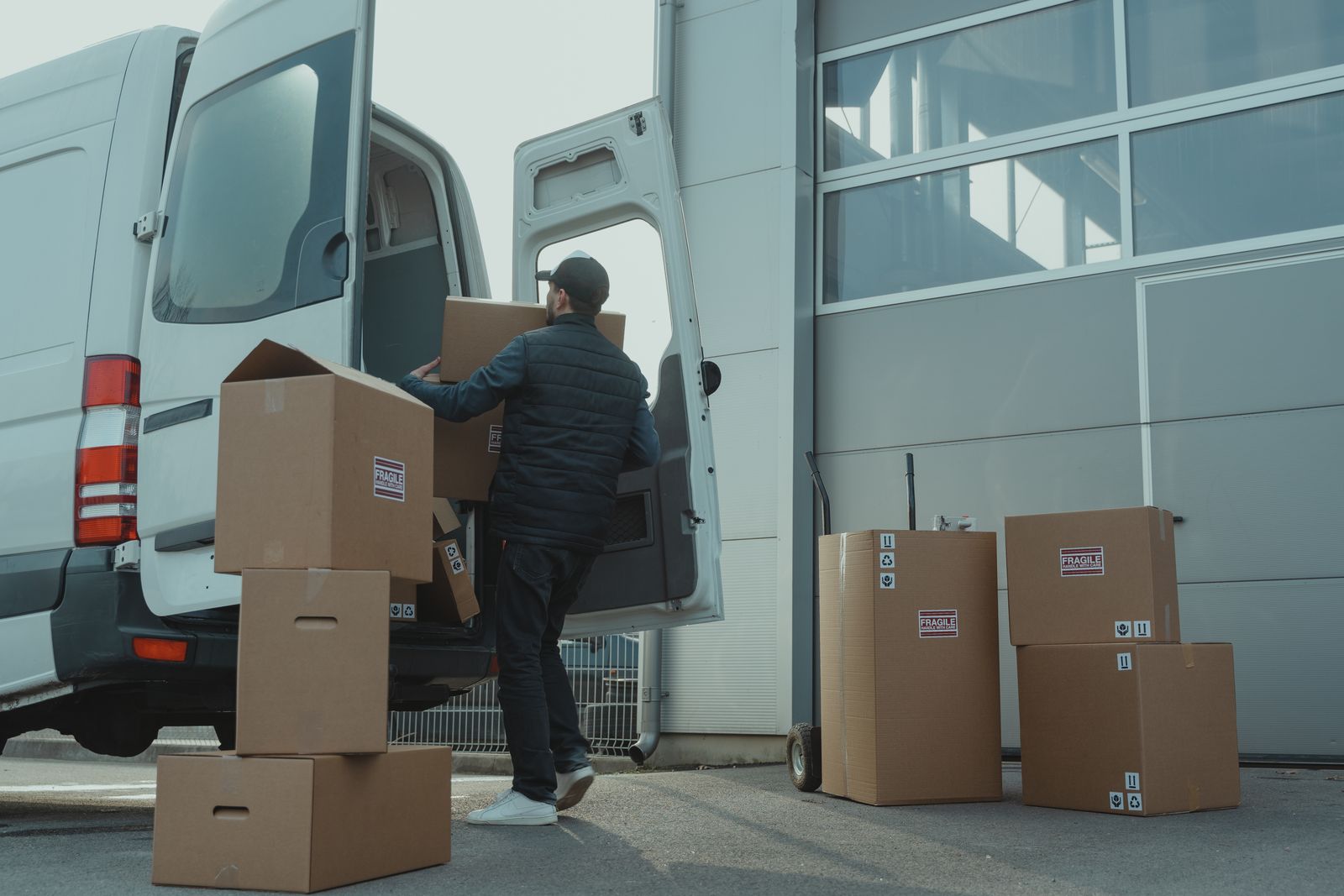
- Photos: loading van — photo via Pexels, https://www.pexels.com/photo/6169056/ ; mover carrying boxes — photo by Artem Podrez, https://www.pexels.com/photo/5025669/ ; warehouse interior — photo by Tiger Lily, https://www.pexels.com/photo/4483610/
More guides
- How to Hire a Moving Company That Won't Hold Your Furniture HostageMovers › Moving & Storage
- How Much Do Movers Cost? Local vs. Long-Distance Pricing ExplainedMovers › Moving & Storage
- Binding vs. Non-Binding Estimates: The Difference That Decides Your Final BillMovers › Moving & Storage
- Moving Insurance and Valuation: What 'Full Value Protection' Really CoversMovers › Moving & Storage
- Long-Distance Moving: A Start-to-Finish Guide for Household GoodsMovers › Household Goods Moving & Storage
- All Guides & ArticlesBrowse the full guides library