Movers › Moving Companies
Hiring a Moving Company in California: A Resident's Guide to Costs and Rules
California regulates a move inside the state more tightly than the federal government regulates a move across it, and almost nobody moving house here knows that. If your move never crosses the state line, the familiar federal rules — the 110 percent rule, the USDOT number — are not the ones protecting you. A state rulebook is: Maximum Rate Tariff 4, published by the Bureau of Household Goods and Services (BHGS), which took over household-mover regulation from the California Public Utilities Commission on July 1, 2018. It caps what a licensed mover may charge, prescribes the estimate you must be given, and sets the strange-sounding billing rule that confuses more Californians than any other line on a moving bill.
This site lists 1,770 moving companies, and California's share of them works under these rules whether they mention them or not. Here is what the rules are, what a move here actually costs, and where the national advice you will read everywhere else simply does not apply.
The licence: Cal-T, and why it is the first question
Every company moving household goods for hire within California must hold a permit from BHGS — the permit number, commonly called the Cal-T number, must appear in the mover's advertising and on its paperwork. This is not a formality. To hold the permit a mover has passed a written examination on the tariff itself, undergone fingerprint-based background checks, and must carry at least $600,000 in combined liability insurance and $20,000 in cargo insurance, plus workers' compensation coverage.
Verify the number before anything else, through the BHGS license search at bhgs.dca.ca.gov. No Cal-T number, or one that does not check out, ends the conversation — an unlicensed mover is outside the tariff entirely, which means outside the price ceiling, outside the estimate rules, and outside the state's complaint process. If the company also offers to take you out of state, it needs federal registration as well; the two systems are separate, and a mover can hold one without the other.
The price ceiling most Californians never use: MAX 4
Here is the California fact that changes every negotiation: licensed movers here do not set their own maximum prices. Maximum Rate Tariff 4 sets maximum rates for the services a household mover provides. A mover may charge less than the maximum. It may not charge more — a quote above the ceiling is not a premium service, it is a regulatory violation. The current tariff took effect January 1, 2026, after a 2.7 percent adjustment. As one worked example, the 2026 tariff maximum for Bay Area counties is $234.39 an hour for a truck and two movers, plus $84.09 for each additional mover. You can request the current rate schedule from BHGS directly — by phone at (916) 999-2041 or by email — and any mover who will not tell you where its rates sit against the tariff maximum is telling you something.
Before work begins, a California mover must give you a written Agreement for Moving Services carrying a Not to Exceed Price. Read those words carefully, because they are stronger than the federal equivalent: your liability is capped at 100 percent of that price — not 110 percent — unless you sign a Change Order for additional services. If a crew suggests extra work on the day, the protection survives only if the change is put in a signed Change Order before the work is done. Verbal additions are where capped prices go to die.
Double drive time: the rule that is not a rip-off
Every California complaint inbox contains this letter: "They charged me for driving time twice." They did, and the state required it. Under the tariff, billable time on an hourly local move is the total of loading time, unloading time, and double the actual driving time between your old address and your new one. A 20-minute drive is billed as 40 minutes. The logic is that the truck and crew must return after unloading, and that return would otherwise be unbillable; the mover, not you, absorbs the drive from their yard to your first address and the rules are written so the charge is visible rather than buried in a higher hourly rate.
Two consequences follow. First, do not waste outrage on it — it applies to every licensed mover in the state, and a mover who promises not to charge it is either unlicensed or planning to recover it elsewhere. Second, distance between your two California addresses matters more here than in other states, because every minute of it is billed twice. In Los Angeles traffic, the difference between a crosstown move at 10 a.m. and the same move at 4 p.m. is a real line item. Ask the mover to schedule the drive against traffic, and get the estimated drive time in the written agreement where you can see it.

The 100-mile line: where your move changes species
California draws its own line between local and long-distance. Moves of 100 constructive miles or less may be billed by the hour, with double drive time. Past 100 miles inside the state — Los Angeles to San Francisco, at roughly 380 miles, is the classic case — the tariff requires pricing by certified shipment weight and mileage instead, with weight conventionally estimated at 7 pounds per cubic foot. That changes what you should scrutinise: not the clock, but the weight estimate, the weighing, and the inventory it was built from. And the moment a move crosses the state line entirely, California's tariff stops applying and federal interstate rules take over — a mover quoting you California hourly terms for a move to Nevada or Arizona is applying the wrong rulebook.
What a California move costs
Local moves are hourly, typically with a three-hour minimum. Published California rates cluster like this:
| Crew | Typical California rate | Los Angeles / San Francisco | Best for |
|---|---|---|---|
| 2 movers + truck | $100–$150/hr | $130–$200/hr | Studio and one-bedroom moves |
| 3 movers + truck | $140–$200/hr | $180–$250/hr | Two- to three-bedroom homes |
| 4 movers + truck | $180–$260/hr | $220–$320/hr | Large homes, heavy furniture |
In totals: a studio or one-bedroom local move commonly runs $400 to $900; a two-bedroom, $800 to $1,800; a three- to four-bedroom house, $1,500 to $3,500. San Francisco sits at the top of the state's ranges — two movers at $150 to $220 an hour, a local two-bedroom at $1,000 to $2,500 — because steep streets, scarce parking, and walk-up buildings turn hours into more hours. San Diego runs lower, roughly $110 to $175 an hour for two movers. Within-state long-distance moves for a two-bedroom home are commonly quoted from about $900 to $2,200 for Los Angeles to San Diego (about 120 miles) and $1,800 to $4,500 for Los Angeles to San Francisco. Hold every one of these figures against the tariff ceiling and the Not to Exceed Price: in California, uniquely, the written cap is not a courtesy. It is the law of the move.
Downsizing in California: the senior-specific traps
If you are leaving a long-held family home for a smaller place, a retirement community, or a child's home, three California realities deserve planning around. First, the destination's rules: many senior communities and Bay Area and Los Angeles apartment buildings require elevator reservations, certificates of insurance from the mover, and weekday-only move windows. A licensed California mover produces that insurance paperwork routinely; an unlicensed one cannot, and discovering that at the loading dock costs a day. Second, the sort is the saving: hourly billing means every box you decide not to move is money — a house sorted ruthlessly over a month, with family taking what they want and donations collected before moving week, routinely cuts a full day of crew time. Movers charge by the hour for indecision as faithfully as for furniture. Third, the paperwork is your protection, so keep it: the Agreement for Moving Services with its Not to Exceed Price, any Change Orders, and the inventory. If something goes wrong, BHGS runs the complaint process for licensed movers, and a complaint built on the state's own documents is the kind that gets resolved.
Where the national advice does not hold
Ignore, for an in-state move, any guide that tells you to demand a "binding estimate" in the federal sense, to rely on the 110 percent rule, or to check only a USDOT number. Your instruments are different and in several ways better: a Cal-T permit you can verify, a state tariff ceiling on rates, a Not to Exceed Price capped at 100 percent, double drive time that is mandatory rather than negotiable, and a state bureau that takes complaints about its own licensees. Use them in that order — verify the permit, ask where the quote sits against MAX 4, get the Not to Exceed Price in writing, and schedule the drive like it costs money. In California, it does — twice.
Sources
- Bureau of Household Goods and Services (BHGS), via Suburban Relocation Systems, "How to Choose a Moving Company in California" — BHGS permits required for intrastate carriers, at least $20,000 cargo insurance, the MAX 4 rate ceiling, and requesting the rate schedule from BHGS at (916) 999-2041.
- JH Moving, "Bay Area Moving Cost: What Movers Really Charge" — the current Max 4 tariff took effect January 1, 2026; billed time is loading plus unloading plus doubled drive time, rounded to quarter hours; the Bay Area tariff maximum of $234.39 an hour for two movers plus $84.09 per additional mover; moves past 100 miles priced by weight at 7 pounds per cubic foot.
- Prime Moving, "Double Drive Time Movers in California" — Item 320 of Maximum Rate Tariff 4 requires double drive time on hourly moves of 100 constructive miles or less; moves over 100 miles are charged on certified weight and mileage; the Agreement for Moving Services carries a Not to Exceed Price capping liability at 100 percent absent a signed Change Order.
- Triple Real Estate Magazine, San Diego moving guide — BHGS assumed authority from the CPUC on July 1, 2018; permit requirements include a written examination on Maximum Rate Tariff 4, background checks, $600,000 combined liability insurance, $20,000 cargo insurance, and workers' compensation; license verification at bhgs.dca.ca.gov.
- The Guru of Moving, "How Much Do Movers Cost in California? (2026 Prices)" — local moves $800 to $2,500 and in-state long-distance $1,500 to $6,000 or more; hourly ranges by crew size for California generally and for Los Angeles and San Francisco; Los Angeles to San Francisco about 380 miles at $1,800 to $4,500 for a two-bedroom; San Diego two movers at $110 to $175 an hour.
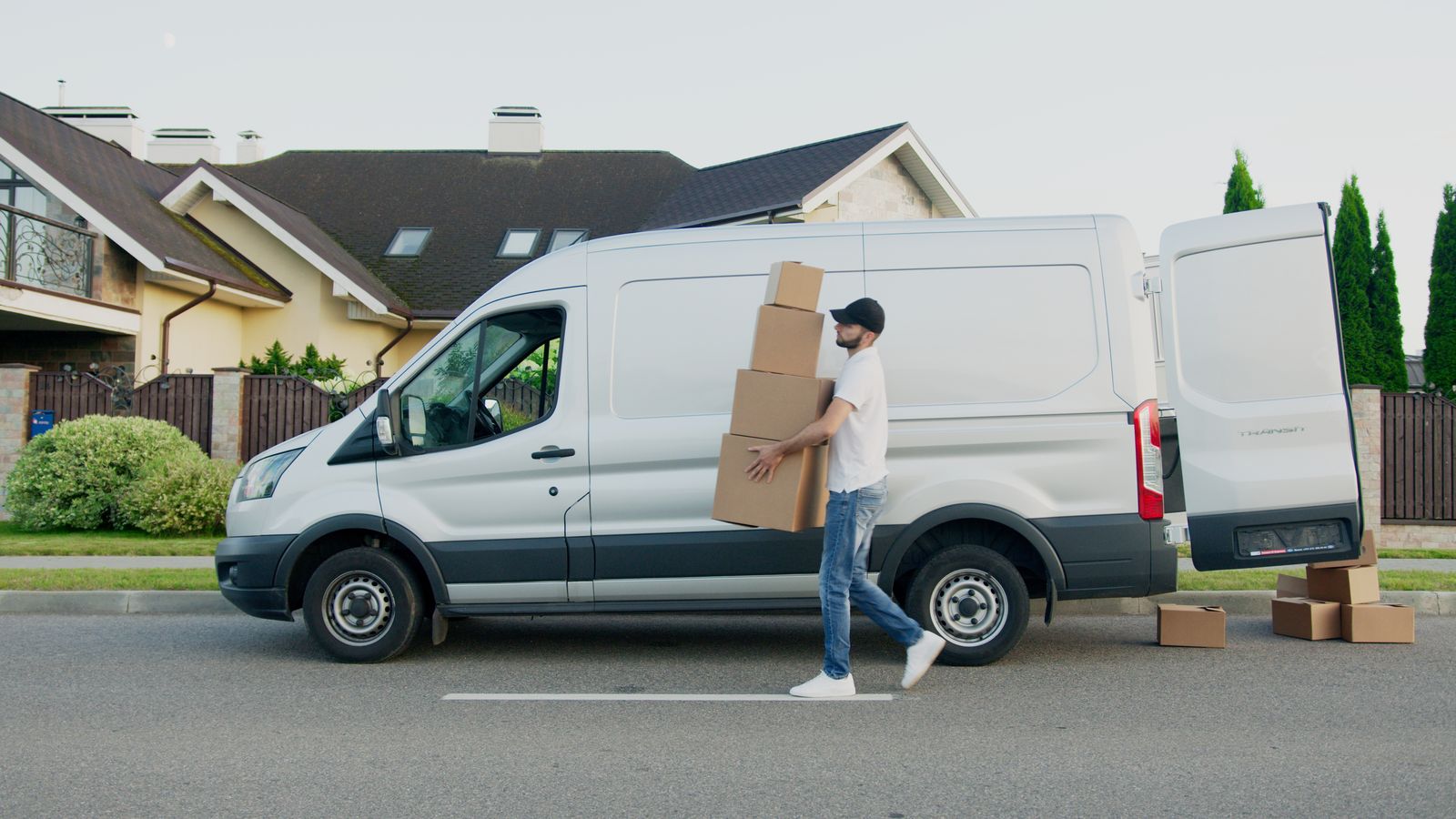
Photos: family packing — photo by Pexels photo 4569340, https://images.pexels.com/photos/4569340/pexels-photo-4569340.jpeg; mover carrying boxes — photo by Pexels photo 7464232, https://images.pexels.com/photos/7464232/pexels-photo-7464232.jpeg
More guides
- How to Hire a Moving Company That Won't Hold Your Furniture HostageMovers › Moving & Storage
- How Much Do Movers Cost? Local vs. Long-Distance Pricing ExplainedMovers › Moving & Storage
- Binding vs. Non-Binding Estimates: The Difference That Decides Your Final BillMovers › Moving & Storage
- Moving Insurance and Valuation: What 'Full Value Protection' Really CoversMovers › Moving & Storage
- Long-Distance Moving: A Start-to-Finish Guide for Household GoodsMovers › Household Goods Moving & Storage
- All Guides & ArticlesBrowse the full guides library