Movers › Building & House Moving & Raising
How to Negotiate Moving or Raising a Whole House Quotes Without Burning the Relationship
Yes, this guide is about moving the house itself. Not the furniture. The building.
Structural movers are a small, specialized trade: crews who slide steel beams under a house, lift it on unified hydraulic jacks, and either set it back down on a new, taller foundation (raising) or roll it down the road on dollies to a new lot (moving). The directory behind this site counts just 657 listings in Building & House Moving & Raising, against more than 85,000 moving listings overall. In many regions you will have two credible bidders within driving distance, sometimes one. That scarcity changes the negotiation completely — and it is why this guide's title ends the way it does. You are not haggling over a commodity with a company you will never see again. You are choosing the only crew for a hundred miles who will hold your house in the air, and you will need their goodwill on the hardest day of the project.
So the goal is not to win. The goal is to get a complete, honest, comparable quote — and then to trade, openly, on the parts of the job where the mover genuinely has room, while leaving untouched the parts where squeezing produces risk instead of savings.
What the numbers actually look like
You cannot negotiate a quote you cannot read, so start with the landscape. Published cost guides converge on a rough per-square-foot figure for the lift-and-move itself: about $12 to $16 per square foot, which puts a typical structural move in the $18,000 to $40,000 range before permits and a new foundation, with large houses and long or difficult routes running to $100,000 and beyond — Angi's 2026 figures put the national average near $40,000 and the broad range at $18,000 to $100,000. Raising a house in place is its own category: the lift alone commonly runs $10,000 to $40,000, and a full flood-elevation project — new foundation, utility reconnections, stairs and access, engineering — most often lands between $30,000 and $70,000 in Modernize's summary, and well above that for slab homes or FEMA-compliant elevations.
The crucial fact for negotiation is what those headline numbers exclude. The mover's quote is usually only one slice of the project:
| Cost element | Typical range | Usually in the mover's quote? |
|---|---|---|
| Lift and transport (the mover's core work) | $12–$16 per sq ft; $18,000–$40,000 typical | Yes — this is the quote |
| New foundation at destination / under raised house | $5,100–$19,400 for a basic foundation; far more for full elevation work | Sometimes — ask |
| Utility disconnect and reconnect | $3,000–$10,000 for a raise; up to $34,500 in whole-move estimates | Rarely — usually your contractors |
| Permits, route surveys, escorts | $400–$5,000 for permits alone | Partly — clarify which permits |
| Engineering and surveys | $1,500–$5,000 for engineering on a raise | Rarely |
| Site prep, tree trimming, temporary road work | Varies by route | Almost never |
Two quotes $15,000 apart are often not two prices for the same job. They are two different jobs wearing the same title. The first negotiation skill is forcing every bidder to price the same scope.
Step one: make the quotes comparable before you discuss price
Ask each bidder for an itemized quote with the same skeleton: preparation and structural reinforcement; the lift; transport and route costs (for a move); cribbing and hold time while foundation work happens (for a raise); setting and leveling; and an explicit list of exclusions. Then ask the questions that surface the hidden divergences:
- Who handles the route? For a road move, someone must survey the route for low wires, bridges with weight limits, tight turns, and soft shoulders, and arrange utility lifts and police escorts where required. If one bid includes escort and wire-lifting coordination and the other assumes you will arrange it, they are not comparable.
- How many days of cribbing are included? On a raise, the house sits on timber cribbing while the new foundation is built underneath it. Quotes include a set number of days or weeks; after that, standby charges accrue. A cheap quote with ten included days can finish more expensive than a higher quote with thirty.
- What does the price assume about my house? Chimneys, additions, porches, and masonry veneer all change the work — masonry structures need more steel and more jacks and move more slowly, which is why they are commonly estimated 20 to 30 percent higher to lift. If a bidder has not been inside your crawl space, their number is a guess with a signature on it.
- What is expressly not covered? Plaster and drywall cracking is the classic example: lifting a house, however carefully, can crack brittle finishes, and many contracts put cosmetic repair on the owner. That is not a scandal — it is a term. Know it before, price it into your budget, and do not discover it in the exclusions paragraph afterward.
Getting three itemized bids on identical scope is unglamorous work, and it is where most of the money in this negotiation is actually saved — before anyone has asked for a discount.
Where the margin actually is
Structural movers price in risk and in logistics, and their flexibility lives in logistics. These are the trades that work:
Schedule flexibility is the strongest card a budget buyer holds. A mover's expensive days are the ones where a crew and a unified jacking system sit idle between jobs, or deadhead empty to a distant site. If your timeline can flex — you can take the slot after their big job nearby, or let them set the move date within a window — say so explicitly and ask what it is worth. Filling a gap in a mover's calendar is real money to them and costs you nothing but patience.
Scope you can genuinely take off their plate. Site preparation you or a local contractor can do — clearing access, removing a porch or deck that must come off anyway, arranging your own utility disconnects through the utility companies — reduces their labor and their coordination burden. Offer it as a trade, with the boundary in writing: a task half-transferred is worse than one not transferred at all, because on lift day nobody owns it.
Distance and route simplicity. If the destination lot is negotiable, a shorter, straighter route with fewer wire lifts is cheaper in ways no discount conversation can match. Ask the mover to price your preferred route and the easier alternative. Sometimes the "expensive mover" is just the one who drove the route and counted the obstacles.
Payment structure. A mover carrying a five-figure job carries financing and no-show risk. A larger deposit or faster payment milestones can be worth a modest price concession — modest being the operative word, and never so front-loaded that you lose your leverage if the schedule slips. Tie payments to visible milestones (house lifted, house set, house leveled) rather than to calendar dates.
What never to squeeze
Complaint files teach this section. The line items that look like padding are usually the physics:
- The engineering. A structural assessment before the lift, and an engineer's plan for the new foundation, are not upsells. Skipping them does not remove the cost; it converts it into a risk you now own entirely.
- Insurance and bonding. Ask for certificates, verify them, and do not reward the bidder who is cheap because they are uninsured. If a house comes off cribbing, there is no version of that story where the discount was worth it.
- Crew size and time on the lift. A unified jacking system lifts a house evenly, in small increments, with people watching every beam. Pressuring a crew to move faster or with fewer hands is pressuring them to accept deflection your frame will pay for.
- The route survey and escorts. A house that meets a low bridge or an unlifted power line mid-route is a catastrophe measured in six figures and news coverage. If a bidder waves off the survey, that is not savings. That is the bid to discard.
There is a sentence that works with every good mover and no bad one: "Where would you cut this job if it were your money — and where would you refuse to?" Professionals answer it instantly and specifically. It tells you where their margin is, where their fear is, and whether they think about your house the way you need them to.

Raising for flood: negotiate with the paperwork, not just the price
If you are raising to meet a base flood elevation (BFE), part of your negotiation is not with the mover at all. An elevation above BFE can reduce flood insurance premiums substantially over the years you own the home — Modernize cites an average NFIP premium reduction of about 30 percent a year — which changes what the project is worth to you and therefore how hard a given price should be pushed. If your home was substantially damaged by flooding and you carry an NFIP policy, Increased Cost of Compliance coverage can pay up to $30,000 toward elevation. Grant programs exist in some states and after some disasters, usually covering a share of cost on a slow timeline. None of this lowers the mover's price. All of it lowers your net cost, and a mover experienced with flood elevations — who has worked with elevation certificates, floodplain offices, and grant documentation before — is worth a premium over one who has not, because their paperwork competence is part of what you are buying.
Get the target elevation in the contract: the finished floor height relative to BFE, who obtains the elevation certificate, and who is responsible if the set-down misses the permitted height. On a flood raise, a two-inch miss is not a cosmetic issue. It is the entire point of the project.
Putting the deal in writing
The agreement should carry: the itemized scope and exclusions; the route or the cribbing period, as applicable; included days and the standby rate after them; the payment milestones; insurance certificates; who pulls which permits; the target elevation or destination set-down standard; a damage standard that distinguishes structural damage (the mover's problem) from cosmetic cracking (usually yours); and a weather and delay clause, because houses do not move in high winds and a contract silent on delay invites a dispute about whose delay it was.
Negotiate the changes before you sign, in the same tone you have used throughout: specific, written, and unhurried. In a trade this small, your reputation travels too — movers talk, and the customer who negotiated hard but fairly, paid on the milestones, and had the site ready when promised is the customer whose next call gets answered first.

A closing checklist for the tight-budget buyer
- Three itemized quotes, same scope skeleton, exclusions listed in writing.
- Route survey (for a move) or included cribbing days and standby rate (for a raise) stated in every bid.
- One explicit trade offered: schedule flexibility, owner-handled site prep, or a simpler route — priced, not implied.
- Engineering, insurance, and survey lines untouched by the discount conversation.
- Flood projects: BFE target, elevation certificate responsibility, and any ICC or grant paperwork assigned to a named party.
- Payments tied to milestones you can see from the driveway.
The cheapest house move is the one done once, by a crew that still takes your calls. Negotiate the logistics, respect the physics, and put every promise in the contract — that is the whole technique.
Sources
- HomeGuide, "How Much Does It Cost to Move a House?" — $12–$16 per square foot, $18,000–$40,000 average range excluding permits and foundation, with foundation, utilities, and permit cost ranges: https://homeguide.com/costs/cost-to-move-a-house
- Angi, "How Much Does It Cost to Move a House?" — 2026 national average of $40,000 and an $18,000–$100,000 range driven by size, distance, and route complexity: https://www.angi.com/articles/cost-move-house.htm?m=angienewsletter&entry_point_id=32951035&cid=eml_E007_M001_green__20180105
- Vanselow Design, "How Much Does It Cost to Elevate a House in Florida? (2026)" — what an elevation quote includes, and Increased Cost of Compliance coverage paying up to $30,000 toward elevation for substantially flood-damaged NFIP homes: https://vanselowdesign.com/blog/how-much-does-it-cost-to-elevate-a-house/
- Modernize, "How Much Does It Cost to Raise a House?" — lift costs of $10,000–$40,000, flood-elevation projects commonly $30,000–$70,000, utility reconnection and engineering ranges, and an average NFIP premium reduction of about 30 percent after elevation: https://modernize.com/foundations/cost-to-raise-house
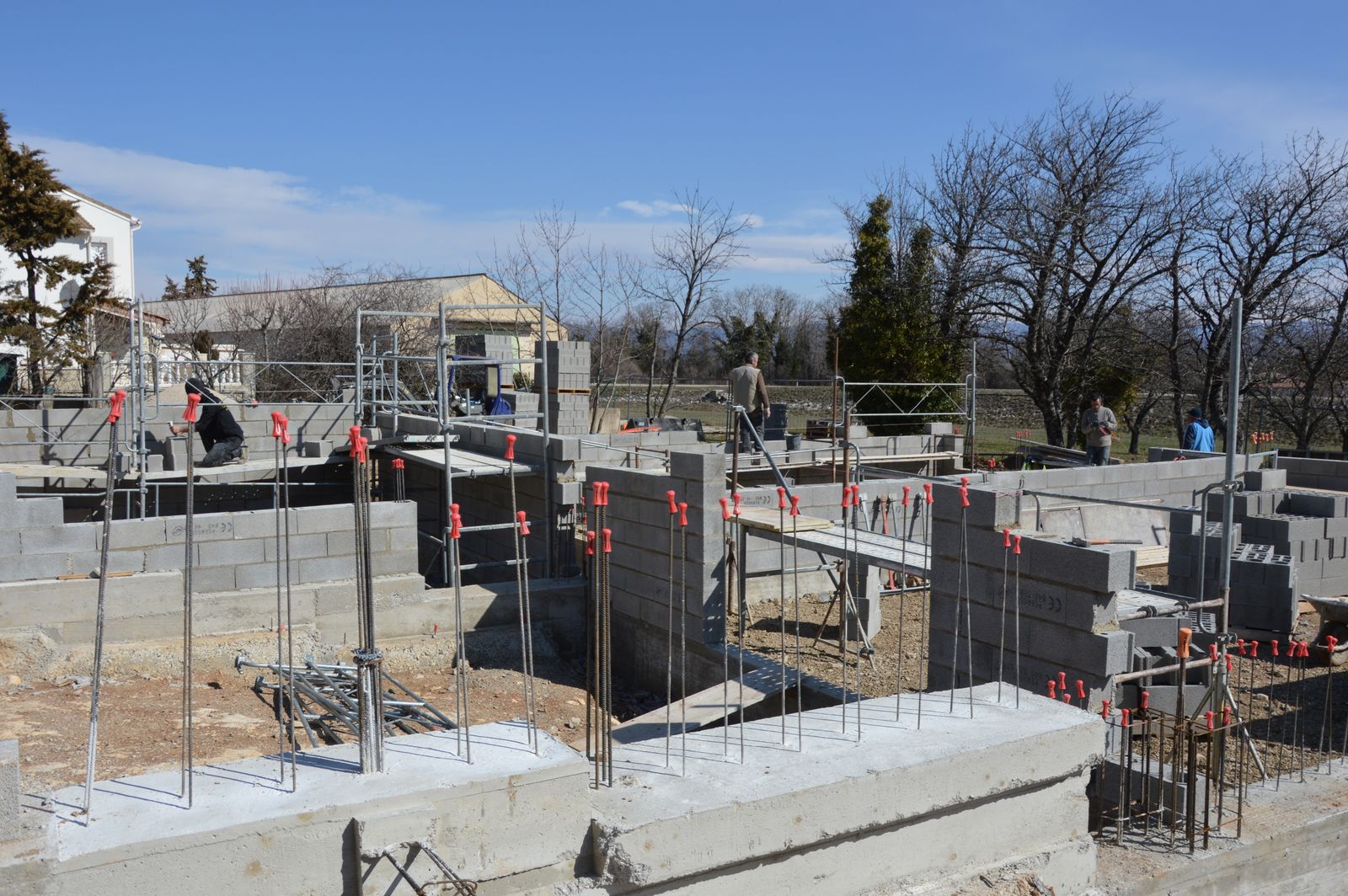
- Workers building a concrete foundation — photo by Ulrick Trappschuh, https://www.pexels.com/photo/15458299/
- Couple packing boxes while relocating — photo by SHVETS production, https://www.pexels.com/photo/7203883/
- Mover carrying boxes beside a van — photo by Artem Podrez, https://www.pexels.com/photo/5025669/
More guides
- How to Hire a Moving Company That Won't Hold Your Furniture HostageMovers › Moving & Storage
- How Much Do Movers Cost? Local vs. Long-Distance Pricing ExplainedMovers › Moving & Storage
- Binding vs. Non-Binding Estimates: The Difference That Decides Your Final BillMovers › Moving & Storage
- Moving Insurance and Valuation: What 'Full Value Protection' Really CoversMovers › Moving & Storage
- Long-Distance Moving: A Start-to-Finish Guide for Household GoodsMovers › Household Goods Moving & Storage
- All Guides & ArticlesBrowse the full guides library