Movers › Barrels & Drums
How to Prepare for Barrels and Drums: The Week Before, the Day Itself, and After
A 55-gallon drum looks like the simplest object in a warehouse: a cylinder, no moving parts, nothing to assemble. Then you learn what it weighs. Fifty-five gallons of water is about 459 pounds before you count the drum itself, so a full steel drum of water comes in near 500 pounds, and denser contents — oil, syrup, many industrial liquids — push past 550. It is a quarter-ton object with a high center of gravity, no handholds, and contents that slosh. Almost every bad outcome in drum handling, as one equipment buyer's guide puts it, traces back to someone underestimating that one number.
That is why moving barrels and drums is a preparation job, not a lifting job. Whether you are receiving a delivery of drums, shipping product out, clearing a workshop of waste oil, or relocating a small operation's worth of chemicals and lubricants, the work that decides how the day goes happens in three phases: the week before, when you identify, document, and stage; the day itself, when you inspect, close, and move; and afterwards, when you check, store, and file. This guide walks through all three, with the regulatory details that apply when the contents are hazardous — because with drums, the difference between an ordinary move and a regulated shipment is what's inside, and you are expected to know.
The week before: know exactly what you have
Inventory the drums, not the count. "Fourteen drums" is not an inventory. For each drum, record its material (steel, plastic, or fiber), its type (closed-head with bung openings, or open-head with a removable lid and locking ring), its size, its contents, and its condition. The material and type decide everything downstream: what handling equipment can grip it, whether it can be rolled, and what rules apply. A steel drum runs 20 to 40 pounds empty; a plastic drum only 7 to 10 — which is why plastic drums feel deceptively manageable right up until they're full.
Identify the contents, in writing. If any drum holds a hazardous material — solvents, fuels, many chemicals, waste oil in some contexts — the move may be a regulated hazardous materials shipment under the federal rules in 49 CFR Parts 171–180, with requirements for packaging, marking, labeling, shipping papers, and trained personnel. You cannot decide that on the day. Read the labels and safety data sheets now. A drum whose contents nobody can identify is not a moving problem; it is a hazardous-waste problem, and it should not be loaded onto a truck until it is identified.
Check the UN markings if the drums will travel. Drums certified for hazardous materials carry a UN mark — codes like 1A1 (steel, closed-head) or 1A2 (steel, open-head) — showing the design passed performance tests. That certification is only valid if the drum is closed exactly as the manufacturer instructed. Which leads to the least-known preparation task in this entire guide:
Get the closure instructions, and the tools to follow them. Federal rules (49 CFR 173.22 and 178.2) require that UN drums be closed in accordance with the manufacturer's closure instructions — specific torque values for bung plugs and bolt rings, applied with a calibrated torque wrench. Drum manufacturer Skolnik's guidance is blunt: closing a bolt-ring drum means tightening to a specified torque (their salvage-drum procedure specifies 55–60 ft-lbs, worked around the ring with a mallet until the torque stabilizes), and inspectors expect to see a calibrated torque wrench and its calibration record. Closing "hand tight plus a bit" voids the drum's certification and, in enforcement cases PHMSA has brought in the last two years, has drawn proposed civil penalties against shippers. A week before is when you request the closure instructions from the drum maker and confirm you own a torque wrench — not the morning of the move.
Arrange the paperwork. For hazardous contents: shipping papers with the proper shipping name, hazard class, and identification number; labels and placards as applicable; and an emergency response telephone number. For ordinary freight: a bill of lading with an accurate drum count and total weight — remember, fourteen full drums can be three and a half tons, which changes what truck you need. Confirm the carrier knows they are collecting drums, what is in them, and how they are packaged; carriers can and do refuse loads that arrive different from what was booked.
Stage the equipment and the space. Based on your inventory, have ready: a drum hand truck rated for the load (commonly 600–1,000 pounds depending on type), a drum dolly or pallet jack, a forklift with proper drum attachments if you are moving palletized drums — Mobil's lubricant-handling guidance notes that fork jaws need adapters shaped to the drum's curve, since straight jaws need dangerous squeeze pressure — plus pallets in sound condition, a bung wrench, a torque wrench, stretch wrap or strapping, and a spill kit sized to your largest drum. Clear and inspect the route: thresholds, ramps, dock plates, tight turns. And set aside a staging area with secondary containment if hazardous liquids are involved — EPA rules for hazardous waste storage size containment at 10 percent of the total volume of containers or the volume of the largest container, whichever is greater.

| Drum | Empty weight | Full of water | Handling notes |
|---|---|---|---|
| Steel, 55 gal | 20–40 lb | ~500 lb | Rim grips and chime hooks; rolls on its chimes |
| Plastic, 55 gal | 7–10 lb | ~465 lb | Needs a molded rim strong enough for grips; thin walls flex |
| Denser contents (oil, syrup) | as above | 550 lb or more | Recheck equipment ratings — water numbers no longer apply |
The day itself: inspect, close, then move
Inspect every drum before it moves. Walk the set with your inventory in hand. Check for dents (especially on rims, where grips attach), corrosion, bulging, damaged threads, and any sign of leakage — wet rings at the base, stained pallets, odor. Tighten-check every bung. A leaking drum does not get moved; it gets contained and, if necessary, repacked into a salvage drum — the oversized drum designed for exactly that. Moving a leaking drum converts a packaging problem into a spill, and possibly a reportable incident.
Close to the instructions. Fit lids and rings, then torque closures to the manufacturer's specification with the calibrated wrench. If you are filling drums on the day, leave headspace for expansion as the instructions direct, and mark and label each drum as it is closed, while its contents are certain — never label from memory at the end of the day.
Move with equipment, at the drum's pace. The rules from handling-equipment guidance are consistent: keep the drum's center of gravity low and close to the hand truck's frame; tip only as far as the truck's rests require; never let a drum roll under its own momentum; never drop drums from a truck bed — use the liftgate, a hoist, or skids with the truck braked and wheels chocked, keeping control of the drum the whole way down. Rolling a drum on its chimes is acceptable on flat, smooth floors, watching for anything sharp that could puncture the shell; repositioning a drum from upright to its side is a two-person job. If a drum starts to go over, let it — nobody stops 500 falling pounds, and the spill kit is cheaper than the injury.
Load and secure for the road. Drums travel upright, on pallets or the vehicle floor, blocked, braced, or strapped so they cannot shift, tip, or roll — a load that moves in transit arrives as a load that leaks. Keep incompatible materials apart if your shipment mixes contents. Count drums on and sign the paperwork only when the count, labels, and papers agree.
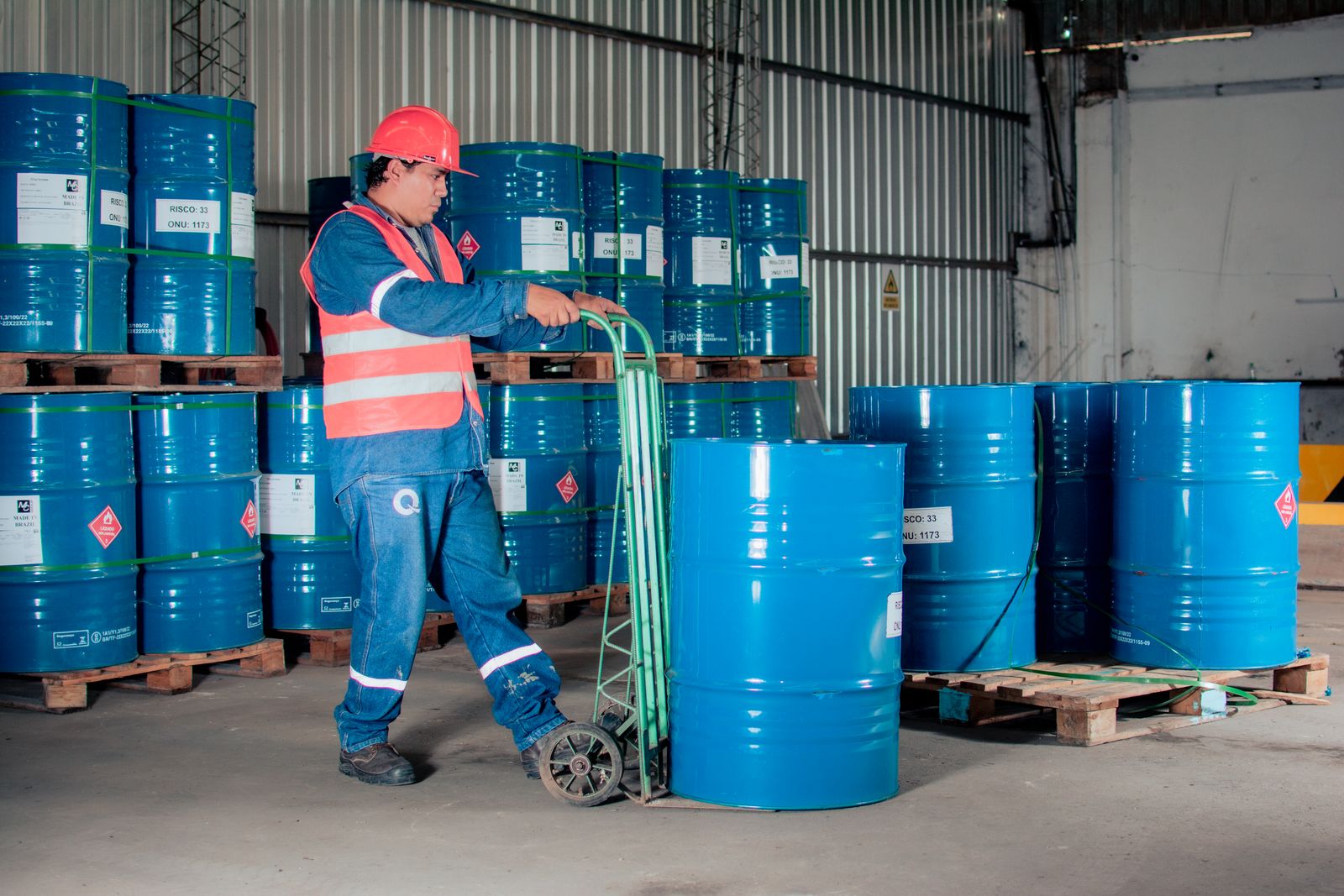
After: receive, store, and close the loop
Inspect on arrival, before you sign clean. Count the drums, then look at them: new dents, shifted rings, weeping bungs, a drum riding at an angle because its pallet failed. Note damage on the delivery paperwork before the driver leaves — afterwards it is your word against the record. Any drum that leaked in transit goes to containment first and gets assessed before it joins storage.
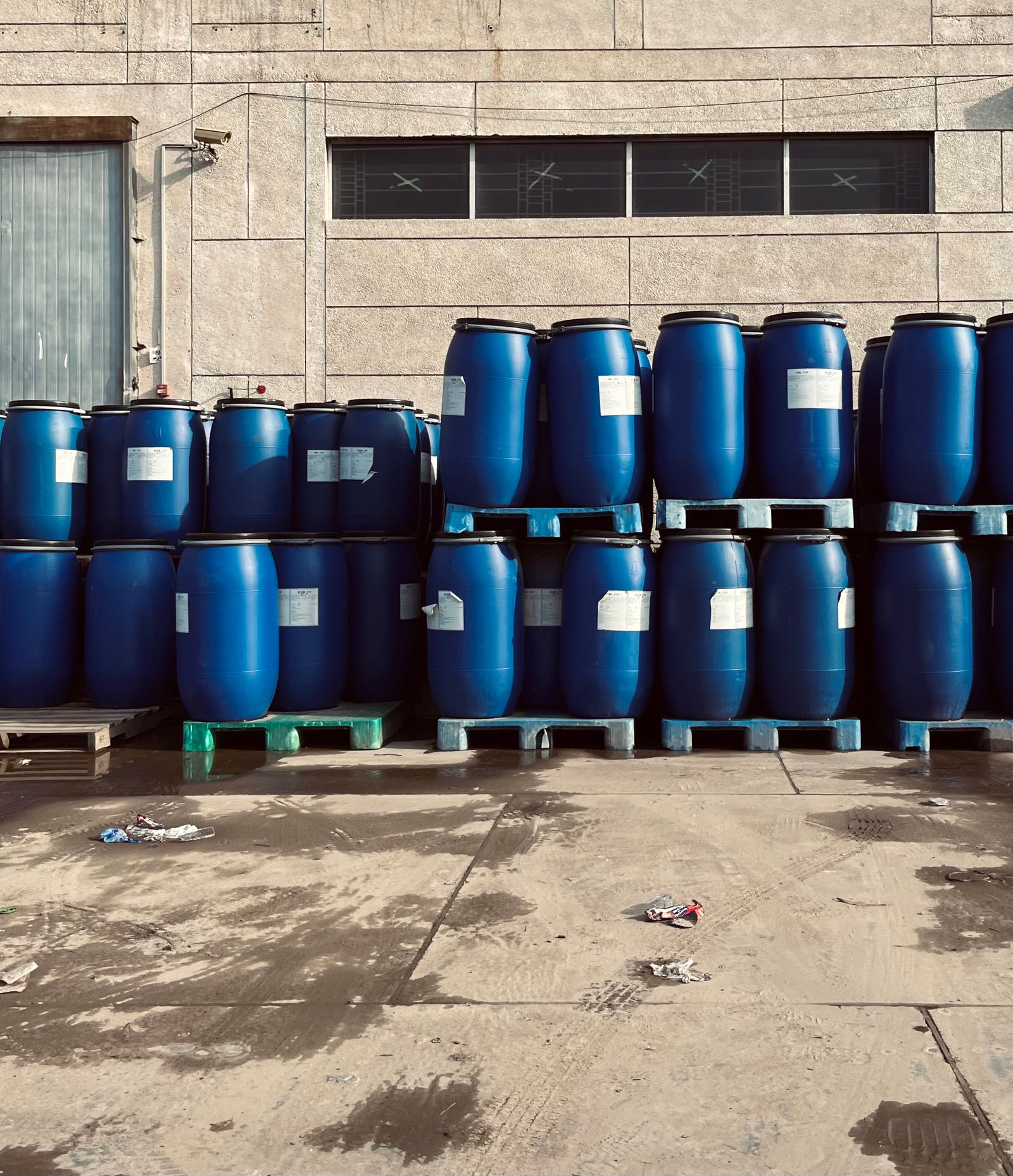
Store like you mean it. Drums go upright, on pallets or racking, off bare ground where possible, with labels facing out and legible — Mobil's storage guidance stresses that careless handling smudges and tears labels, and an unlabeled drum is tomorrow's identification problem. Keep lids and bungs closed; contamination of contents by moisture and dust is the quiet failure mode of drum storage. Hazardous and flammable contents bring their own storage rules — containment sizing, separation, bonding and grounding when dispensing flammables under OSHA 1910.106 — and your fire code and insurer have views as well. Do not stack beyond what the drums and your setup are rated for, and keep aisles clear enough to get a hand truck to any drum without moving three others.
Deal with the empties. An "empty" drum that held hazardous material still carries residue and, until it meets the federal definition of empty (49 CFR 173.29 — all material removed that can be removed by normal means, with tight residual limits), it is still regulated for transport. Decide the empties' route now: return to supplier, reconditioner, or scrap — each wants the drums in a particular state, and all of them want the labels question answered honestly.
Photograph the set. Before the first drum moves, take a dated photo of each drum's label and UN mark, and one of the full set as staged. It takes five minutes, costs nothing, and settles most later arguments about what was shipped, in what condition, and in which drum.
File the paperwork. Closure records, shipping papers, the signed delivery inspection, and any incident notes. If anything leaked, however small, write down what, where, and what you did — that note is what turns a future question into a short conversation.
If you are hiring this out rather than doing it in-house, the same three phases are your checklist for vetting the help: a carrier or mover who asks about contents, drum types, and closure instructions in the first conversation is one who has done this before. This site lists 232 barrels and drums services — ask yours how they handle a drum that turns out to be leaking on the day, and judge them on whether the answer involves a salvage drum or a shrug.
Sources
- CustomMHS, Drum & Cylinder Handling Buyer's Guide — drum weights (55 gallons of water ≈ 459 lb; full steel drum near 500 lb; denser products past 550 lb), drum types and grip compatibility, equipment capacities, EPA containment sizing under 40 CFR 264.175.
- Metal Fusion Pro, drum hand truck safety guide — pre-move drum and truck inspection, center-of-gravity and tipping rules, and why a leaking drum is not moved.
- Mobil, Handling & Storing Lubricants — full drum weight around 450 lb, unloading by liftgate/hoist/skids with brakes set and wheels chocked, forklift jaw adapters, rolling on chimes, and label protection in storage.
- Skolnik Industries, closure instruction guidance — bolt-ring closure torque (55–60 ft-lbs) applied with a calibrated torque wrench under 49 CFR 178.2(c), and inspector expectations.
- U.S. DOT / PHMSA, 49 CFR 173.22, 173.29, 178.2 and interpretation 00-0247 — shipper duty to close UN packagings per manufacturer instructions; the regulatory definition of an empty drum.
- PHMSA Notices of Probable Violation (2025) — enforcement against shippers whose drums were not closed per closure instructions.
Photos
- Photo by Conrad Marshall, https://www.pexels.com/photo/615670/
- Photo by Martin Zapata, https://www.pexels.com/photo/20379378/
- Photo by Ghasiq Anjum, https://www.pexels.com/photo/12845179/
More guides
- How to Hire a Moving Company That Won't Hold Your Furniture HostageMovers › Moving & Storage
- How Much Do Movers Cost? Local vs. Long-Distance Pricing ExplainedMovers › Moving & Storage
- Binding vs. Non-Binding Estimates: The Difference That Decides Your Final BillMovers › Moving & Storage
- Moving Insurance and Valuation: What 'Full Value Protection' Really CoversMovers › Moving & Storage
- Long-Distance Moving: A Start-to-Finish Guide for Household GoodsMovers › Household Goods Moving & Storage
- All Guides & ArticlesBrowse the full guides library