Movers › Mini & Self Storage
Mini and Self Storage by Season: When to Book, When to Wait, and What Timing Changes
If you are downsizing — selling the house, sorting a lifetime of furniture, deciding what goes to the children, what goes to charity, and what genuinely cannot be decided yet — storage is rarely the plan. It is the pause button. And pause buttons, in this industry, are rented by the month, with no fixed term and no fixed price.
That is why timing matters more for storage than for almost any other part of a move. Self storage follows the moving calendar with unusual fidelity: demand surges in late spring and summer, softens in autumn, and bottoms out in winter. The same unit, on the same corridor, can be scarce and full-priced in June and discounted in January. But the seasonal story has a second, less honest chapter that I hear about in complaints again and again: the cheap month is often a promotion, and promotions end. This guide covers both — when the calendar genuinely works for you, and how to tell a seasonal bargain from a teaser rate designed to be replaced.
The calendar, in one view
The pattern is consistent across industry data. SpareFoot's analysis of its reservation data found June was the busiest month for storage reservations in 2025, accounting for 13.7 percent of national demand, with May and August close behind at about 10.8 percent each. January through March, by contrast, consistently show lower reservation activity — which usually means more availability and softer pricing. Industry occupancy analyses tell the same story from the operator's side: peak leasing runs roughly May to August, move-ins build from March, physical occupancy often tops out in August or September, and December is typically the lowest occupancy point of the year.
| Season | What the market is doing | What it means for you |
|---|---|---|
| Late winter (Jan–Mar) | Slowest leasing; facilities competing for move-ins | Best choice of units, most promotions, most negotiating room |
| Spring (Apr–May) | Demand building; college move-outs and home sales stack up | Book early in this window if you need summer storage |
| Summer (Jun–Aug) | Peak moving season; June is the single busiest month | Scarcest availability, firmest prices, popular sizes go first |
| Early autumn (Sep–Oct) | Leasing cools but occupancy is still near its peak | Prices soften at the edges; good units free up as summer tenants leave |
| Late autumn–winter (Nov–Dec) | Weakest demand; December is the occupancy low | Promotions return; a good moment to start — or to move units |
Two qualifications matter. First, seasonality is local: storage demand is decided within a few miles of a facility — industry analysts put the typical trade area at a 3-to-5-mile radius — and a college town or military base can run its own calendar. Second, occupancy lags leasing: a facility can be nearly full in October even though hardly anyone new is arriving. Ask about the waitlist and month-end turnover.
Why summer costs more — and what exactly you lose
In peak season you do not just pay more. You lose three specific things.
Choice of size. The sizes downsizers need most are the sizes everyone needs. Nationally, the small units have been gaining share — SpareFoot found the 5×5 became the most popular size in 2025, at 32.8 percent of reservations, up from 27.9 percent in 2024 — which reflects exactly your situation: apartment moves, in-between leases, and downsizing overflow. In June, the 5×5 and 5×10 on the ground floor, near the elevator, are the first to go. What remains is the same square footage up a lift or down a long corridor, which matters more when the person carrying boxes is you.
Choice of facility. Storage is a proximity product. In winter you can usually rent within a short drive of the house you are leaving or the flat you are moving to. In summer you may be offered space across town, and every visit — and downsizing storage involves many visits — becomes an expedition.
Negotiating room. Discounts fade when demand is healthy; that is the industry's own diagnostic. A facility holding a waiting list does not offer first-month-free. A facility at winter occupancy, trying to fill corridors before spring, very often does.
None of this means a summer move is a mistake. Houses sell when they sell, and completion dates are not chosen for storage economics. It means that if your move must happen in summer, book the unit in spring — April or early May, before the June peak — and accept a few weeks of overlap rent as the price of choice. On a small unit, a month of overlap is usually cheaper than a summer of the wrong unit in the wrong place.
The prices underneath the seasons
Season moves prices within a range; size and climate control set the range itself. Recent national averages, gathered from operator pricing guides published for 2026, cluster tightly:
| Unit | Standard, per month | Climate-controlled, per month | Roughly holds |
|---|---|---|---|
| 5×5 | about $47–$53 | higher; varies by market | Boxes, seasonal items, a closet's worth |
| 5×10 | about $74 | about $82 | A small room's furniture and boxes |
| 10×10 | about $115–$123 | about $124–$137 | One-to-two-bedroom home's core contents |
| 10×20 | about $193–$207 | substantially higher | A house's contents during a gap between homes |
Treat these as orientation, not quotes. Storage pricing is hyper-local: published city tables show a 10×10 in Los Angeles at over $200 a month against national averages near $120. Climate control typically adds roughly 15–30 percent; SpareFoot's trend data put climate-controlled units at about $9 a month more than standard on average in 2025, with the gap widening in warmer months. For a downsizer storing wooden furniture, photographs, documents, books, and electronics through a summer, that premium is often the most defensible money in the whole arrangement — heat and humidity do quietly, over months, what a bad mover does in an afternoon. For garden tools and plastic tubs, it is money for nothing.
Budget, too, for the charges around the rent: a one-time administration fee commonly around $10–$25, a lock, and — at many facilities — a monthly insurance or protection-plan charge that can run from under $10 to nearly $40 depending on the cover level. Ask for the all-in monthly figure, in writing, before you compare facilities. Comparing headline rents is how the complaints I read begin.
The complaint file: teaser rates and the increase that follows
Now the part of the seasonal story that is not about seasons at all.
Self-storage leases are month-to-month. That flexibility is sold as a benefit to you, and it is — you can leave whenever the house sale completes or the sorting is finally done. But it also means the operator can raise your rent, on notice, in almost any month. The industry has a term for the practice: existing-customer rate increases, or ECRIs. Trade-press analysis of the sector describes the modern model plainly: operators compete for move-ins with aggressive promotions — first month free, first month for $1, 50 percent off for one to three months, web-only rates discounted by anywhere from 25 to as much as 80 percent in some markets — and then recover the margin with larger increases once tenants are in place, on the reasonable assumption that most people will not move a unit full of furniture to save a modest sum each month.
The numbers behind that description are striking. Inside Self-Storage's analysis of operator data reported that in the fourth quarter of 2024, Public Storage's average in-place rate — what existing tenants actually pay — was 74 percent higher than its average move-in rate. One operator executive quoted in the same trade coverage described the trap from the tenant's side: a unit displayed at a $50 web rate can rise to $100 or even $150 after about 90 days, when the promotional period ends.
This interacts with the seasons in a way worth understanding before you sign:
- A winter promotion that expires in spring hands you the full street rate exactly when street rates firm up. The "winter bargain" can cost more over six months than renting at an honest rate in March.
- A summer move-in at full price is at least a known price — but expect the first increase notice a few months in, often landing in autumn, when operators know you are least likely to face moving everything again before winter.
- Length of stay is the multiplier. Industry data put the average stay at around 19 months and lengthening. Every increase compounds across a stay that long. A $20 monthly increase in month four is not $20; over the remaining year and a half of a typical stay, it is several hundred dollars.
None of this is illegal, and none of it is hidden, exactly — it is in the rental agreement, in the fine print about promotional periods and rate changes. The protection is arithmetic, done before you move in: ask what the rate becomes when the promotion ends, ask when the facility last raised rates on existing tenants and by how much, and price the unit over the number of months you honestly expect to stay — not over the first month. If you expect six months, compare six-month totals. Facilities that answer those questions clearly exist, and the asking itself tells you which kind you are dealing with.

A downsizer's timing playbook
For seniors leaving a larger home, the calendar usually offers more flexibility than a job move or a lease end — and the playbook is mostly about using it.
If the house sale is flexible, store in winter, move in spring. Rent the unit in January or February, when choice and promotions peak, and move things in gradually, in daylight, in your own time, over weeks. Gradual move-ins are the great unpriced advantage of downsizing over every other kind of move: no single exhausting day, no crew waiting, and time to discover that a third of what you planned to store does not need storing at all.
Right-size ruthlessly before you price-shop. At national averages, six months in a 5×10 costs roughly $444 in base rent against roughly $714–$738 for a 10×10. The difference between those units is usually one honest weekend of decisions. No promotion in any season pays as reliably as renting less space.
Match the unit to the visit pattern, not just the contents. You will be back — for documents, for the good china at holidays, for things a daughter decides she does want. A slightly cheaper unit at the far end of a top-floor corridor is expensive in effort every single visit. In winter, when facilities are competing, the accessible unit and the cheap unit are often the same unit. That coincidence is the real seasonal bargain.
Set a review date, and keep it. Storage drifts. Put a date in the calendar three months out to re-ask the only question that matters — does this still need storing? — and a second date to check what you are actually paying against what you signed at. If the rate has jumped, call before you haul: operators will sometimes moderate an increase for a tenant who is plainly prepared to leave, because an occupied unit at a lower rate beats an empty one at a theoretical rate. That negotiation, like the unit itself, works best in the off-season.
Read the lien and late terms before you need them. Every state has a self-storage lien law under which a facility can, after default and notice, sell a unit's contents. Keep the payment method current, keep your contact details updated — especially if you are between addresses, which downsizers by definition are — and make sure a family member knows where the unit is and what the gate code is.
When waiting is the wrong call
Seasonal advice cuts both ways, and an honest guide should say when not to follow it. Do not leave a house's contents in a house you no longer own to chase a January rate. Do not store through a hot summer in a standard unit to save the climate-control premium if what is stored is a piano, photographs, or leather and wood furniture — the saving is small and the damage is permanent. And do not book the distant facility in peak season purely because it has space, if the nearer one has a waitlist measured in weeks: for a stay measured in months or years, a short wait for the right place beats a long tenancy in the wrong one.
This site's directory lists 2,753 mini and self storage listings under the Movers category alone, alongside thousands more under Storage — the choice, in most towns, is real. Use the calendar to make that choice at the moment the market is working for you: book in the quiet months, price the whole stay rather than the first month, and treat any rate that sounds too good for the season as what it usually is — an introduction, not a price.

Sources
- SpareFoot, "2026 Moving Trends: Where & When People Are Moving" — June 2025 was the busiest storage reservation month at 13.7% of national demand; May and August about 10.8% each; January–March consistently lower; 5×5 the most popular size at 32.8% of 2025 reservations; climate-controlled units about $9/month above standard on average in 2025; national occupancy 76.9% and average stay 19.3 months (Storable Industry Pulse, Q1 2026, as reported there). https://www.sparefoot.com/blog/2026-moving-trends
- Oakside Companies, "Seasonal Occupancy Trends in U.S. Self-Storage" — peak leasing May–August; occupancy often tops out August–September; slowest rentals December–February; promotions commoner and street rates softer in late autumn. https://www.oaksideco.com/seasonal-occupancy-trends-us-self-storage
- MMCG Invest, "Self-Storage: Micro-Market Demand, Seasonal Occupancy" — demand decided within a 3–5 mile radius; peak leasing May–August; December typically the lowest occupancy point. https://www.mmcginvest.com/post/micro-market-demand-and-seasonal-occupancy-trends-in-u-s-self-storage
- Neighbor, "10×10 Storage Unit: Cost, Capacity, and When to Size Up" — standard 10×10 averages $120/month nationally, climate-controlled $137; administration fees about $10–$25; insurance about $8–$38/month. https://www.neighbor.com/storage-blog/10x10-storage-unit-guide/
- Extra Space Storage, "Storage Unit Pricing Guide" (2026) — 10×10 averages $115 standard / $124 climate-controlled; climate control typically 20–30% above standard; city-level price tables. https://www.extraspace.com/blog/self-storage/how-much-do-storage-units-cost/
- Public Storage, "The Complete Guide to Storage Unit Prices in 2026" — most popular sizes 5×5 ($47), 5×10 ($74), 10×10 ($123), 10×20 ($207). https://www.publicstorage.com/blog/public-storage/the-complete-guide-to-storage-unit-prices-in-2026.html
- Inside Self-Storage, "The ECRI Evolution" — existing-customer rate increases as the industry's revenue model; move-in promotions ($1 move-in, first month free, 50% off); Public Storage's Q4 2024 in-place rate 74% above its move-in rate. https://www.insideselfstorage.com/revenue-management/the-ecri-evolution-modern-self-storage-rate-management-and-its-impact-on-asset-revenue-value-and-underwriting
- Inside Self-Storage, "How to Safely Use Self-Storage Discounts and Specials" — common promotions (first month free, 50% off for one to three months, $1 first month); web discounts of 25% to as high as 80% in some markets; the $50 web rate rising to $100–$150 after about 90 days, as described by a multi-facility operator quoted there. https://www.insideselfstorage.com/revenue-management/death-by-lost-dollar-how-to-use-self-storage-discounts-and-specials-so-they-do-your-business-and-the-industry-no-harm
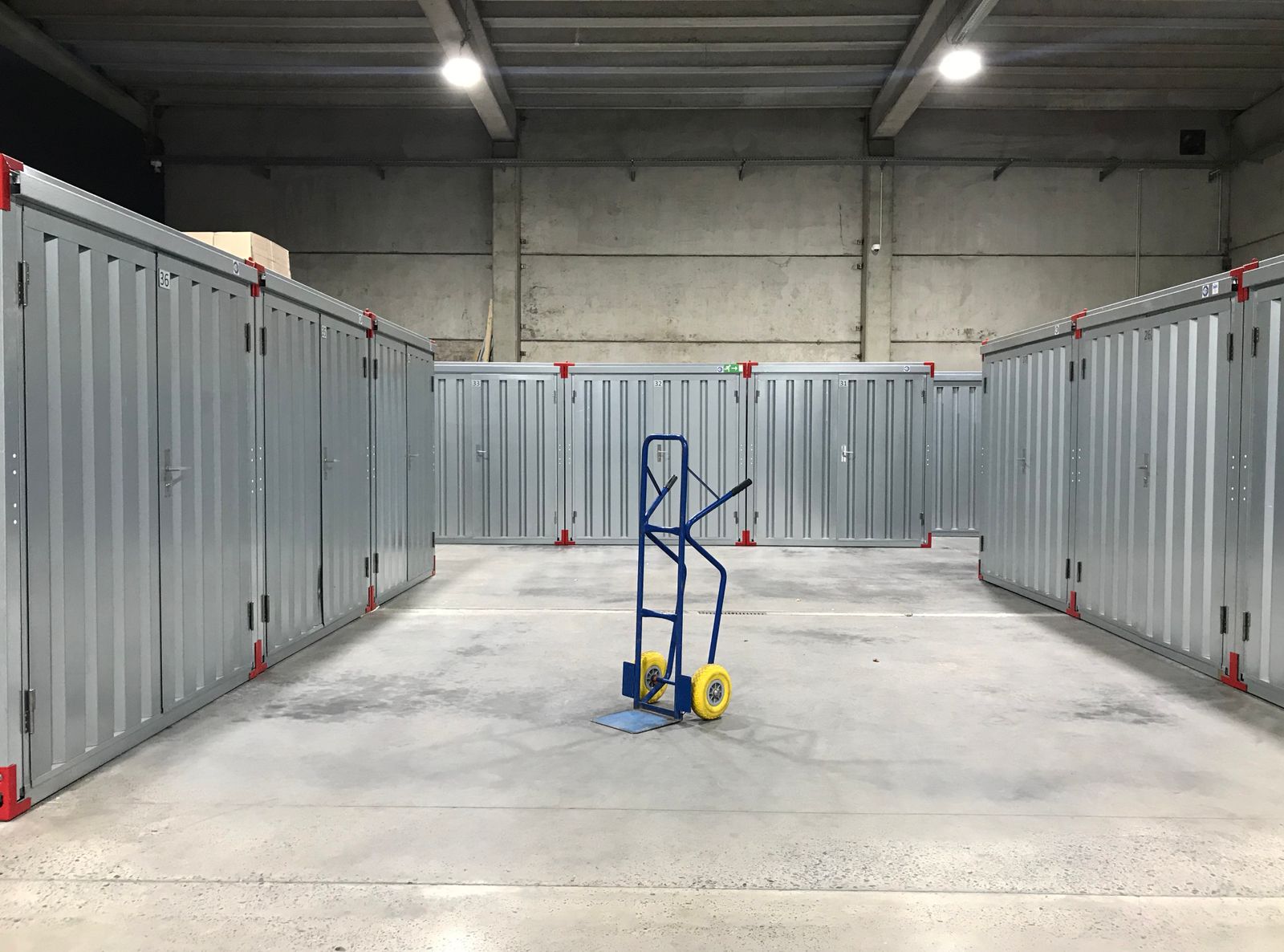
Photos: storage corridor — photo by David Slaager, https://www.pexels.com/photo/5759145/ ; warehouse interior — photo by Tiger Lily, https://www.pexels.com/photo/4483610/ ; stacked boxes — photo by cottonbro studio, https://www.pexels.com/photo/4568693/ . All Pexels License, free to use.
More guides
- How to Hire a Moving Company That Won't Hold Your Furniture HostageMovers › Moving & Storage
- How Much Do Movers Cost? Local vs. Long-Distance Pricing ExplainedMovers › Moving & Storage
- Binding vs. Non-Binding Estimates: The Difference That Decides Your Final BillMovers › Moving & Storage
- Moving Insurance and Valuation: What 'Full Value Protection' Really CoversMovers › Moving & Storage
- Long-Distance Moving: A Start-to-Finish Guide for Household GoodsMovers › Household Goods Moving & Storage
- All Guides & ArticlesBrowse the full guides library