Movers › Moving Equipment & Supplies Rental
Moving Equipment and Supplies Rental for Small Businesses: What Changes When It Is Not Personal
A household move forgives improvisation. If you run out of furniture pads, you use blankets. If the dolly is late, a neighbor lends one. A small business move does not forgive any of that, because the equipment is not moving couches — it is moving the means of making money, on a deadline set by a lease, a landlord, and customers who do not care that your stockroom is in boxes.
I have coordinated relocations where the rental counter was the whole project. Get the right dollies, pallet jacks, and truck, in the right numbers, for the right number of days, and an ordinary crew finishes on schedule. Get one of those wrong — too few pads, a hand truck rated for half the load, a forklift nobody on site is qualified to run — and you pay for the mistake three times: in extra rental days, in damaged inventory, and in days the business cannot open.
This guide is about what actually changes when the renter is a business: the volumes, the contracts, the tax treatment, and the service level you should expect — and demand — in writing.
The inventory is different, and so is the math
A household rents a handful of items. A business rents a system. Start by walking the premises the way a rental counter thinks: everything that rolls, lifts, protects, or contains.
Rolling stock is the core. A standard two-wheel hand truck rents for about $10 to $25 a day at home-improvement and truck-rental counters, with appliance dollies in a similar band and furniture dollies around $10 to $12 a day. Those are consumer numbers for one or two units. A business moving a stockroom, a small warehouse, or a retail back room should be thinking in multiples: four to six hand trucks so nobody waits, two appliance dollies for the heavy and awkward pieces, and flat furniture dollies under anything that will be staged before it is loaded.
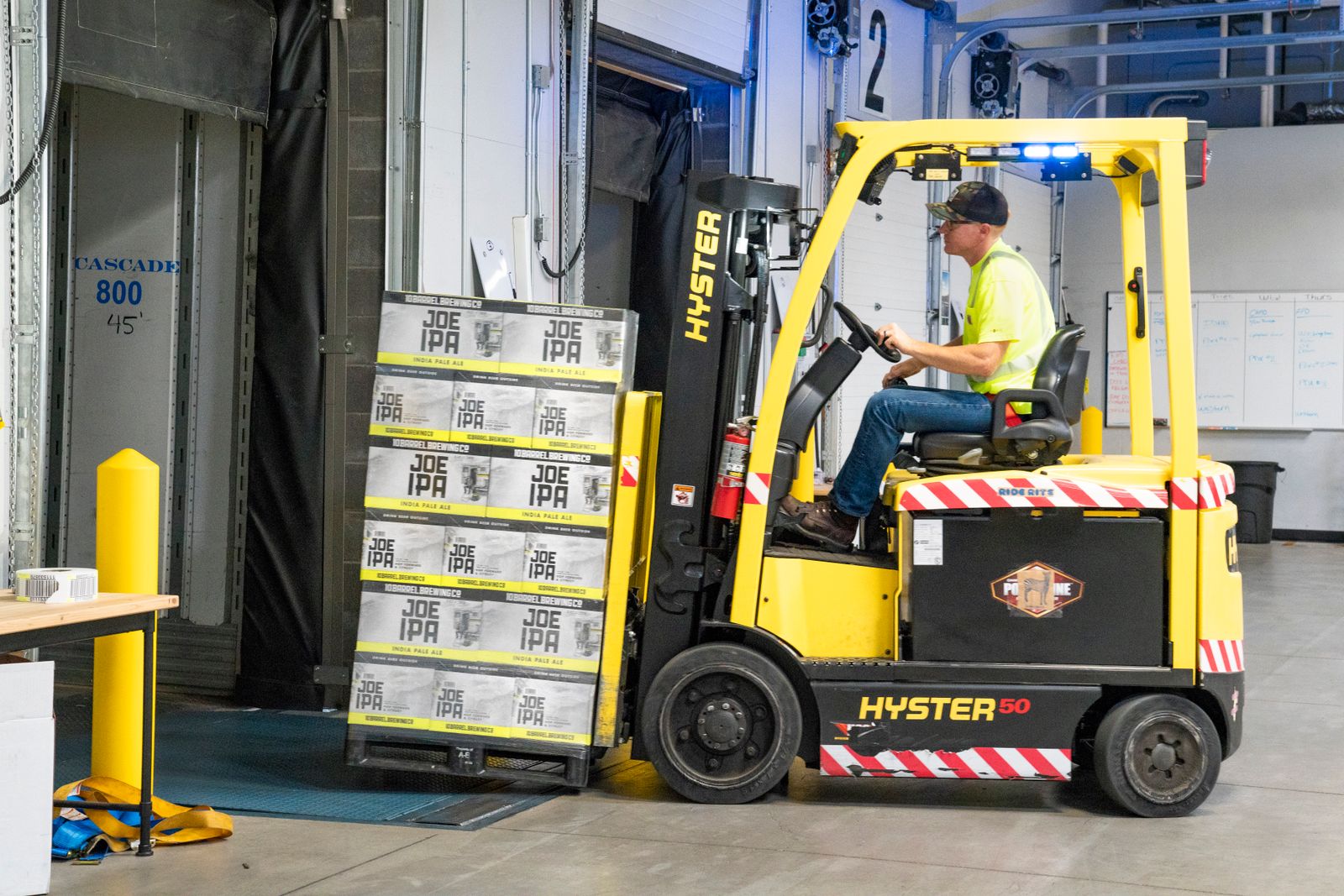
Pallet equipment is where business rental leaves the household world entirely. A manual pallet jack is a modest rental; a powered pallet jack runs roughly $50 to $150 a day, $150 to $400 a week, and $500 to $1,200 a month in current rental guides. A standard 5,000-pound warehouse forklift rents for roughly $150 to $350 a day, $500 to $850 a week, and $1,500 to $2,500 a month. Buying that same forklift new is a $20,000 to $70,000 decision. For a move that needs a forklift for four days, rental is not a compromise. It is the obvious answer.
Protection and containment is the line item businesses under-order most. Furniture pads rent by the dozen, commonly $10 to $15 per dozen per rental period, and a business should count pads per piece of furniture and per stack of inventory, not per room. Add stretch wrap, packing paper, and boxes bought in business quantities — wardrobe boxes at roughly $8 to $12 each are a household luxury; for a business, the equivalent spend is on uniform small-parts boxes, file boxes that stack, and labels that survive handling.

What the rental actually costs a business
| Item | Typical rental | Business note |
|---|---|---|
| Hand truck | $10–$25/day | Rent 4–6 for a stockroom move; deposits $25–$100 per counter transaction |
| Appliance / furniture dolly | $10–$15/day | Rate is per unit, per day — late returns multiply fast |
| Furniture pads | $10–$15 per dozen | Count per piece and per stack, not per room |
| Powered pallet jack | $50–$150/day; $500–$1,200/month | Weekly rate usually beats five daily rates |
| Forklift, 5,000 lb | $150–$350/day; $1,500–$2,500/month | Delivery, pickup, and operator are separate questions |
| Box truck, local | From $19.95/day plus mileage | Business use, mileage, and extra days change the quote |
Two pricing habits separate business rental from personal rental. The first is duration structure: daily, weekly, and monthly rates are not simple multiples. A weekly forklift rate of $500 to $850 can cost less than four daily rentals, and a monthly powered pallet jack can cost less than three weeks billed weekly. If your move might slip — and business moves slip when inspections, internet installs, or certificate-of-occupancy paperwork slip — price the longer period up front and ask what an early return credits you.
The second is the extras that are not extras. Delivery and pickup of heavy equipment, damage waivers, cleaning fees, fuel or charging, and extra days all sit outside the headline rate. On truck rentals, the comparison is instructive: one major comparison puts an extra one-way day at $100 with one national company and $40 for a truck and $20 for trailers and towing equipment with another. For a business, an extra day is rarely optional — it is the day the new premises were not ready — so negotiate it before you sign, not from the loading dock.
Contracts: the business version has teeth
A household rental agreement is a page. A business rental is a commercial contract, and four clauses deserve a slow read.
Who may operate the equipment. Forklifts are the sharp end. A rented forklift delivered to your site does not come with permission for anyone to drive it; your business is responsible for using trained, authorized operators and for what happens if it does not. If nobody on your team is qualified, rent the equipment with an operator — rental guides put an operator at roughly $55 to $110 an hour on top of the equipment rate — or hire the lifting as a service instead of renting the machine.
Damage, loss, and the waiver. Consumer renters click past the damage waiver. Businesses should not. Price what the waiver covers, what it excludes, and what your own commercial insurance already covers, because paying for duplicate protection across a dozen line items is real money, and discovering a gap after a pallet jack goes through a wall is worse. Photograph every piece of equipment at pickup and return, with timestamps. That habit, borrowed from corporate relocation work, settles most condition disputes before they start.
Volume and account terms. If your business rents more than twice a year — seasonal inventory moves, event work, deliveries — ask for a commercial account. National rental companies run business programs with negotiated rates, centralized billing, and priority availability in peak season. The consumer counter in late May, when every household in town wants the same truck, is the worst place for a business with a lease deadline to be standing.
Return discipline. Business rentals fail at the return, not the pickup. Equipment scattered across two sites, pads left at the old premises, a pallet jack locked inside a building you no longer have keys to — each becomes extra days at daily rates. Assign one person to own the return list, and stage everything for collection the way you staged it for loading.
The tax treatment is genuinely different
This is the change personal movers never think about, and it is worth real money.
For individuals, the federal moving-expense deduction is suspended for everyone except active-duty military moving under orders, and that suspension has been made permanent; employer reimbursement for a personal move is now taxable wages. None of that applies to moving the business itself.
Moving existing business property — equipment, inventory, furniture, and supplies — from one business location to another is an ordinary and necessary business expense. Guidance summarizing IRS Publication 535 makes the key distinction plainly: the cost of moving your existing machinery and equipment to a new location is deductible now, while the cost of installing newly purchased equipment is capitalized into that equipment's basis and recovered through depreciation. Improvements to the new space — new walls, upgraded electrical, renovations — are also capitalized, not expensed as moving costs. Rental fees for trucks and equipment used to move existing business property sit on the deductible side of that line; keep them in a dedicated relocation account on your books, reported with other business expenses, rather than scattered across supplies and travel.
Three recordkeeping habits make that treatment defensible: keep the rental agreements and paid invoices with the move file, not in a general receipts pile; note on each invoice what was moved and between which addresses; and separate, on paper, any spending that mixed personal and business goods in the same truck. If an owner moves a home and a business in the same weekend — common for very small firms — the business share needs its own paper trail, because the personal share follows the suspended, military-only rules.
This is general information about how the categories work, not tax advice for your firm. A move with capitalized improvements, new equipment installs, and a lease termination in the same quarter is exactly the kind of file to walk through with your accountant before filing, not after.
Service levels: what a business should expect
A consumer accepts the truck that is on the lot. A business should contract for certainty.
Ask, in writing, about substitution: if the reserved forklift or truck is unavailable, what arrives instead, and who decides whether it is adequate? Ask about breakdown response: a dead pallet jack on load day is a schedule emergency, and commercial rental firms that serve businesses publish response commitments that consumer counters do not. Ask about delivery windows for heavy equipment — a forklift delivered at noon for a crew that starts at seven is half a day of wages burned. And ask about weekend and after-hours returns, because business moves happen disproportionately on weekends, when the business is closed, and a Monday return billed from Saturday is a contract term, not a surprise.
Availability is the other service issue. This site lists 4,321 moving listings, and the broader rental market behind them is deepest exactly when you need it least and thinnest in late spring and at month-end. A business with a fixed lease date should reserve heavy equipment earlier than it reserves the truck: trucks are fungible, a specific-capacity forklift or a liftgate vehicle is not.
Rent, buy, or hire it done: the honest decision
Renting wins when the need is bounded: a relocation, a seasonal surge, a one-off warehouse reset. Buying wins when the same equipment works five days a week, year-round — rental guides make the same point about forklifts, where renting the same unit beyond roughly six to eight months usually costs more than owning. The third option is the one small businesses forget: hire the move as a service for the heavy or regulated parts, and rent only the simple rolling stock your own team can safely use. A hybrid — your staff on hand trucks and pads, professionals on the forklift and the safe — is how most well-run small relocations I have coordinated actually happened.
Price the whole system, not the headline item. Add the daily rates, the delivery, the waiver, the operator if you need one, the extra-day terms, and the tax-deductible treatment of the total, and compare that number against both a purchase and a full-service quote. The cheapest rental counter in town is expensive if it costs you a second weekend. The right rental, contracted properly, is the opposite: a business that closes on Friday in one address and opens on Monday in another, with the equipment already gone.
Sources
- U-Haul, moving truck rental price comparison — establishes local truck pricing structure, extra-day charges ($40 truck / $20 trailers with U-Haul vs. $100 with Penske), and equipment add-on pricing.
- Metal Fusion Pro, hand truck rental guide — establishes hand truck and appliance dolly rental sources and rates ($10–$25/day, deposits $25–$100).
- US Prime Movers, 2026 moving truck hire cost guide — establishes equipment rental ranges for dollies, pads, and hand trucks.
- ForkliftLift, 2026 forklift rental price guide — establishes forklift and powered pallet jack daily, weekly, and monthly rates and operator costs.
- Fyle, business moving expense categories summarizing IRS Publication 535 — establishes that moving existing business equipment is deductible now, while installing new equipment and improving new premises are capitalized.
-
Taxstra, moving expense deduction in 2026 — establishes that the personal federal moving deduction is suspended except for active-duty military and that business relocation follows different rules.
-
Warehouse aisle — photo by Tiger Lily, https://www.pexels.com/photo/4483610/
- Forklift moving boxes — photo by Tiger Lily, https://www.pexels.com/photo/4481459/
- Loading a van — https://www.pexels.com/photo/6169056/
More guides
- How to Hire a Moving Company That Won't Hold Your Furniture HostageMovers › Moving & Storage
- How Much Do Movers Cost? Local vs. Long-Distance Pricing ExplainedMovers › Moving & Storage
- Binding vs. Non-Binding Estimates: The Difference That Decides Your Final BillMovers › Moving & Storage
- Moving Insurance and Valuation: What 'Full Value Protection' Really CoversMovers › Moving & Storage
- Long-Distance Moving: A Start-to-Finish Guide for Household GoodsMovers › Household Goods Moving & Storage
- All Guides & ArticlesBrowse the full guides library