Movers › Packaging
Moving Packaging and Supplies Myths, Debunked: What People Believe vs. What Is Actually True
Packing supplies are the smallest budget in a move and the most mythologized. Families who will interrogate a mover's DOT number for an hour will pack a wedding's worth of glassware on the strength of something an uncle said in 2009. The complaint files tell the story: a remarkable share of self-pack damage traces not to carelessness but to a belief — about free boxes, big boxes, newspaper, tape — that sounds like thrift and behaves like sabotage.
So here is the myth list, tested one by one against published prices, working movers' guidance, and the physics of a loaded truck. Some myths turn out to be half-true, which is what makes them durable. None survives exactly as told.
Myth 1: "Free boxes are always the smart move"
Partly true, and the exceptions are the point. Free boxes are genuinely abundant: liquor stores hand over small, exceptionally sturdy cartons with dividers made for glass; grocery and big-box stores cycle cartons all day; U-Haul runs a Take a Box, Leave a Box shelf in more than 2,000 locations and an online box exchange; a three-bedroom move needs roughly 40–60 boxes that would cost $150–$300 new. For linens, toys, clothes, and books-in-small-boxes, free is smart.
The myth fails at the edges, and the edges are where damage lives. Damp, stained, or greasy boxes — produce and fast-food cartons are the repeat offenders — can carry moisture, odor, and pests into your load. A box whose walls flex or whose bottom is soft will fail under stacking weight in the truck, and a failed box costs more than a new one: whatever was inside it, plus the crew time spent repacking at hourly rates. Wildly mismatched sizes also slow a professional load, because crews stack uniform boxes fastest. The working rule from movers' own guides: cover most of the move with free boxes, and buy the specialty cartons new — double-wall dish packs, wardrobe boxes, TV and mirror boxes — because those protect the items whose replacement cost dwarfs the cardboard. Free is a strategy, not a religion.
Myth 2: "Bigger boxes mean fewer trips, so buy large"
False, and it is the most physically expensive myth on this list. A box does not know what is in it; your back and the box's seams find out together. Standard guidance exists for a reason: small boxes (about 1.5 cubic feet) for books, tools, and dense items; medium (about 3 cubic feet) for general household goods; large (4.5 cubic feet and up) strictly for light, bulky things — bedding, pillows, lampshades. A large box filled with books can pass 70 pounds, which is how boxes burst on stairs and how amateur movers get hurt. Price is not the obstacle people imagine: published U-Haul starting prices run about $1.39 for a small box, $2.04 for a medium, $2.48 for a large, and $3.49 for an extra-large. The two-dollar difference between sizes is not savings; the mix of sizes is the system. Buy the spread, fill each size with what it is for.
Myth 3: "Newspaper is fine for wrapping dishes"
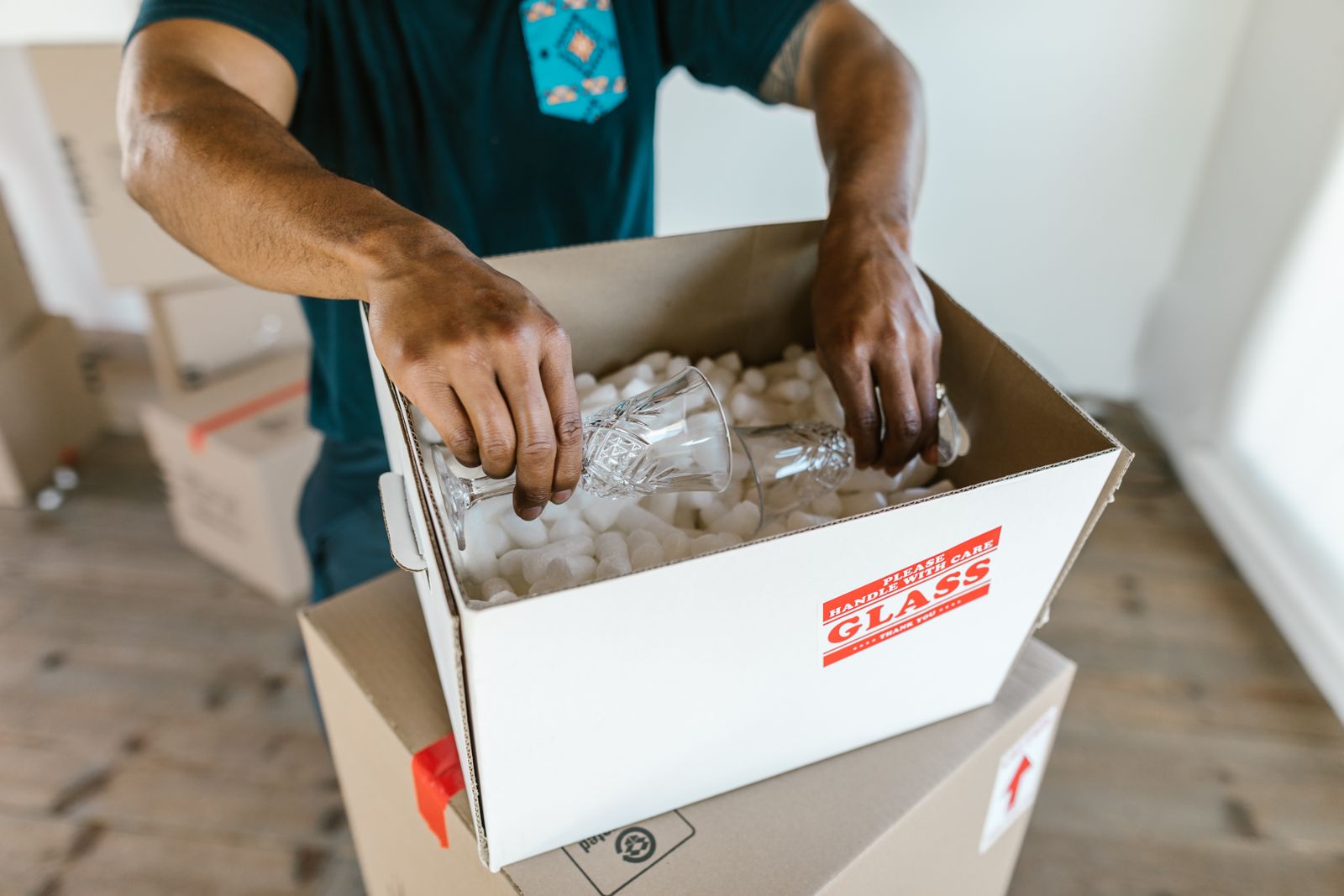
Half-true, with an ink-stained catch. Newsprint cushions adequately, which is why your grandparents' china survived. What it also does is transfer ink onto porous surfaces — china, unglazed ceramics, light plastics — leaving you a washing project at the far end and, on some finishes, a permanent souvenir. Clean packing paper exists precisely to solve this: it is unprinted newsprint, sold in bundles (one supplier lists 200 sheets at about $19.99; professional bundles run larger), and it is the workhorse material in real packing kits. The related myth — that bubble wrap should wrap everything — fails in the opposite direction. Bubble cushion is for the genuinely fragile and the high-value: stemware, electronics, art. Wrapping every mug and book in it burns money and time; published supply budgets put total materials for a move at roughly $180 for a one-bedroom home to $750 for three bedrooms when a packing company supplies them, and bubble-wrapping the universe is how a self-packer lands at the top of that range with nothing to show for it. Paper for the many, bubbles for the few.
Myth 4: "The movers bring all the supplies — and they're included"
Usually false, in two separate ways. When professional packers supply materials, the materials are a priced line, not a courtesy: HomeAdvisor's cost data puts packing materials supplied by a packing company in the $180–$750 range by home size, notes that companies commonly upcharge on them, and itemizes the going rates — wardrobe and dish boxes around $13–$15 each in its table, TV and picture boxes higher. When you hire movers for labor and transport only, supplies are typically yours to provide unless the contract says otherwise. The myth's damage is procedural: a crew that arrives to a house with no boxes, no paper, and no tape does not shrug and produce them free; it either packs with what it has at retail-plus prices, or waits — at the crew's hourly rate — while someone drives to a store. Read the estimate for the words "materials included" and a number next to them. If the number is absent, so is the inclusion.
Myth 5: "Any tape works if you use enough of it"
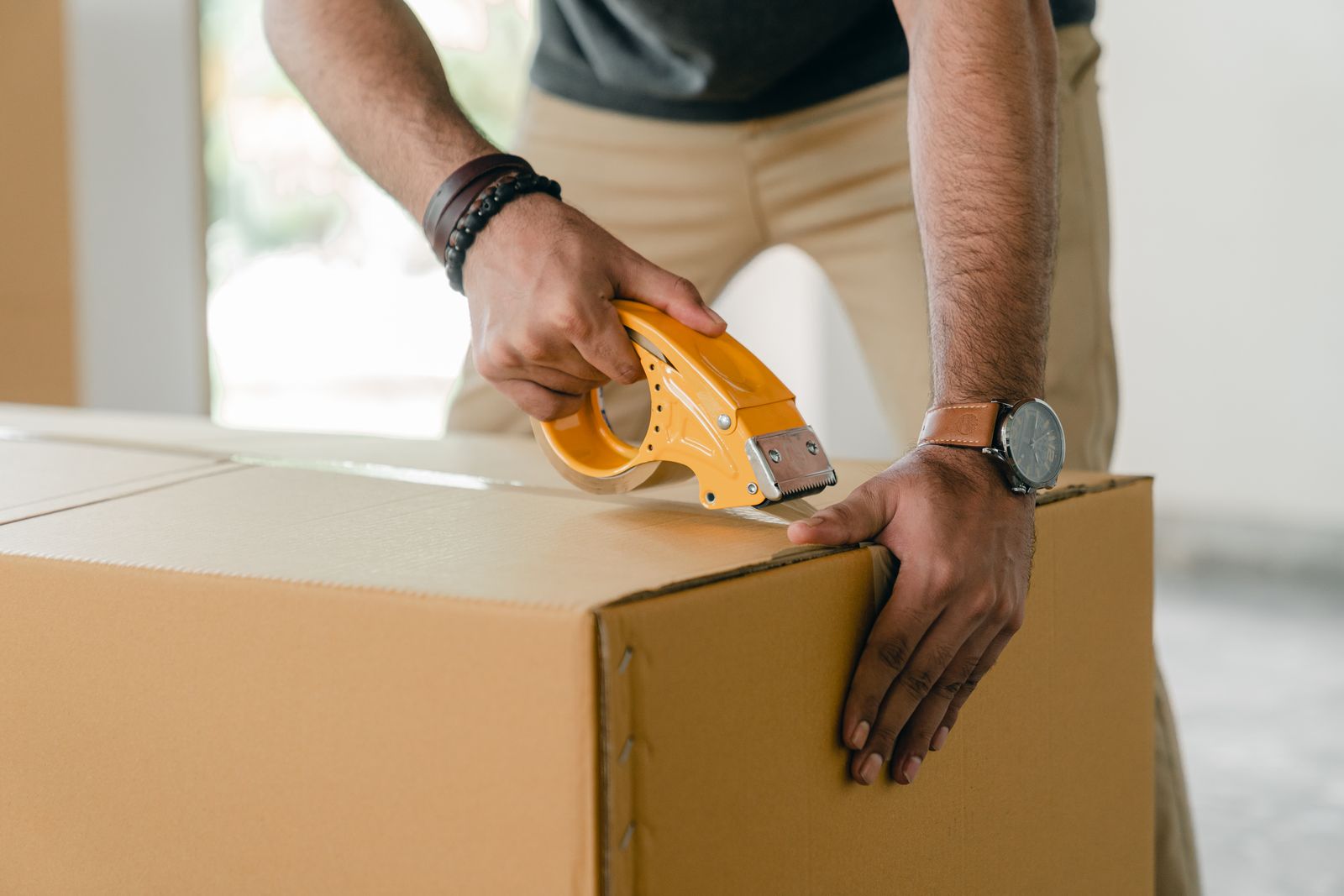
False, and visibly so on every failed box bottom. Packing tape is formulated for cardboard: it grips corrugated fiberboard and holds under load and temperature swings. Masking tape dries out and lets go; duct tape, the household hero, adheres poorly to dusty cardboard and its adhesive softens in a hot truck — the two environments a moving box is guaranteed to meet. Technique matters as much as product: the bottom of a loaded box wants the center seam plus the edges (the "H" pattern), not a single strip down the middle, and tape is cheap enough that this is no place to economize — a 55-yard roll of paper packing tape lists around $7.25, and ordinary packing tape runs a few dollars a roll. The myth survives because tape failure is delayed: the box holds in your living room and lets go on the stairs, in the truck, in front of witnesses.
Myth 6: "Those free USPS boxes are perfect for packing"
False, and it is the one myth on this list with a rule attached. Priority Mail boxes are supplied free for one purpose: shipping via Priority Mail. The Postal Service's own terms say so, and the boxes are sized for parcels, not households. The same applies to UPS's free supplies. This is not a victimless shortcut that experienced movers wink at; it is misuse of a federal service's materials, and it solves a problem that liquor stores, grocery stores, and box exchanges already solve legally and better. Cross it off the list your uncle gave you.
Myth 7: "Specialty boxes are a racket"
Mostly false — with one honest exception. The racket theory dies on the price list. A dish pack is a double-wall box, materially stronger than a standard carton, listing around $8–$11 in current published prices; a wardrobe box at $14–$24 sounds steep until you price re-ironing or dry-cleaning a closet, or simply count the packing time it deletes — clothes travel on their hangers, closet to closet. TV boxes with foam protection run higher still, against the replacement cost of the screen they protect. The honest exception: you do not need a specialty box for everything, and kits that bundle a specialty carton for every category are selling comfort, not protection. Dishes, glassware, the TV, mirrors and art, and hanging clothes earn their cartons. Everything else travels perfectly well in standard boxes of the right size — which is Myth 2's lesson wearing a different hat.
Myth 8: "You can estimate supplies by guessing — everyone does"
False, and the easiest myth to replace with arithmetic. Box counts by home size are published planning ranges, not mysteries: roughly 15–25 boxes for a studio or one-bedroom, 25–40 for two bedrooms, 40–60 for three, 60–100 or more for four-plus — plus about 15 percent over your estimate, because running out of boxes the night before the move is the classic, entirely preventable moving-eve crisis. Tape, paper, and markers scale with the box count. The families in the complaint files who "just guessed" are recognizable by the last-minute retail run in their story, priced at whatever the nearest store charges a captive customer at 9 p.m.
Myth 9: "Renting plastic bins is always greener, cheaper, and better"
Sometimes true, never automatic. Rented plastic bins arrive clean, uniform, stackable, and tape-free, and they leave on schedule — a genuine service for a local move between two addresses with firm dates. The myths are in the absolutes. Cheaper? Bin rental is priced per week, so a move that slips — a closing delay, a lease gap, a container that sits in a driveway for a month — can quietly outrun the cost of the cardboard it replaced, and bins cannot be kept, cut down, or given away when the plan changes. Better? Bins come in one or two sizes, which reintroduces Myth 2 in plastic: dense loads in a big bin are heavy loads. Greener? Reusable beats disposable only when the rental company's logistics actually reuse them locally at scale; a bin delivered by a dedicated van making two extra trips for your household is a more complicated ledger than the brochure suggests. And bins solve none of the fragile-item problem — the dish pack, the TV box, and the packing paper are still on your list. Choose bins for a dated, local, two-address move. Choose cardboard for gaps, storage, long distances, and any plan you suspect might change, because cardboard forgives a changed plan and a weekly rental clock does not.
What is actually true, in one list
- Free boxes: yes for most of the load, no for damp or damaged cartons, and buy the fragile-item specialties new.
- Box size is a weight system: small for dense, large for light, no exceptions for optimism.
- Clean packing paper for dishes; bubble cushion reserved for the genuinely fragile.
- Materials are a priced line unless your contract says "included" with a number.
- Packing tape, H-pattern, both ends. No substitutes.
- Priority Mail boxes are for Priority Mail.
- Specialty boxes earn their price for dishes, glass, screens, art, and hanging clothes — and only there.
- Count first, buy once, add 15 percent.
Movers-Map's directory includes 234 Packaging listings alongside its moving companies — suppliers exist at every price point, and the honest total for a self-packed family move is usually a few hundred dollars, not the fortune of myth and not the zero of legend either. Pack on facts and the cardboard stops being the risky part of your move.
Sources
- MovingExperts, "Where to Get Free Moving Boxes: 15 Proven Sources (2026)" — free-box sources and quality limits, box counts by home size (40–60 for three bedrooms at $150–$300 new), the 15-percent overage rule, and buying dish-pack, wardrobe, and TV boxes new: https://movingexperts.com/where-to-get-free-moving-boxes-15-proven-sources-2026/
- Ace Moving Co., "How Much Do Moving Boxes Cost? 2026 Box Prices" — U-Haul published starting prices (small $1.39, medium $2.04, large $2.48, extra-large $3.49) and wardrobe box prices up to $21.50: https://acemovingco.com/blog/how-much-do-moving-boxes-cost/
- HomeAdvisor, "How Much Do Packers and Movers Cost in 2026?" — packing materials at $180–$750 when supplied by a packing company, with per-unit prices for boxes, paper, bubble wrap, and tape: https://www.homeadvisor.com/cost/storage-and-organization/packing-unpacking-service/
- MoversLineup, "Moving Supplies: Paper, Bubble Wrap & Boxes" (Nov 2026) — item prices from Uline and U-Haul, materials totals of about $180 (one-bedroom) to $750 (three bedrooms), and packing paper versus bubble wrap guidance: https://moverslineup.com/guides/packing-supplies/
- Mighty Might Moving, "Free Moving Boxes in Georgetown, TX" — inspection rules for used boxes and the USPS Priority Mail restriction on reusing free shipping boxes for moving: https://www.mightymightmoving.com/blog/where-to-get-free-moving-boxes-georgetown-tx
- SMKlog, "How to Get Moving Boxes for Free" — U-Haul Take a Box, Leave a Box (2,000+ locations) and Box Exchange programs, and box-count planning ranges by home size: https://smklog.com/lp/how-to-get-moving-boxes-for-free
- Taping-box photograph via Pexels: https://www.pexels.com/photo/4246120/
- Packing-glassware photograph via Pexels: https://www.pexels.com/photo/7464230/
- Photo by cottonbro studio: https://www.pexels.com/photo/4554242/
More guides
- How to Hire a Moving Company That Won't Hold Your Furniture HostageMovers › Moving & Storage
- How Much Do Movers Cost? Local vs. Long-Distance Pricing ExplainedMovers › Moving & Storage
- Binding vs. Non-Binding Estimates: The Difference That Decides Your Final BillMovers › Moving & Storage
- Moving Insurance and Valuation: What 'Full Value Protection' Really CoversMovers › Moving & Storage
- Long-Distance Moving: A Start-to-Finish Guide for Household GoodsMovers › Household Goods Moving & Storage
- All Guides & ArticlesBrowse the full guides library