Movers › Packaging
Packaging for Beginners: The Mistakes First-Timers Make, and How to Dodge Them
Nobody's first packing job goes the way they pictured it. The picture is an orderly Saturday: boxes in a neat row, everything wrapped, everything labeled, done by dinner. The reality, for most first-timers, is a Sunday-night scramble, a box of books nobody can lift, plates in a grocery bag, and a roll of tape that ran out two rooms ago.
The good news is that first-time packing mistakes are not random. They are the same eight or nine errors, made for understandable reasons, and every one of them has a cheap fix that professional packers treat as routine. Packing services are a real trade — Movers-Map lists 234 packaging providers in its movers category alone — but most households pack most things themselves, and pack them well, once they know where the traps are. Here they are, in roughly the order you will meet them.
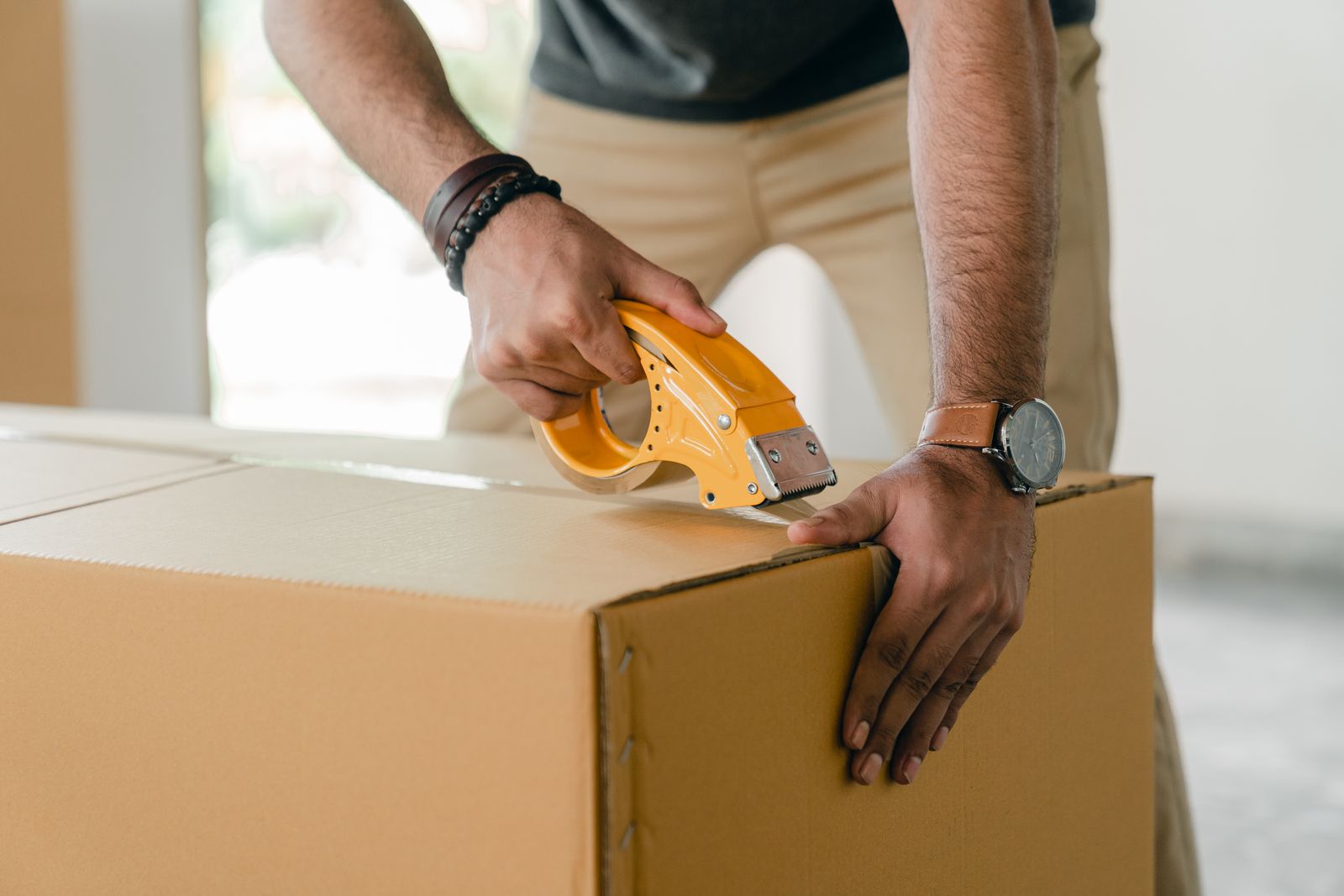
Mistake 1: Starting with the wrong boxes
Beginners collect boxes — from grocery stores, liquor stores, a colleague's garage — and end up with a floppy assortment of sizes and strengths. Two problems follow. Odd-shaped, mixed-size boxes do not stack squarely in a truck, so they shift and crush. And thin, pre-used cardboard has already spent its strength: a box that carried cereal is not built to carry your cookware under two more boxes in a stack.
The dodge: buy or borrow real moving boxes in three standard sizes, more smalls than you think and fewer larges. Uniform sizes stack like bricks. If you do use secondhand boxes, reject anything soft, damp-stained or previously crushed, and save the weakest for pillows and linens only.
Mistake 2: The heavy thing in the big box
This is the classic. A big box invites filling, and books, dishes and canned goods are dense — a large box of them can pass 70 pounds before it looks full. Then three things go wrong at once: the bottom seam gives way under a load cardboard was never asked to hold, whoever lifts it risks their back, and the box cannot safely sit on top of anything else in the truck.
The dodge: the trade's rule of thumb is to keep any box under roughly 50 pounds, and to match box size to density, not volume. Small boxes for heavy things — books, dishes, tools, small appliances. Medium boxes for mixed everyday items. Large boxes only for light, bulky things — bedding, towels, clothing, cushions — which should still come in around 30 to 40 pounds. Test-lift before you tape: if you cannot lift it comfortably, it is not finished, it is overpacked.
Mistake 3: Leaving air inside the box
Here is the fact that reorganizes everything else on this list: things in transit mostly break because they move, not because weight sits on them. A truck accelerates, brakes and leans through corners for hours. A plate with an inch of air around it slides and strikes its neighbor at every stop. A plate wedged so it cannot travel a quarter inch survives the same road without a mark.
The dodge: pad the bottom of the box, pad the top, and fill every void between with crumpled packing paper until the box feels solid. Then do the professional's test: close it, shake it gently, and listen. If you hear or feel anything shift, open it and add paper. Silence is the standard.
Mistake 4: Packing plates flat
Stacked flat, one on top of another, is how plates live in a cupboard — and how they crack in a truck, because the stack concentrates every jolt onto the bottom plates and the rims chip against each other.
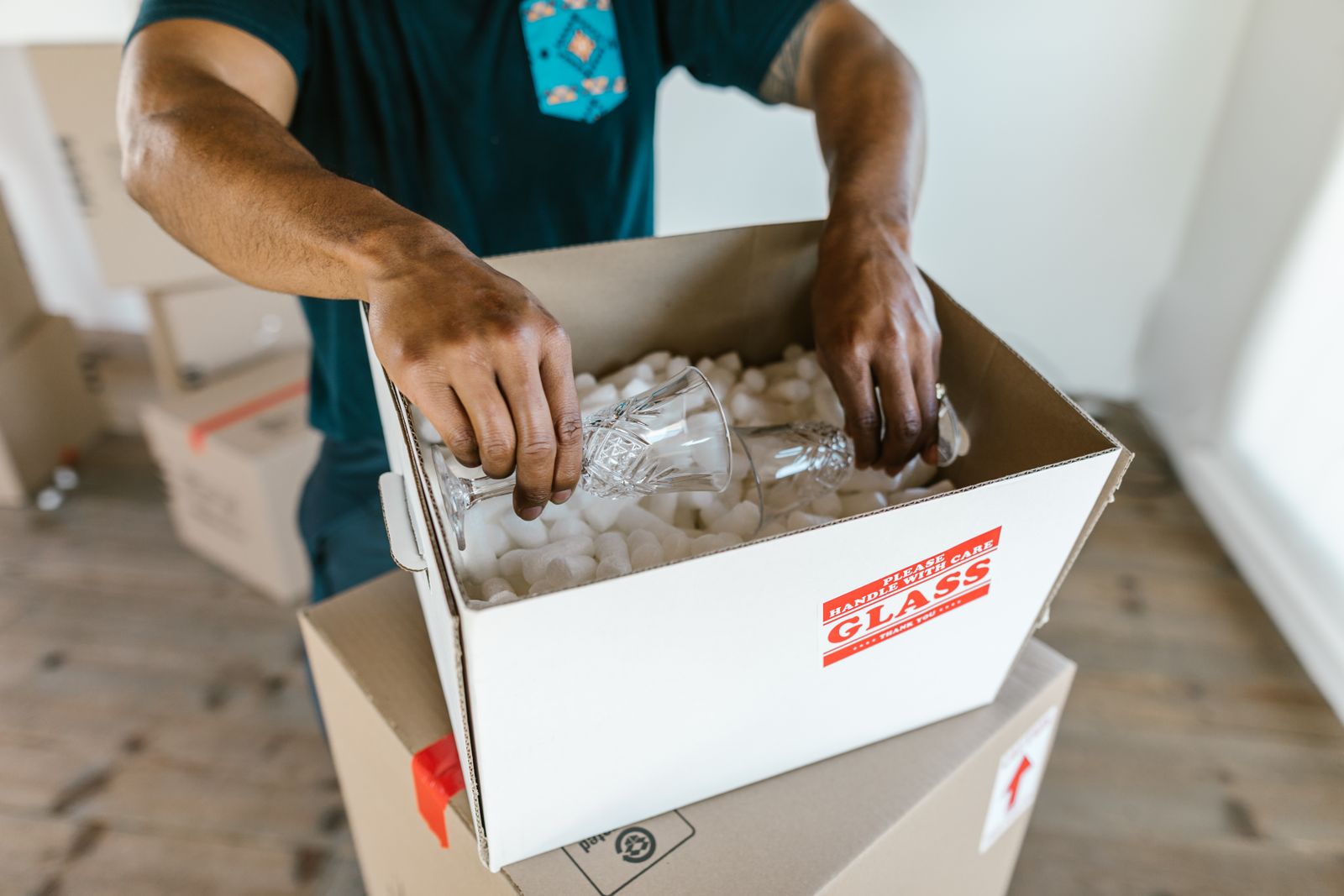
The dodge: wrap each plate individually in packing paper and stand the bundle on edge, like records in a crate. On edge, plates are at their strongest and the padding between them absorbs the road. Glasses get the same logic: wrapped individually, ideally in a divided cell box, standing upright, never nested bare inside each other. Dish-pack boxes — double-walled, built for this — are worth their small premium for anything you would grieve.

Mistake 5: Labeling the top, or not at all
A label on the top of a box is visible exactly until the box is stacked, which is immediately. Unlabeled and top-labeled boxes produce the same result at the destination: a crew carrying boxes room to room asking questions, fragile boxes landing in the garage, and the kettle surfacing three days after you needed it.
The dodge: label on two sides, with the destination room and a short content note — "Kitchen — mugs and glasses," not just "Kitchen." Mark fragile boxes on the sides too. And keep one box deliberately separate: an essentials box with the kettle, chargers, toiletries, a change of clothes, basic tools and the documents you will need on day one, which travels with you, not in the truck.
Mistake 6: Packing what should never go in a box
First-timers pack liquids that leak, aerosols, cleaning chemicals, paint, and — worst of all — anything flammable. Movers will not knowingly carry hazardous materials such as gasoline, propane or paint thinner, and a leaking bottle of detergent ruins more belongings in a typical move than breakage does.
The dodge: work through the hazardous and perishable list early. Use up, give away or safely dispose of fuels, solvents and aerosols rather than packing them. Liquids you must take go in sealed plastic bags, upright, in a plastic bin — or in your own car. Food, plants and anything alive get a plan of their own, not a cardboard box in a hot truck.
Mistake 7: Starting the day before
Packing takes roughly three times longer than a first-timer estimates, because every drawer contains decisions. Started too late, packing degrades in a predictable sequence: wrapping gets skipped, boxes get overfilled, labels disappear, and the last hour becomes loose items in bags — the single most damage-prone way anything travels.
The dodge: start two weeks out if you can, one week at the absolute minimum, a room or two a day, beginning with the things you use least — books, off-season clothes, the good china — and ending with the kitchen. Book the packing itself into your calendar like the appointment it is. If time genuinely runs out, that is the moment a partial professional pack earns its money: the crew packs the kitchen and the fragile rooms, you pack clothes and books.
Mistake 8: Assuming your packed boxes carry the mover's liability
This is the mistake nobody discovers until something breaks. Moving paperwork distinguishes CP boxes — carrier packed, packed by the mover — from PBO boxes, packed by owner. The Federal Motor Carrier Safety Administration, which regulates interstate movers, is plain about the consequence: packing your own boxes can lower your cost, but if items you packed are damaged, it can be harder to establish a claim against the mover for those boxes, and improper packing of your own containers is one of the things that can reduce the mover's normal liability. A box with no external damage whose contents broke is, to a claims adjuster, a packing failure — yours.
The dodge: pack to the standard in Mistakes 3 and 4, because your technique is your coverage on self-packed boxes. And think about the split: the items where a claim would actually matter — the fragile, the valuable, the hard to replace — are the items to consider having the mover pack, so they travel as CP boxes under the mover's responsibility. Packing you buy from the mover is an accessorial (additional) service under the federal rules, and for interstate moves it belongs on the written estimate with the other charges — agreed in advance, not improvised on moving day.
| Beginner instinct | What actually happens | The professional habit |
|---|---|---|
| Biggest box for the heaviest things | Bottom seam fails; box too heavy to lift safely | Small boxes for dense items; ~50 lb ceiling per box |
| Wrap it and drop it in | Contents shift and strike each other for the whole drive | Fill every void; the box must pass the silent shake test |
| Plates stacked flat | Rims chip; bottom plates crack under the stack | Each plate wrapped, stood on edge like records |
| Label on top | Invisible the moment boxes are stacked | Room + contents on two sides; fragile marked on sides |
| Pack everything, including liquids and aerosols | Leaks, and movers refuse hazardous materials outright | Dispose of hazards; liquids bagged, upright, in plastic |
| The mover covers anything that breaks | Owner-packed (PBO) boxes are hard to claim for | Pack to standard; let the mover pack what a claim would matter for |
Mistake 9: Guessing the supplies — and running out mid-room
The final beginner error is logistical: too little paper, too little tape, no marker that works. Packing paper is the supply first-timers most underestimate, because it disappears three ways at once — wrapping, cushioning the bottom and top of every box, and filling voids. A household that buys one small bundle will be stuffing boxes with towels and newspaper by the second room. Newspaper, incidentally, is a false economy for anything light-colored or washable-by-hand: the ink transfers, and you will wash every dish at the other end.
The dodge: buy more paper and tape than your estimate says — a third more is a sane margin — and buy them before you start, not during. Keep one workstation: boxes, paper, tape gun, marker, and a pair of scissors, in the room you are packing, so supplies are never a reason to stop mid-box. Unused paper and unopened tape are returnable or keepable for the next move; a half-packed kitchen at 11 p.m. because the tape ran out is not. The same logic applies to boxes themselves: running five boxes short at the end is how the loose-items-in-bags failure of Mistake 7 begins.
The short version
Packing well is not a talent; it is nine small disciplines, each one cheap: right boxes, weight matched to size, no air, plates on edge, labels on the sides, hazards out, an early start, an essentials box, and a clear-eyed view of which boxes are your responsibility. Do those, and your first packing job will look — at the unpacking end, which is where it counts — very much like a professional one.
Sources
- FMCSA consumer guidance, via Green Van Lines' summary of the FMCSA Protect Your Move materials and 49 CFR Part 375, Appendix A — packing and unpacking are accessorial services; CP (carrier packed) vs. PBO (packed by owner); self-packing can make damage claims harder to establish and improper packing can reduce a mover's normal liability; written interstate estimates must include accessorial charges (49 CFR 375.403/375.405): https://greenvanlines.com/guides/do-movers-pack-for-you
- Boston Best Rate Movers, "Packing Tips" — the no-movement rule, the roughly 50 lb box ceiling, dishes packed vertically, labeling on at least two sides, and the common first-timer mistakes: https://www.bostonbestrate.com/services/packing-tips-boston
- Timeless Moving, "How to Pack a Kitchen for a Move Without a Single Break" — breakage is caused by movement; pad bottom and top and fill every void; heavy kitchen items in small or medium boxes: https://www.timelessmovingtx.com/blog/how-to-pack-a-kitchen-for-a-move
- Perfect Moving, "Stop Overpacking Boxes During Your Move" — box-size-to-weight matching and safe per-box weight limits: https://perfectmoving.com/moving-storage-tip/overpacking-boxes-until-theyre-too-heavy/
- Commonwealth of Virginia DMV, consumer moving guidance — movers are not liable for damage inside owner-packed boxes absent external damage to the box: https://transactions-t.dmv.virginia.gov/moving/your_move.asp
- Photos: taping a moving box — photo by Ketut Subiyanto via Pexels, https://www.pexels.com/photo/4246120/; family packing boxes — photo by cottonbro studio via Pexels, https://www.pexels.com/photo/4569340/; glassware packed in a divided box — photo by cottonbro studio via Pexels, https://www.pexels.com/photo/7464230/
More guides
- How to Hire a Moving Company That Won't Hold Your Furniture HostageMovers › Moving & Storage
- How Much Do Movers Cost? Local vs. Long-Distance Pricing ExplainedMovers › Moving & Storage
- Binding vs. Non-Binding Estimates: The Difference That Decides Your Final BillMovers › Moving & Storage
- Moving Insurance and Valuation: What 'Full Value Protection' Really CoversMovers › Moving & Storage
- Long-Distance Moving: A Start-to-Finish Guide for Household GoodsMovers › Household Goods Moving & Storage
- All Guides & ArticlesBrowse the full guides library