Movers › Packing & Crating
Packing and Crating Services Warranties and Guarantees: What They Promise and What They Quietly Exclude
Every packing and crating company promises, in large friendly type, that your belongings are protected. The sentence that decides whether you are actually paid lives several pages later, in smaller type, under headings like "limitations," "exclusions," and "claims procedure." In corporate relocation work, I watched the same pattern repeat: the family or employee assumed the guarantee covered the loss; the guarantee, read closely, covered something narrower — and the gap between the two was discovered only after the crate was opened.
This is especially hard on people downsizing out of a house full of decades-old, irreplaceable things, which is exactly who hires packing and crating help. Here is how to decode the language before you sign, what the standard exclusions quietly remove, and the claim steps that determine whether a promise pays out.
First translation: most "guarantees" are not insurance
The single most useful thing to know is that movers and packers generally do not sell insurance. What they offer is valuation — a contractual statement of how much the company will be liable for if it loses or damages your goods. Industry guides are explicit about the distinction: insurance is sold by licensed insurers; valuation is a liability cap set by the mover's tariff and your contract. When a packing company's brochure says "fully guaranteed" or "complete protection," it is almost always describing valuation, and valuation comes in tiers.
The baseline tier, Released Value Protection, is included free and is close to symbolic: the carrier's liability is capped at 60 cents per pound per article. A ten-pound antique clock is "covered" for six dollars. The stronger tier, Full Value Protection, costs extra and obliges the mover to repair the item, replace it with one of like kind and quality, or pay its current market value — the lesser of repair cost or market value. Crating specialists selling freight work frame the same fork honestly: standard carrier liability pays by weight, "often pennies on the dollar for high-value equipment," while full declared-value coverage settles a loss at what you declared the shipment to be worth.
So the first question to ask any packing or crating service is not "are you guaranteed?" It is: which valuation tier is in my contract, what is its limit, and what does the upgrade cost? Get the answer as a line item, not a verbal assurance.
The exclusion that swallows the guarantee: who packed the box
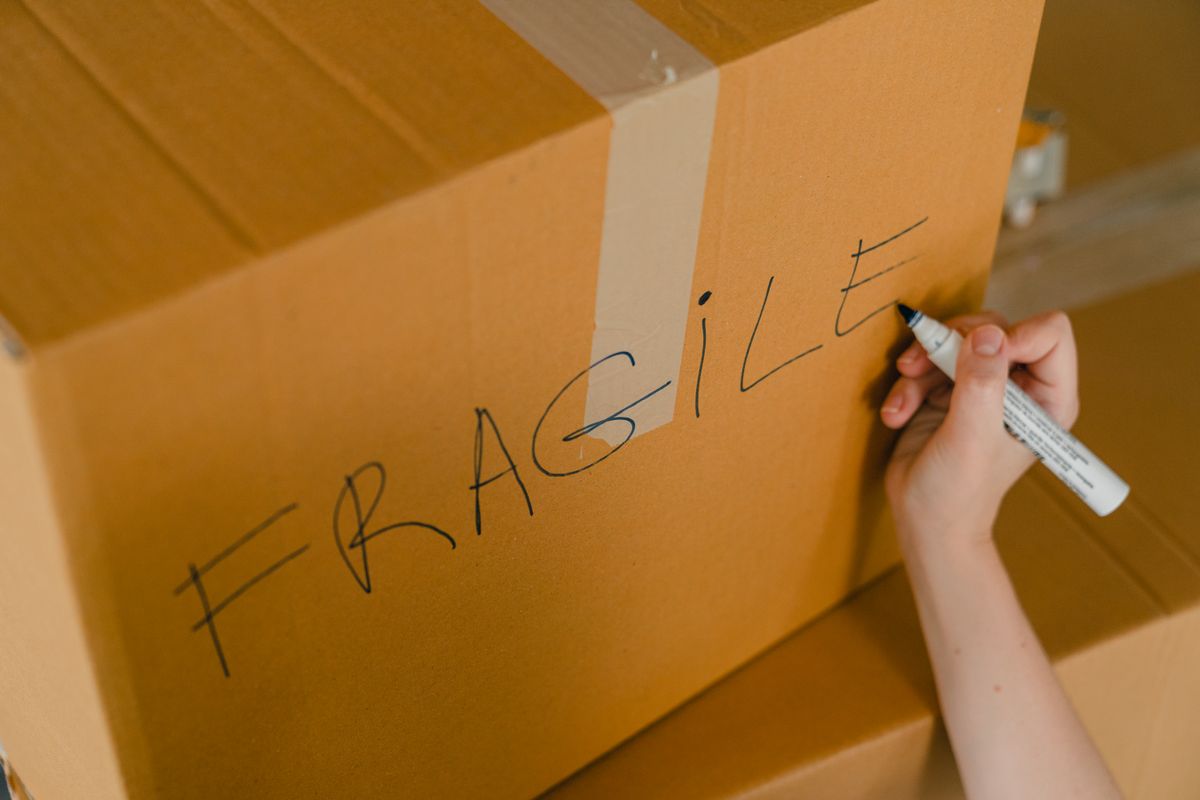
Here is the quiet mechanism at the center of this article. A carrier's liability for the contents of a box depends on who packed it. Cartons the crew packs are the crew's responsibility. Cartons marked PBO — Packed By Owner are, with one narrow exception, yours.
The logic is stated plainly in carrier terms: the crew never saw what went into a sealed owner-packed box, how it was cushioned, or whether the carton was sound, so damage inside it is not theirs to pay for. Published carrier terms list the owner-side causes in detail — insufficient or improper packing, overloaded, open, unsealed, or deteriorated containers, weak cartons, containers not designed for moving. The one exception that can push a PBO claim back onto the mover is visible external evidence: clear crush, impact, or drop damage to the outside of the box, consistent with the damage claimed inside.
For a downsizing household, the practical consequence is large. The china, crystal, and family silver you carefully packed yourself last month, to "save money," are the items least covered by the guarantee you are paying for. If protection matters for a category of goods, let the crew pack that category — a professional pack line on the written quote is what shifts the risk back to the company. Many households split it sensibly: crew packs the fragile and the valuable; the family packs books, linens, and clothes, where a coverage gap costs little.
The rest of the quiet exclusions
Beyond PBO, the standard exclusion lists across carrier tariffs and protection plans are remarkably consistent. Read your contract for each of these by name:
- Inherent vice and latent defects. Damage that comes from inside the item itself — a cracked pressboard panel, aged wiring in a lamp, veneer already lifting, a frame joint already failing — is excluded even under Full Value Protection. For antiques and older furniture, this is the exclusion most likely to be invoked, and the defense against it is documentation: dated photographs and a condition report before packing, so "it was already like that" has to compete with evidence.
- Acts of nature. Storm, flood, and hurricane damage fall outside both valuation tiers. Third-party transit insurance is the product that can fill this gap.
- Mechanical or electrical derangement. An electronic device that simply stops working after the move, with no visible physical damage, is commonly excluded. If the piano's digital cousin — a home theater, a computer — matters, ask specifically.
- Prohibited and high-risk goods. Cash, securities, jewelry, deeds and important papers, firearms, hazardous materials, perishables, and live plants are excluded from standard coverage or barred from the truck entirely. The standard advice is unglamorous and correct: valuables and irreplaceable documents travel with you, in your car.
- Undeclared high-value items. Items worth more than $100 per pound must typically be listed on a High-Value Inventory form to be fully covered even under Full Value Protection. Undeclared, their recovery can be capped. For a downsizer, this form is where the good jewelry that is going in a box anyway, the artwork, and the silver get named — or quietly don't.
What a crating warranty actually warrants
Custom crating adds a second layer of promises, and it helps to separate them. A crate builder can warrant the crate itself — that it was built to the stated specification, from the stated materials, with the cushioning and blocking the design calls for. For international shipments there is a hard, checkable standard hiding in this area: wood packaging crossing borders must meet ISPM 15, meaning the timber is heat-treated (a core temperature of 132.8°F for at least 30 minutes, in one specialist's summary) and stamped, so the shipment clears plant-quarantine inspection instead of being held, fumigated, or rejected at the port. If any part of your move crosses a border, "ISPM-15 certified and stamped" belongs in the contract in words — it is one of the few guarantees in this trade that is physically verifiable on delivery day.
What a crate warranty usually does not do is guarantee the condition of the contents on arrival regardless of cause. Contents coverage still runs through valuation or a separate insurance policy, and insurers and carriers alike will ask how the item was packed — which is why reputable craters document the build: dimensions, weight, fragility assessment, materials, photographs of the item secured inside before sealing. That documentation is not marketing. It is the evidence file for the claim you hope never to file, and a company that produces it unprompted is telling you it expects its work to be examined.
For genuinely valuable pieces — art, antiques, heirloom furniture — specialists in transit insurance give consistent advice: third-party goods-in-transit coverage is the stronger instrument, and it pays on a declared value you can prove. Arrange the appraisal or gather the receipts before the move. An insurer will settle at the value the evidence supports; declare a number you cannot document and the claim shrinks to the number you can.

The claim steps that decide whether it pays
Guarantees fail at the procedure stage as often as at the coverage stage. The steps that protect you are consistent across carrier and insurer guidance:
- Before the move: photograph valuable items from several angles, note serial numbers, complete the High-Value Inventory form, and keep appraisals and receipts outside the shipment — with you, or photographed on your phone.
- At delivery: inspect before you sign, and note damage on the delivery receipt in specific words. For crates and boxes, the outside matters: photograph crush or impact damage before opening, because external evidence is what connects internal damage to the carrier's custody — decisively so for anything arguably owner-packed.
- Preserve the evidence: keep the packing materials and the damaged item as found until the claim is resolved. A repaired item and a discarded box are a claim with its evidence thrown away.
- File promptly, in writing: claim deadlines are set by the contract and tariff, and they are real. File within the stated window even if your documentation is still being assembled, and keep copies of everything you send.
- Claim the provable value: support the amount with the appraisal, receipt, or comparable listings you gathered beforehand. Claims settle at documented value, not at remembered value.
| Promise in the brochure | What it usually means | What to get in writing |
|---|---|---|
| "Fully insured" | Valuation coverage, not an insurance policy | The tier, the limit, and whether a separate insurer is involved |
| "Guaranteed protection" | Full Value Protection, if you selected and paid for it | The tier as a priced line item on the quote |
| "We stand behind our packing" | Crew-packed cartons are covered; PBO cartons are not | Which rooms/categories the crew packs, stated on the quote |
| "Crated for maximum safety" | The crate meets the builder's specification | Materials, cushioning spec, build photos — and ISPM-15 stamps if crossing a border |
| "Claims handled promptly" | A procedure with deadlines and evidence rules | The claim window, the form, and the address for filing |
The bottom line
A packing or crating guarantee is worth exactly what its exclusions leave behind. Read for the valuation tier and its limit, the PBO line that decides whose risk a box is, the inherent-vice and acts-of-nature exclusions, and the high-value declaration you may need to file. Let the crew pack what you cannot afford to lose, document everything before it is sealed, and treat the claim procedure as part of the product you are buying. There are plenty of specialists to choose from — this site's directory lists 186 packing and crating businesses within the moving trade — and the ones worth hiring will walk you through their exclusions before you think to ask. The guarantee is in the fine print. So is the truth about the guarantee.
Sources
- SafeBound Moving, "What Movers Are Never Liable For" — the PBO box rule, inherent vice, banned goods, acts of God, and the $100-per-pound high-value form: https://www.safeboundmoving.com/blog/what-movers-are-never-liable-for?c6cbd55a_page=344
- Premier Relocations / Mayflower, "The Truth About Moving Insurance Coverage" — valuation vs. insurance, Released Value at $0.60 per pound, Full Value Protection, and standard exclusions including mechanical derangement: https://premier-mayflower.com/what-moving-insurance-actually-covers-and-what-it-doesnt/
- Boxed Movers, "Nationwide Terms and Conditions of Moving Services" — customer-packed property terms and valuation exclusions in a published carrier contract: https://www.callboxed.com/terms
- VeloCrate, "Custom Crating" — ISPM-15 certified export crates and full declared-value coverage vs. per-pound carrier liability: https://www.velocrate.com/crating
- Las Vegas Crating, "Shipping Services" — ISPM-15 heat treatment to a core temperature of 132.8°F for at least 30 minutes: https://www.lasvegascrating.com/shipping
- Direct Courier blog, "How to Insure Fragile Furniture Shipments" — third-party transit insurance, proof of value, and appraisals for antiques and heirlooms: https://blog.directcourier.co.uk/how-to-insure-fragile-furniture-shipments
- Movers-Map.com taxonomy listings, queried November 24, 2026 — 186 Packing & Crating listings and 234 Packaging listings.
- Labeling a fragile box and open box with tape — photos via Pexels, https://www.pexels.com/photo/4246112/ and https://www.pexels.com/photo/4498152/
More guides
- How to Hire a Moving Company That Won't Hold Your Furniture HostageMovers › Moving & Storage
- How Much Do Movers Cost? Local vs. Long-Distance Pricing ExplainedMovers › Moving & Storage
- Binding vs. Non-Binding Estimates: The Difference That Decides Your Final BillMovers › Moving & Storage
- Moving Insurance and Valuation: What 'Full Value Protection' Really CoversMovers › Moving & Storage
- Long-Distance Moving: A Start-to-Finish Guide for Household GoodsMovers › Household Goods Moving & Storage
- All Guides & ArticlesBrowse the full guides library