Movers › Piano & Organ Moving
Piano and Organ Moving Jargon, Translated: The Terms Providers Use and What They Mean for Your Bill
Every trade has jargon, but piano moving's jargon is unusually expensive to misunderstand. The words on the quote describe physical operations — taking a grand apart, turning it on its side, lifting it through a window — and each operation has a price. When a family tells me a piano move "came in at twice the quote," the story almost always contains a term they nodded at without translating: a turn fee, a hoist, a crate, a pitch raise waiting at the other end.
I coordinate relocations for a living, and pianos are the line item I never let a general mover price casually. The national average for a professional piano move is about $400, within a typical range of $200 to $1,000 — but that average hides the vocabulary. Here it is, term by term, with what each one does to your bill.
The instrument words, because they set the base price
Spinet, console, studio, upright. The upright family, smallest to tallest. A spinet or console move typically runs $250 to $450; a full upright, $300 to $600. Height is weight and leverage, so the taller the cabinet, the more the crew and care cost. When a provider asks "what kind is it?" they are not making conversation — they are choosing crew size.
Baby grand, grand, concert grand. Grands are priced by length, and they travel disassembled and on their side (see "tipping," below). A baby grand typically runs $400 to $800 to move; a full grand, $500 to $1,200 locally, and long-distance grand moves can run $1,100 to $4,200 or more. Measure yours — length, front to back of the lid — before you call, because "grand" alone spans five feet to nine.
Console and tone cabinet (organs). An electronic organ moves as furniture-plus-electronics: heavy, top-heavy, and full of components that dislike impact. A pipe organ is not a move at all in the household sense — it is a disassembly of an instrument into ranks of pipes and chests, done by organ builders, priced as a project. If a general mover offers to "just wrap" a pipe organ, that sentence is your cue to call a specialist instead.

The handling words, where the add-ons live
| Term | What it actually means | What it does to the bill |
|---|---|---|
| Piano board / skid board | The padded board a grand is strapped to, on its side, for the whole move | Standard equipment for grands — included in a real piano mover's price; a line item if it is not |
| Leg and lyre removal | A grand's legs and pedal assembly come off before it is tipped; uprights travel assembled | Dismantling is typically a modest charge (around $100 in published guides); reassembly at destination is part of the same job — confirm both ends are priced |
| Tipping | Turning the grand onto its straight side onto the board | The skilled core of a grand move; not an extra, but the reason grands cost more than uprights |
| Stair fee / turn fee | Stairs priced per flight, or per step plus a charge for each landing turn | Published rates run $40–$100 per flight, or $5–$10 per step plus about $75 per turn. Count flights at both houses — beginners count one end |
| Long carry | The distance from door to truck exceeds the included allowance | A per-job surcharge; measure your driveway and building corridor before quote day |
| Hoisting / crane lift | The piano cannot fit the stairs or door, so it goes through a window or over a balcony by crane or hoist | The big one: roughly $750–$2,000 when needed. It is also, sometimes, the only honest option — a mover who identifies it in the survey is saving you a failed delivery day |
| Crating | A custom wooden crate built around the instrument for long-distance, storage, or high-value moves | About $200–$600. Worth it for antiques, art-case pianos, and any shipment changing trucks or sitting in a warehouse |
Padding and wrapping deserve one sentence: blankets, straps, and a heavy-duty dolly are the standard kit, and on a specialist's quote they are the job, not an upgrade. If padding appears as a premium tier, you are talking to a generalist.
The paper words, where the risk lives
Valuation / released value. The same trap as household moving, sharpened by the cargo. A piano shipped under default released-value terms is covered at 60 cents per pound — a few hundred dollars for an instrument worth tens of thousands. "Declared value" or full-value coverage costs more and is the only version that means what families think "insured" means. Ask which one is on the paperwork, by name, before the board comes out.
Climate-controlled storage. If the piano waits between houses, this is storage held at stable temperature and humidity — typically about $50 to $75 a month in published rates — and for a wooden instrument it is not a luxury label. A piano is wood, felt, and glue under tension; an unconditioned warehouse in August is an active harm, not a pause.
Site survey. A real piano mover asks for photos or visits before quoting stairs and turns. A quote given blind, over the phone, for a grand piano with two staircases is not a quote — it is an opening bid on a negotiation that happens on your staircase, with your piano on a board, which is the worst negotiating position in the moving industry.

The after words, which are not on the mover's quote at all
Acclimation. The piano needs two to four weeks in its new room before tuning. This is not the move "shaking it out of tune" — it is humidity. The soundboard is a thin wooden sheet that swells and shrinks with the air, changing string tension and pitch; the Piano Technicians Guild identifies exactly this movement as the driver of pitch change. Tune before the piano has settled and you will pay for the tuning twice.
Pitch raise. If the piano has drifted far from A440 — common after a long move, storage, or years unplayed — the technician may need a pitch correction pass before a fine tuning can hold. It is a separate, legitimate charge, and being quoted it is not an upsell invented at your piano; ask the technician to show you the measured pitch and you can verify the need yourself.
Tuning. Budget $100 to $200 for the post-move tuning itself, booked two to four weeks out, ideally with a Registered Piano Technician — the Piano Technicians Guild's credentialed grade. Put the appointment in the diary on moving day, because the good technicians in any city are booked ahead, and a piano tuned late is a small sorrow that lasts exactly as long as you let it.
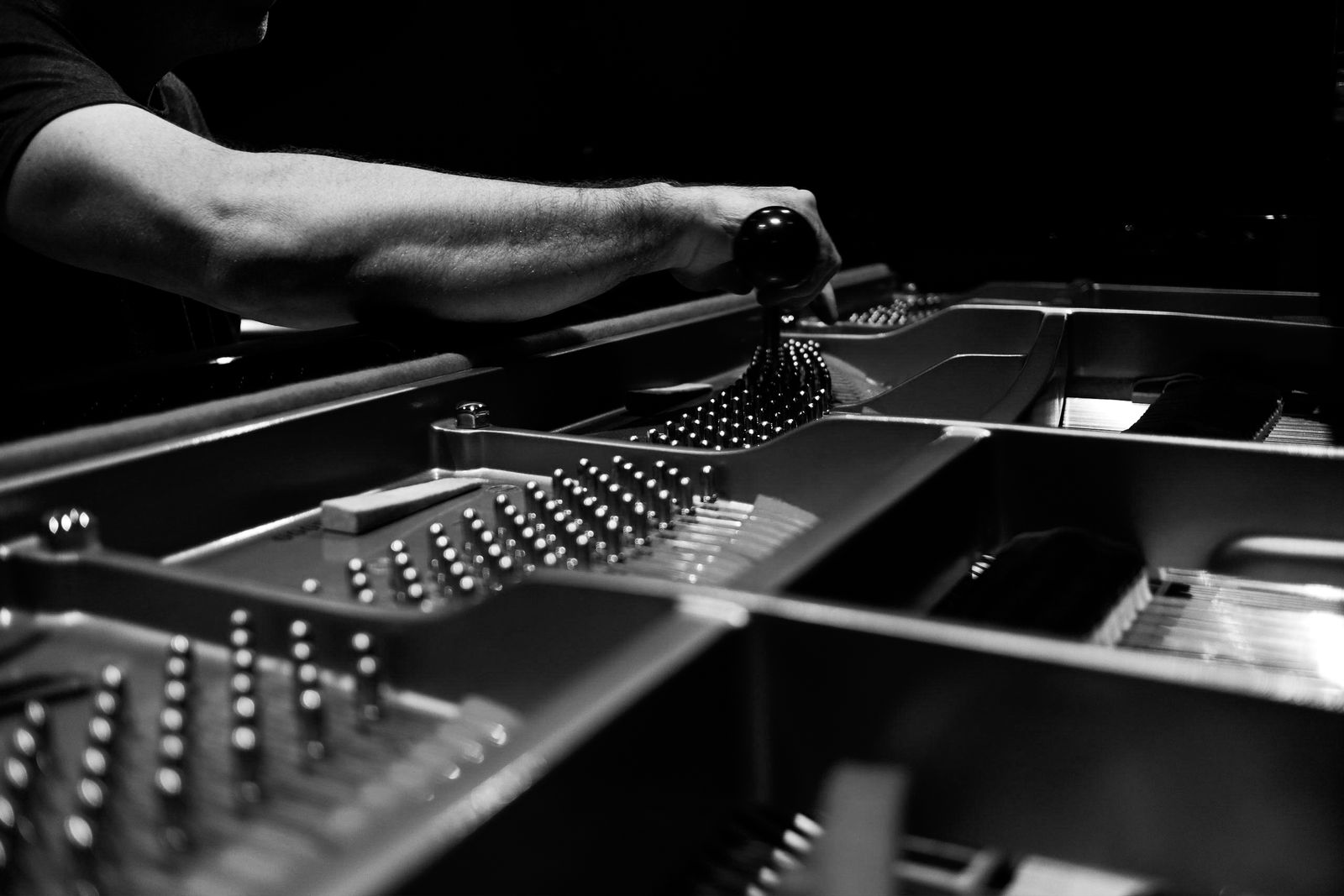
Regulation and voicing. If keys feel uneven or the tone has gone harsh after the move, technicians will offer these words: regulation is the mechanical adjustment of the action; voicing is shaping the hammers' felt to change tone. Neither is a moving repair, and neither should be sold to you on moving day — but a piano that was due for both will announce it in a new room, and now you know what the words mean before you agree to them.
The organ words, briefly — because they change who should do the job
Organs borrow the piano vocabulary and then leave it behind. A console is the cabinet the organist plays — for a Hammond-style instrument it travels with its tone cabinet or Leslie speaker, the separate rotating-speaker cabinet that produces the signature sound, and the two are quoted, wrapped, and carried as a matched set. Bench and pedalboard come off and travel separately; a quote that does not mention them has not looked at the instrument. For a pipe organ, the vocabulary becomes architectural: ranks (each set of pipes), chests (the boxes that feed them air), and blower (the machine that makes the wind). Moving one means an organ builder dismantles, labels, and later revoices the instrument in its new room — voicing a pipe organ is not the piano term above but a full tonal regulation of every pipe. Families inherit these instruments through churches and estates more often than they buy them, and the translation that matters is this: a pipe organ quote from anyone but an organ builder is not a low quote, it is a category error, and the instrument pays for it.
Three phrases that should stop the conversation
Fluency has an opposite. "We move pianos all the time" from a general household crew, offered without a board, a stair plan, or a named valuation, means your piano is their occasional experiment. "Stairs won't be a problem" said before anyone has seen the stairs means the problem is scheduled for moving day, at moving-day prices. And "fully insured" without a document naming the coverage type and amount is a mood, not a policy. Each phrase is cheap to say and expensive to believe. The specialists who deserve the job speak in the vocabulary this guide translates — operations, numbers, and paper — and they do it before the piano leaves the floor.
How to use this at quote time
Read any piano quote by translating it into operations: what comes apart, what it rides on, what the stairs cost at both ends, what happens if it does not fit, what it is covered for, and what you will pay a tuner a month later. This site lists 377 piano and organ moving specialists — enough that you can get two or three quotes from people for whom a piano board is standard kit rather than a rental. When one of them walks your staircase, counts the turns, and puts the hoist in writing "only if needed," you are hearing fluency. Hire fluency. The piano will arrive sounding like the one you packed, which was the entire point.
Sources
- Angi, piano moving cost guide — establishes the national average of about $400, the typical $200–$1,000 range, and costs by piano type from digital ($200–$350) to grand ($500–$1,200), plus custom crating at $200–$600.
- MovingPlace and Fixr piano moving cost data, via X Van Lines' cost guide — establishes stair fees of $40–$100 per flight or $5–$10 per step plus about $75 per turn, crane hoisting at $750–$2,000, dismantling around $100, climate-controlled storage at about $50–$75 per month, and tuning at $100–$200.
- Piano Technicians Guild materials, via technician guidance on post-move tuning — establishes the two-to-four-week acclimation period, humidity-driven soundboard movement as the cause of pitch change, and the pitch-raise procedure for instruments far from A440.
Photos: grand piano strings — photo by Luan Gracioli, https://www.pexels.com/photo/14494758/ ; grand piano in room — photo by Stanislav Kondratiev, https://www.pexels.com/photo/12214095/ ; tuner's hand — photo by Patrick Pecome, https://www.pexels.com/photo/29039292/
More guides
- How to Hire a Moving Company That Won't Hold Your Furniture HostageMovers › Moving & Storage
- How Much Do Movers Cost? Local vs. Long-Distance Pricing ExplainedMovers › Moving & Storage
- Binding vs. Non-Binding Estimates: The Difference That Decides Your Final BillMovers › Moving & Storage
- Moving Insurance and Valuation: What 'Full Value Protection' Really CoversMovers › Moving & Storage
- Long-Distance Moving: A Start-to-Finish Guide for Household GoodsMovers › Household Goods Moving & Storage
- All Guides & ArticlesBrowse the full guides library