Movers › Self Service Moving & Storage
Self-Service Moving and Storage in 2026: What Changed in Prices, Rules and Availability
Self-service moving — you pack, you load, a company drives, or a unit waits — used to be the simple end of the moving business. Rent the truck, rent the container, rent the unit, done. In 2026 it is still the cheapest way to move a household, but it is not the same product it was three years ago. Storage street prices have come down while the price you actually pay has learned new tricks. Two of the country's biggest rental markets rewrote the disclosure rules this year. Container companies have quietly re-engineered what you pay for — from the box itself to the space inside it. And availability, the thing nobody thought about when every facility had a "first month free" banner, now runs in opposite directions depending on which side of the market you are standing on.
If you are a renter moving between leases — the classic self-service customer, with a gap between an old place and a new one and everything you own in between — this is the 2026 state of play, organized by what changed and what to do about it.
Prices: the list price fell, the real price learned to move
Start with storage, because the headline is genuinely good news. The national average street rate for a 10×10 non-climate-controlled unit is $119 a month heading into 2026, down 0.8 percent year over year on Yardi Matrix data; climate-controlled 10×10s average about $133 to $134 and held roughly flat. The average across all non-climate sizes is down 1.5 percent. After the pandemic-era run-up — TractIQ's series shows street rates per square foot peaked in August 2021 and have since given back roughly 40 percent of that peak — storage is, on paper, a buyer's market.
Now the three ways the paper price is not your price.
The move-in price and the street price have split apart. Yardi's move-in rates for the fourth quarter of 2025 averaged $96.44 — down 10.7 percent year over year — while the street rate sat at $119. Operators are discounting aggressively to fill units and making it back later. TractIQ's October 2026 data shows the same gap in its own terms: an average web rate of $1.08 per square foot against a $1.29 street rate. The advertised online price is a starting bid, and the industry's model assumes you will not leave when it normalizes.
Existing-tenant increases are where the money is. Rate increases of 5 to 10 percent every 6 to 18 months are common practice for tenants already in place. The renter between leases is unusually exposed here: you planned on two months of storage, the new lease slips, and month four arrives with a higher rent on a unit full of your furniture — the least negotiable position in consumer life. The defense is at signing, not at increase time: ask when the last increase hit existing tenants, how often they come, and whether the promotional rate has a stated step-up date.
Containers repriced around space, not boxes. The container market's 2026 shape is pay-for-what-you-fill. U-Pack's ReloCube — a roughly one-room metal cube, 308 cubic feet, 2,500-pound limit — averaged $2,100 for a long-distance move in July 2026 by the company's own figures, and U-Pack charges only for cubes you actually fill: reserve three, load two, pay for two. Its trailer service prices by the linear foot with a five-foot minimum. In U-Haul's August 2026 published comparison for Los Angeles to Houston, one U-Box (257 cubic feet) quoted $2,098.80 against one ReloCube at $2,453 — the smaller box cheaper on that lane, the larger cube cheaper per cubic foot. PODS, the third model, still prices per container per month with storage built in: local moves run about $350 to $800, and storage time beyond the included period runs $150 to $250 per container per month. The comparison that matters in 2026 is not company to company; it is what unit of space you are being charged for, because the three leaders now sell three different units: the box, the cube you fill, and the foot of trailer.
| What changed | 2023-era norm | 2026 reality |
|---|---|---|
| 10×10 storage street rate | Post-pandemic highs, still climbing | $119/month average, down 0.8% year over year; climate-controlled ~$133–$134, flat |
| Move-in pricing | Modest first-month discounts | Move-in rates ~$96/month average — 10.7% below prior year; web rates well under street rates |
| Container billing | Per container, take it or leave it | Pay-per-cube-filled (U-Pack) and per-linear-foot trailer pricing alongside per-container monthly models |
| Loading windows | Informal, driver-dependent | Written windows with per-day fees: U-Pack allows 3 business days to load, then $50/day per cube |
| Included storage | A selling point, vaguely defined | Specified: U-Pack includes 30 days at destination; PODS builds a month into local pricing |
Rules: disclosure is the new battleground
The most consequential 2026 changes are not prices. They are laws about what must be written down before you sign — and they landed in the two places with the most renters.
California, from January 1, 2026. SB 709 amended the state's Self-Service Storage Facility Act to require that new rental agreements clearly disclose three things the industry preferred to leave fuzzy: whether your rate is discounted or promotional, whether the rental fee is subject to change, and — the number that matters — the maximum rental fee the owner could charge during the first 12 months of your agreement. Read that third disclosure as what it is: the facility telling you, in advance and in writing, the worst your first year can get. A companion law, AB 498, tightened the rules for lien notices sent by email — the notices that precede a lien sale of your unit's contents — which makes the email address on your rental agreement a piece of information with real consequences. Keep it current.
New York City, phasing in through 2026. Local Law 171 of 2025 created a licensing requirement for self-storage facilities under the Department of Consumer and Worker Protection, with operator licensing beginning September 8, 2026; facilities must give you a written schedule of rates before you sign an occupancy agreement, and cannot collect a charge that was not on that schedule without notice first. Local Law 162 of 2025 requires at least 60 days' notice before an occupancy fee increase, and an explanation for any termination of occupancy. The city's rulemaking names the target plainly: "bait-and-switch" tactics, attracting consumers with low advertised prices and then raising them repeatedly.
Everywhere else: the trend, not yet the law. Other states are debating versions of the same ideas — New York State's lien-notice bill was still pending in the Assembly as 2026 began — and the direction is uniform: more disclosure, more notice, more of the transaction in writing and in email. For a renter outside California and New York City, none of this protects you yet. What it does is hand you a standard to demand voluntarily: a facility that will not tell you its maximum first-year rent, in a state that does not force it to, has told you something anyway.
One rule did not change, and it governs more self-service moves than any statute: the loading window is a contract term with a price on it. U-Pack gives you three business days to load and three to unload, weekends excluded, at $50 per cube per extra day; its trailers kept past the window run $250 a day. Container and truck contracts across the industry have the same architecture. The complaints I read cluster here — not on the headline price, but on the day-rate that started accruing while a closing slipped. In 2026, negotiate the window before you sign, not the fee after it runs.
Availability: empty units, full calendars
The strangest feature of the 2026 market is that both halves of self-service are simultaneously loose and tight.
On the storage side, supply is abundant and getting more so, but the wave is cresting. The U.S. now holds more than 2.1 billion square feet of self-storage; about 58.5 million square feet was delivered in 2025, with roughly 53 million planned for 2026 — a 9 percent decline, with Yardi projecting deliveries to keep falling through 2028. Occupancy tells the split story: the big public operators run 89 to 93 percent full, while non-REIT facilities tracked in CMBS data sit near 82 to 86 percent. Translation for a renter: the independent facility across town is hungrier than the REIT facility on the highway, and the move-in specials prove it. Availability is not your problem in 2026. Being poached with a teaser rate is.
On the moving side, the constraint is the calendar, and the cause is housing. Homeowner turnover remains near historic lows — owners locked into low mortgage rates are not moving — which suppresses the whole moving economy's peak-season volume but concentrates demand into the same end-of-month weekends every renter already knows about. Container companies manage this with the loading-window fees above; truck fleets manage it with one-way pricing that swings by direction and date. The practical shift from three years ago: booking lead time matters more than brand loyalty. The cube, truck, or unit you want for the last Saturday of the month is a perishable good, and in 2026 it is priced like one.
There is one more availability change worth knowing if your move crosses the map. The container networks do not cover the same country: PODS does not serve Alaska, Montana, North Dakota, Vermont, West Virginia, or Wyoming; U-Pack runs long-distance only (interstate moves over 100 miles) but covers all 50 states, Canada, and Puerto Rico; U-Box availability follows U-Haul's dealer network, which is nearly everywhere but varies in delivery method. "Self-service" in 2026 is a national product with regional holes, and the holes are exactly where a between-leases renter can least improvise around them.
What to do with all this, if you are moving between leases

- Price the second month, not the first. Every 2026 pricing structure — storage teasers, container months, protection plans — is designed so the first month is the cheapest thing you will ever pay. Ask for the rate at month three and the maximum at month twelve; in California, that maximum is now your legal right to see in the agreement.
- Get the rate schedule and the increase policy in writing, even where the law does not force it. In New York City the schedule of rates is now the facility's license obligation; elsewhere it is a test of who you are dealing with.
- Choose the container billing unit that matches your uncertainty. Unsure how much you will take? Pay-per-cube or per-foot pricing converts a guessing error into a smaller bill. Sure of the load and the dates? A per-container quote with a month built in is often cheaper.
- Treat the loading window as a price term. Three business days is the ReloCube standard; if your closing or lease dates can slip, price the $50-a-day overrun into the comparison before you book, or negotiate the window up front.
- Update the email on the rental agreement like it is a bank account. Under the new lien-notice rules, that address is where the warnings go before a sale. The cheapest storage disaster in America is an unread inbox.
- Shop the independent facility for storage, the national network for the move. Occupancy data says the independents have the empty units and the specials; the move itself needs a network that exists at both ends.
This site's directory lists 117 self-service moving and storage providers among its more than 85,000 moving and storage listings — a small, specific category inside a very large industry, which is a fair picture of the market itself in 2026: the self-service slice keeps getting more professional, more disclosed, and more precisely priced, while the work at the center of it — your boxes, your stairs, your weekend — stays exactly where it always was. On you. The contracts just finally have to say so.
Sources
- SpareFoot, "U.S. Self-Storage Industry Statistics" (Yardi Matrix data) — 10×10 non-climate street rate $119/month, down 0.8% year over year; climate-controlled ~$134 and flat; Q4 2025 move-in rates $96.44, down 10.7%; 2.1+ billion sq. ft. of U.S. storage; 51.1 million sq. ft. projected 2026 construction. https://www.sparefoot.com/blog/self-storage-industry-statistics
- StorageCafe, "Self Storage Industry Trends" (October 2026) — 58.5 million sq. ft. delivered in 2025; ~53.1 million expected in 2026, down 9.1%; climate-controlled 10×10 at $133. https://www.storagecafe.com/self-storage-industry-statistics/
- TractIQ, "Self-Storage Market Data" (October 31, 2026) — street rate $1.29 per sq. ft. vs. web rate $1.08; physical occupancy 86.1% across CMBS-reporting facilities; street rates roughly 40% below their August 2021 peak. https://tractiq.com/self-storage-market-data/
- Yardi Matrix H1 2026 market analysis, via YourCAIO — REIT occupancy 89% (CubeSmart) to 93% (Extra Space); non-REIT occupancy near 82%; deliveries projected to fall to 44 million sq. ft. in 2027 and 38 million in 2028; housing turnover near historic lows. https://www.yourcaio.co/news/self-storage-h1-2026-market-performance-rates-occupancy-supply
- StorageUnitsNearMe, "How Much Is a Storage Unit? 2026 Prices by Size" — booked-online 10×10 average ~$80 vs. $119 street rate; existing-tenant increases of 5–10% every 6–18 months described as common. https://storageunitsnearmewithin5mi.com/guides/storage-unit-cost/
- Forge Buildings, "New 2026 Laws Every Self Storage Operator Should Know" — California SB 709 disclosures (promotional status, changeability, maximum rent in the first 12 months) and AB 498 email lien-notice rules, both effective January 1, 2026. https://forgebuildings.com/new-2026-laws-every-self-storage-operator-should-know/
- New York City DCWP, Notice of Adoption, Self-Storage Facility Rules (implementing Local Laws 162 and 171 of 2025) — facility licensing, pre-signing schedule of rates, no unlisted charges without notice, 60 days' notice of occupancy fee increases, and the "bait-and-switch" finding. https://rules.cityofnewyork.us/wp-content/uploads/2026/08/DCWP-NOA-Self-Storage-Facilities-and-Storage-Warehouses.pdf
- MoveBuddha, "U-Pack ReloCube Guide" and "How Much Does U-Pack Cost? (2026 Pricing)" — ReloCube 308 cu. ft., 2,500 lb limit; single-cube long-distance average $2,100 (July 2026, per U-Pack); pay only for cubes filled; three business days to load/unload, $50/day per cube beyond; 30 days of destination storage included; interstate moves over 100 miles, all 50 states. https://www.movebuddha.com/blog/u-pack-relocube/
- U-Haul, "Compare U-Box Containers to U-Pack ReloCubes" (quotes for August 15, 2026) — Los Angeles to Houston: one U-Box $2,098.80, one ReloCube $2,453; U-Pack cancellation fees; container dimensions. https://www.uhaul.com/tips/storage-containers-u-box-by-u-haul-vs-u-pack-15382/
- FreightWaves Checkpoint, "PODS Review (2026)" — local container moves $350–$800; storage $150–$250 per month; PODS service exclusions (AK, MT, ND, VT, WV, WY). https://www.freightwaves.com/checkpoint/pods-review/
- Movers-Map.com directory taxonomy (site data, November 2026) — 117 self-service moving and storage listings; 85,482 total listings.
Photos (Pexels, Pexels License — free to use):
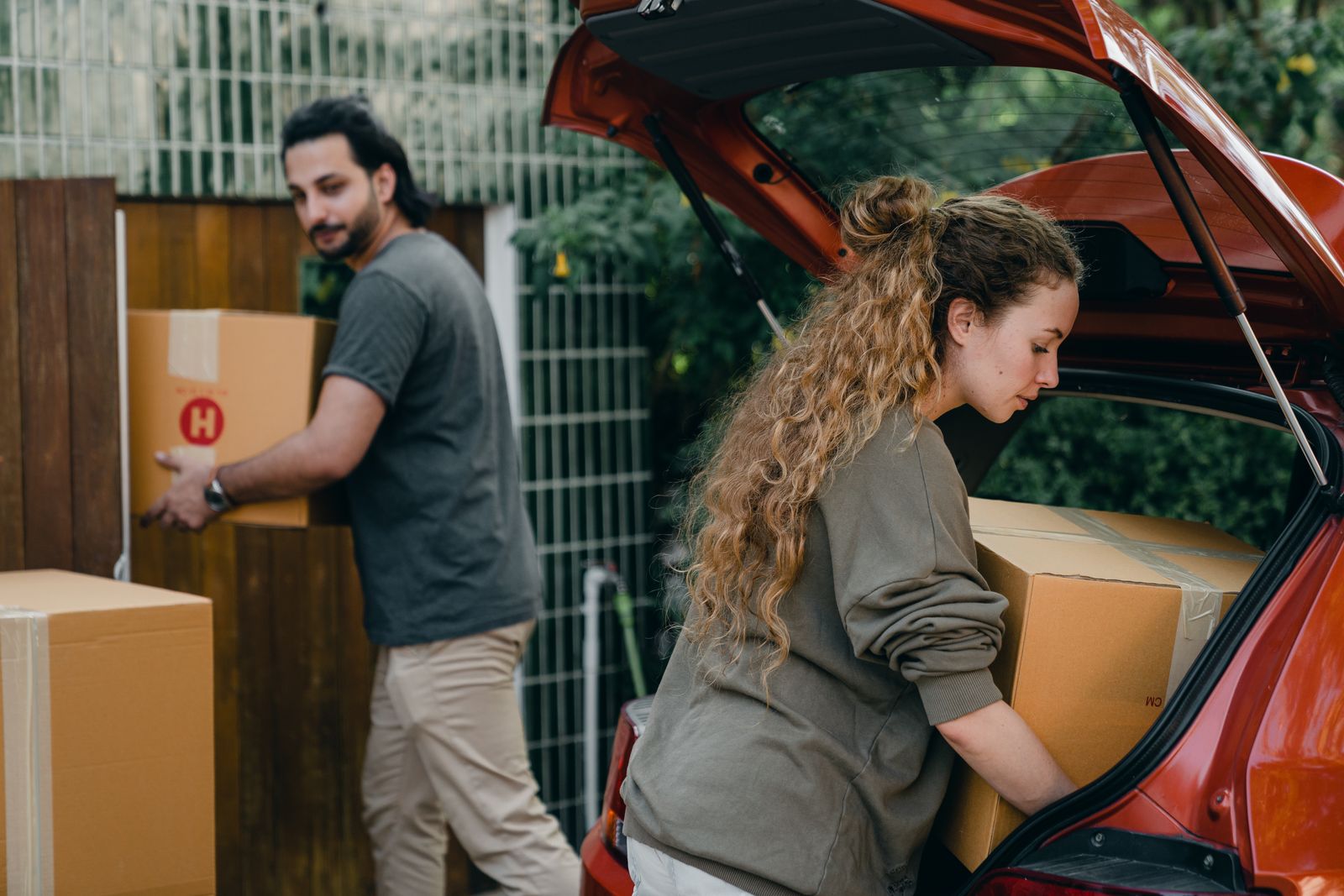
- Couple unloading boxes from a car at their new home — photo by Ketut Subiyanto, https://www.pexels.com/photo/young-couple-unpacking-car-in-yard-of-new-house-4246263/
- Family unpacking moving boxes in their new kitchen — photo by cottonbro studio, https://www.pexels.com/photo/family-unpacking-after-moving-4569340/
More guides
- How to Hire a Moving Company That Won't Hold Your Furniture HostageMovers › Moving & Storage
- How Much Do Movers Cost? Local vs. Long-Distance Pricing ExplainedMovers › Moving & Storage
- Binding vs. Non-Binding Estimates: The Difference That Decides Your Final BillMovers › Moving & Storage
- Moving Insurance and Valuation: What 'Full Value Protection' Really CoversMovers › Moving & Storage
- Long-Distance Moving: A Start-to-Finish Guide for Household GoodsMovers › Household Goods Moving & Storage
- All Guides & ArticlesBrowse the full guides library