Movers › Mini & Self Storage
Mini and Self Storage Contracts and Paperwork: What to Read, Question and Never Sign Blind
Dispatch teaches you a pattern. The customer who calls in a panic about storage is almost never panicking about the unit. The unit is a metal box; it does what it says. They are panicking about a sentence — a rate that doubled, a lock that was cut, a fee they never heard of, a sale notice that went to an old address. Every one of those sentences was in the paperwork they signed, usually in about four minutes, standing at a counter with a truck idling outside.
If you are renting storage between leases, that counter is exactly where you will be: tired, mid-move, and inclined to sign anything with a unit number on it. This guide is the slow read you should do before that moment. A self-storage rental agreement is a short contract by legal standards, but it is an unusual one, and the clauses that decide disputes are not the ones on the first page.
First, understand what you are actually signing
A storage rental agreement is not a residential lease, and the difference is not pedantry. As the trade literature for facility operators puts it, the agreement should state plainly that the relationship is not a residential tenancy but a license to use a space for storing property — and, crucially, that self-storage is a non-bailment service. The facility never takes care, custody, or control of your things. You lock them in; you hold the key; legally, your property remains in your possession, in their building.
That one idea explains almost everything else in the contract. It is why the facility does not insure your goods. It is why the agreement says you store at your own risk. And it is why your protections come from state self-storage lien statutes and from the specific words in your agreement — not from the landlord-tenant law that covers your apartment. There is no habitability standard, no eviction court, and in most states no cap on what the rent can become. Read accordingly.
The money clauses: rent, increases, and the fee schedule
The introductory rate is a starting point, not a price. Most storage agreements are month-to-month, and most reserve the facility's right to raise the rent on written notice — commonly 30 days. Operator guidance treats that clause as a standard must-have, and consumer contract guides put typical increases at roughly 5 to 10 percent a year, sometimes applied more often than annually. A unit that is a bargain for a two-month gap between leases can be a poor deal by month nine, and nothing in a standard agreement stops it. Before you sign, ask two questions out loud: how long is this rate guaranteed, and when was this facility's last increase on this unit size? You may not get a lock-in — some facilities will offer one on a longer commitment, many will not — but the answers tell you what you are actually budgeting.
The due date and the late fee are a system, not a suggestion. Find, in the document itself: the day rent is due (the first of the month, or the anniversary of your move-in date — both are common, and confusing them is how careful people pay late), the grace period if any (typically five to ten days, and contractual rather than guaranteed by law), and the late fee amount and structure. Late fees run as flat charges — consumer guides put them commonly in the $10 to $50 range — or as a percentage of rent, and some states cap them by statute; Oregon, for example, limits a late fee to the greater of $20 or 20 percent of monthly rent, and requires the agreement to state the amount and when it applies. If the fee in front of you looks nothing like your state's norm, that is a question to ask before signing, not after the first late notice.
Price the whole occupancy, not the rent. The monthly number on the sign is one line of the real cost. Read for the rest:
| Charge | Where it hides | What to confirm before signing |
|---|---|---|
| Admin / move-in fee | One-time, at signing | The exact amount, and whether any of it is refundable |
| Required insurance or protection plan | Monthly, added to rent | Whether your own renters or homeowners policy satisfies the requirement instead |
| Lock | At signing, or a required purchase | Whether you may use your own lock, and what a lock cut costs if you lose the key |
| Late and lien fees | In the default section | Amounts, grace period, and the day access is denied |
| Move-out charges | In the termination section | Notice period, condition required, and whether a partial month is refunded or kept |
None of these fees is automatically improper. The problem is discovering them from an invoice instead of from the agreement you were handed.
The lien clause: the most powerful paragraph in the building
Unique to this industry, the operator holds a lien on everything inside your unit. If rent and fees go unpaid, the facility can deny you access, overlock the unit, and — following your state's lien statute — sell the contents at public or private auction. The agreement should reference the applicable state lien law and describe the notification process, because the statute, not the facility's preference, sets the timeline of notices and waiting periods before a sale.
Three practical consequences follow for someone between leases. First, the notices go to the contact information in the agreement: the operator's own guidance stresses that notices are sent to the last address and email the tenant provided, and that updating it is the tenant's responsibility. You are, by definition, moving. The address on your rental agreement is about to stop being where you live. Give the facility the address and email you will actually monitor for the whole storage term, and update them in writing when they change.
Second, know your state's shape of the process before you need it: how long after default a sale can happen, how notice must be delivered, and that in most states you can stop a sale by paying what is owed up to the moment it begins. Timelines vary widely — some states run roughly 60 days of nonpayment before an auction is possible, and notice rules differ down to the delivery method.
Third, servicemembers have an extra layer: agreements routinely include a military-service representation, and federal law gives active-duty servicemembers specific protection against storage lien enforcement. If that could ever apply to you, the clause is worth reading twice.
Insurance and the value cap: the quiet clauses that decide losses
Read the liability section as if the unit has already flooded, because that is the moment it will matter. Standard agreements limit the facility's liability hard: the contract guides describe limitation clauses that commonly reduce the facility's responsibility for theft, water damage, fire, or pests to zero, sometimes replaced by a modest cap. Paired with it you will usually find a limitation on the value of property stored — a declared maximum that confines any potential claim to the figure in the agreement. If you sign a form declaring a low maximum value and then store a piano and a decade of records, you have capped your own recovery before anything went wrong.
Then the insurance clause. Most agreements require you to carry insurance on the stored goods and state that the facility provides none. You generally have three routes: your existing homeowners or renters policy (which often extends some coverage to property in storage, frequently a percentage of your personal-property limit — confirm it with your insurer rather than assuming), a standalone storage policy, or the protection plan sold at the counter. The counter plan is the easiest and often the most expensive per dollar of coverage, and it is a protection plan, not always a true insurance policy. The clause to question is any version that requires the facility's plan specifically and refuses your own proof of coverage. That is a revenue clause wearing a safety clause's clothes.

Use rules, access, and the words "climate controlled"
The prohibited-items list is enforceable, and breaching it can be a default event all by itself: expect bans on hazardous and flammable materials, perishables and food, living things, and anything illegal, plus an absolute ban on living or sleeping in the unit and usually on running a business from it. If you were planning to store paint, fuel, or a wine collection, read the list before the truck is loaded, not at the door.
Access terms decide how usable the unit is between leases: gate hours, whether access is 24-hour or office-hours only, and the point at which nonpayment denies access entirely. And if you are paying extra for climate control, know what the words legally mean — which is often very little. Operator guidance advises facilities to promise no specific temperature or humidity range, describing climate control as an attempt to keep the space within a broad band, roughly no colder than 60 and no hotter than 80 degrees in the example language. If you are storing wood furniture, instruments, or photographs through a summer, ask what the facility actually maintains and get the answer in writing if it influences your choice.
Finally, the clause that swallows every verbal promise: nearly every agreement contains an entire-agreement provision stating that the written document is the whole deal. The friendly assurance at the counter — "we never raise rates in the first year," "we'd call you before anything happened" — is worth exactly nothing against that clause unless it is written into the agreement or an addendum. If a promise matters, ask for it in writing. A facility that means it will write it.
Ending the agreement without paying for an empty unit
Move-out is paperwork too. Find the notice you must give (commonly somewhere between a week's and a month's written notice), whether rent is prorated for a partial final month or charged whole, the condition the unit must be left in, and what happens to anything left behind — abandoned-property handling follows the same lien and disposal logic as default. Put your notice in writing, keep a copy, photograph the empty, swept unit with your lock removed, and get a receipt or email confirming the account is closed. The most common post-storage billing dispute in dispatch experience is not a fee at all; it is rent charged for a month after the customer swears they moved out, against a facility that has no record of notice. Paper beats memory.
Questions to ask at the counter
- How long is this rate guaranteed, and how much notice do you give before an increase?
- What is the total due today, itemized — rent, admin fee, lock, insurance — and what will the ordinary monthly total be?
- When exactly is rent due, what is the grace period, and what is the late fee? On what day do you deny access, and on what timeline can a lien sale happen in this state?
- Will you accept my own renters or homeowners policy as proof of insurance? What value limit does this agreement put on my stored property?
- What are the gate hours, and is "climate controlled" defined anywhere with an actual temperature range?
- How do I give move-out notice, is the last month prorated, and how will you confirm my account is closed?
- Which address and email will you use for rate and lien notices — and how do I update them?
Storage between leases is usually a few months of your life and a few hundred dollars. It goes wrong in exactly one way: a clause you did not read, applied on a timeline you did not know, to an address you no longer check. The directory behind this site lists 2,753 mini and self-storage listings among its moving companies, and the facilities themselves are more alike than different. The contracts are where they differ. Read yours like the dispute has already happened — because for the person at the counter, in the month they needed the unit most, it eventually did.

Sources
- Inside Self-Storage, "Key Legal Provisions of a Self-Storage Rental Agreement" — the agreement as a license rather than a residential tenancy, self-storage as a non-bailment service, storing at the occupant's own risk, value limitations, and the operator's lien and auction rights under state law: https://www.insideselfstorage.com/legal-issues/key-legal-provisions-every-self-storage-rental-agreement-should-include-in-2025
- Inside Self-Storage, "Now's a Great Time to Update Your Self-Storage Rental Agreement" — rate increases on 30 days' notice, notices sent to the tenant's last provided address and email, climate-control language that promises no specific temperature range, and entire-agreement clauses: https://www.insideselfstorage.com/legal-issues/now-s-a-great-time-to-update-your-self-storage-rental-agreement-here-s-why-and-what-to-include
- Vail Airport Storage, "Storage Unit Contract Terms to Understand Before Signing" — late fee ranges, liability limitations, and homeowners and renters policies extending coverage to stored property: https://www.vailairportstorage.com/storage-unit-contract-terms-before-signing
- Oregon storage lien law summary, StatesLaws — Oregon's late-fee cap (the greater of $20 or 20 percent of monthly rent) and the written-agreement requirement under ORS 87.685–87.694: https://stateslaws.com/oregon-storage-unit-laws-liens-sales-and-tenant-rights/
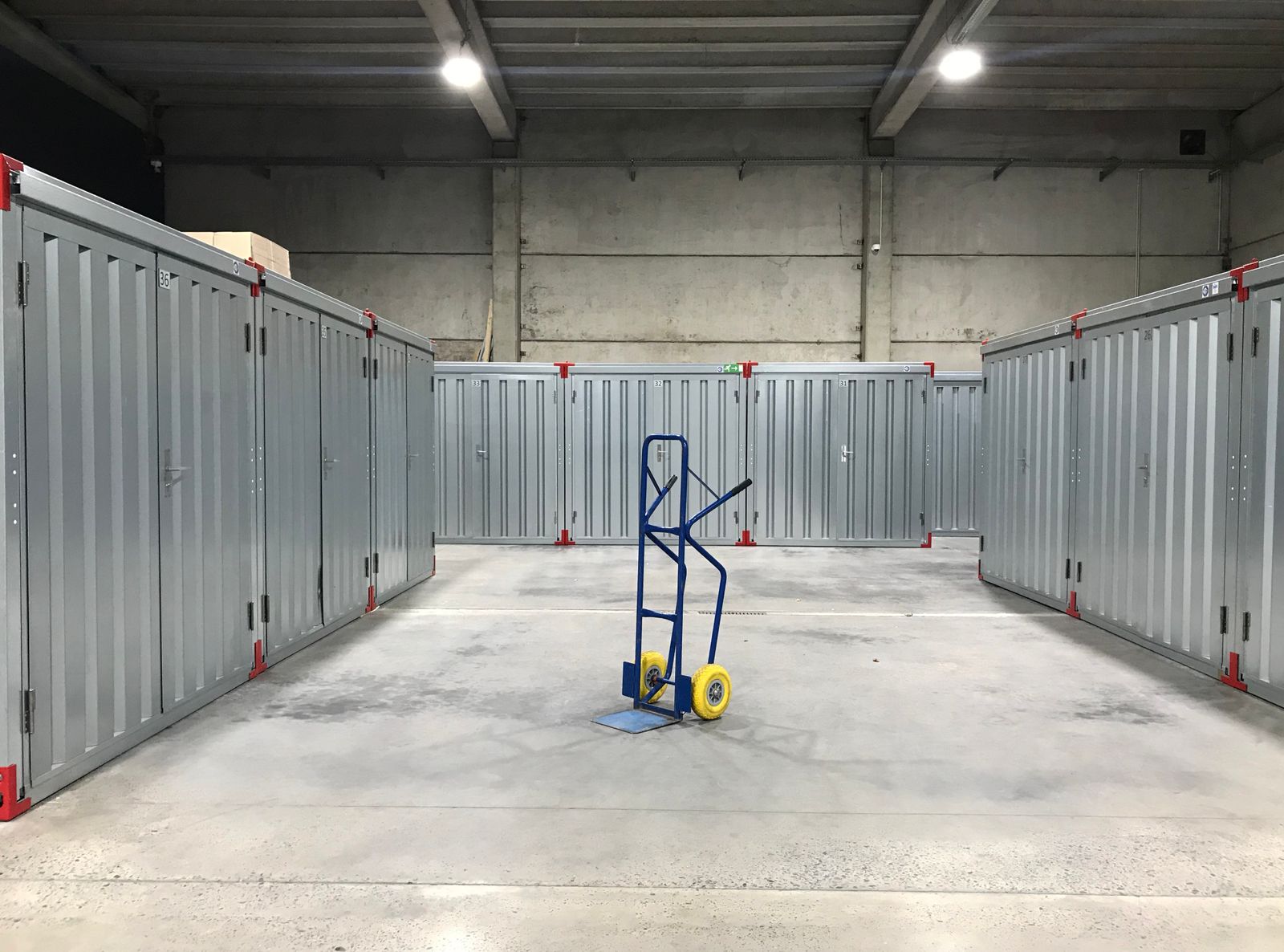
- Indoor storage units with a hand truck — photo by David Slaager, https://www.pexels.com/photo/5759145/
- Labeled cardboard boxes ready for moving — photo by cottonbro studio, https://www.pexels.com/photo/4554242/
- Cardboard boxes stacked on a wooden floor — photo by cottonbro studio, https://www.pexels.com/photo/4568693/
More guides
- How to Hire a Moving Company That Won't Hold Your Furniture HostageMovers › Moving & Storage
- How Much Do Movers Cost? Local vs. Long-Distance Pricing ExplainedMovers › Moving & Storage
- Binding vs. Non-Binding Estimates: The Difference That Decides Your Final BillMovers › Moving & Storage
- Moving Insurance and Valuation: What 'Full Value Protection' Really CoversMovers › Moving & Storage
- Long-Distance Moving: A Start-to-Finish Guide for Household GoodsMovers › Household Goods Moving & Storage
- All Guides & ArticlesBrowse the full guides library