Movers › Shelving Commercial & Industrial
Shelving Commercial and Industrial on a Tight Budget: Where to Save, and Where Saving Backfires
When a business moves — or a family business moves its stock, tools and overflow with it — shelving is the purchase everyone tries to make cheaply, because it looks like the simplest thing in the building. It is bent steel. How much engineering can there be? Enough, it turns out, that the industry prices it by the pallet position, rates it by the pound, anchors it against collapse, and inspects it like a structure — because that is what it is. A loaded rack bay is a small building that you assemble yourself, and the budget question is never really “new or used.” It is which parts of the system carry risk, and which are merely steel.
Coordinating relocations, I watched companies save 40 percent on racking and spend it back twice — once on an engineering review nobody budgeted, and once on replacing components that should never have been bought. I also watched careful buyers build excellent systems for half of new price. The difference was not luck. It was knowing where the money is safe to take out. This guide draws that line.
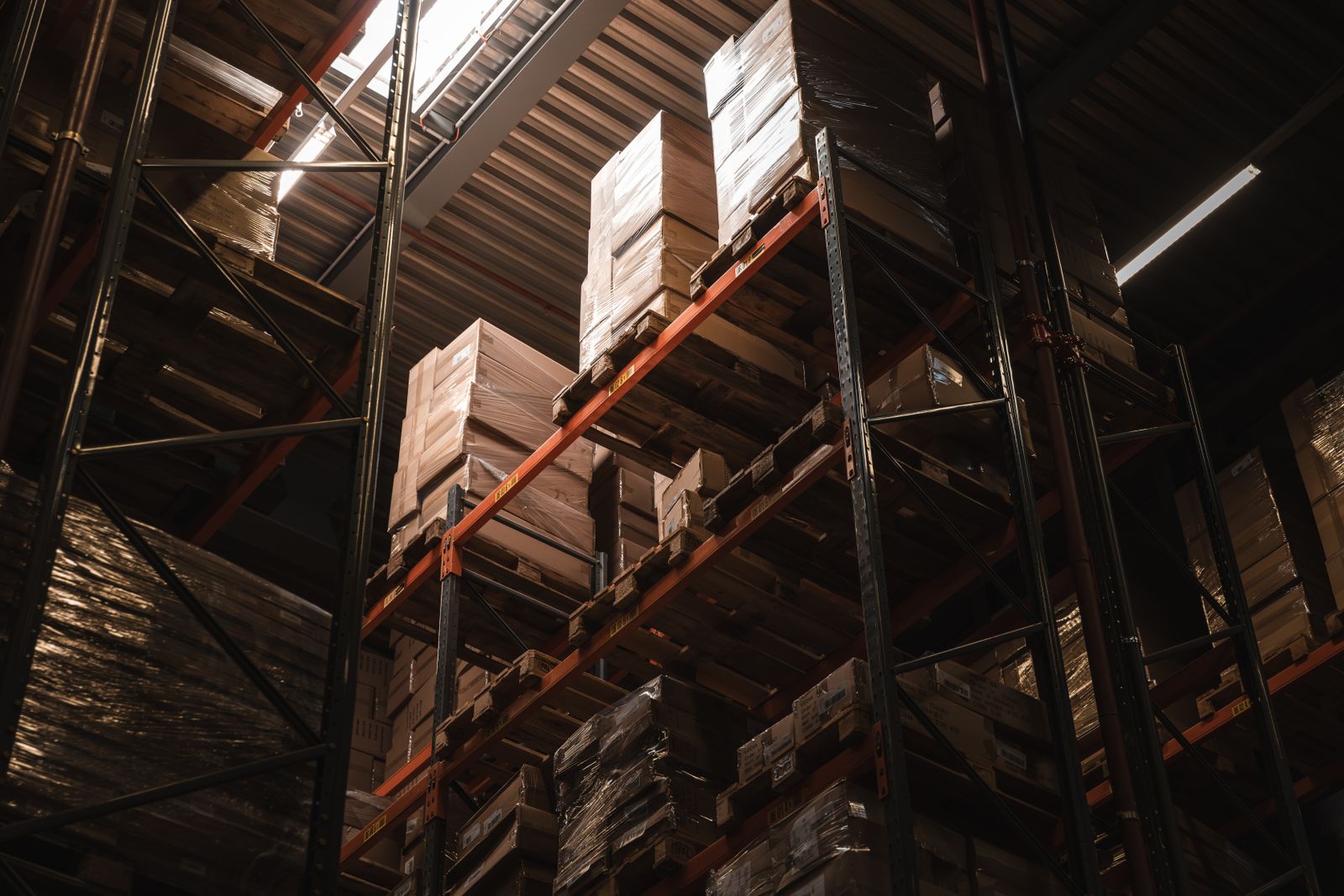
What the system actually costs, in units you can compare
Shelving and racking are quoted in a fog of bay sizes and configurations, so convert everything to the industry's common currency before you compare: cost per pallet position for racking, and cost per bay for shelving.
New selective pallet racking — the standard, most flexible system — typically runs $50–$120 per pallet position depending on the source and whether installation is included, with equipment making up roughly 35 to 50 percent of a complete turnkey project once design, permits and installation are counted. High-density systems cost far more per position: drive-in at $200–$250, push-back at $220–$400, pallet flow at $550–$850. Boltless industrial shelving for cartons, parts and tools runs roughly $200–$800 per bay, scaling with shelf capacity from a few hundred pounds to over 2,000. Cantilever racking for long loads — lumber, pipe, furniture — runs $1,000–$3,000 or more per bay, with arm capacities of roughly 500 to 3,000 pounds that fall sharply as arms lengthen.
Used selective racking is the headline saving: typically 30 to 50 percent below new, with used positions quoted around $20–$75 against $50–$150 new. That gap is real money on any system of size. It is also where the rest of this guide lives, because the saving is genuine only when the used steel is what it claims to be.
Where saving works
Buy used selective racking — for standard duty. The sweet spot is well documented by the dealers who sell both: standard pallets at typical weights of 1,500–2,500 pounds, in mid-height systems of 12 to 16 feet, are well served by quality used selective rack with verified load ratings and a clean inspection. Structural steel does not wear out on a schedule; what ages is paint and protective accessories. A used bay, inspected and correctly installed, performs like a new one.
Buy used beams and decking before used uprights. Practical projects blend: new uprights where load requirements are critical, used beams and wire decks where flexibility allows. Beams are simpler, more interchangeable and easier to inspect than frames; the hybrid captures much of the saving with less of the risk.
Match the connector system you already have. If your existing racking is a common teardrop system, compatible used add-on bays are the cheapest capacity you will ever buy — no re-engineering of the whole, no mixed hardware. Consistency is a saving in itself: one connector type, one gauge family, one supplier who will still have matching bays when you expand.
Save on density you do not need. Every step up the density ladder multiplies cost per position. If your operation picks most pallets most days, selective racking at the lowest price per position is not the cheap option — it is the correct one, and the high-density premium would have bought nothing but slower access.
Save on finish and features, not on steel. Powder-coat colour, brand badges, and cosmetic perfection are negotiable. A scratched beam that is straight and rated is worth more than a gleaming one that is not.
Where saving backfires
Unknown load ratings. This is the false economy that underlies most of the others. A rack's capacity is a property of its exact configuration — upright gauge and height, beam size and level spacing — and used rack frequently arrives with no documentation. If the seller cannot provide the original manufacturer load data, the honest routes are an independent engineering review before use and new load placards for the installed configuration (budget roughly $50–$200 per rack row for placards, and $500–$2,000 for inspection labour on a system of any size). A “bargain” that needs engineering to become legal is a smaller bargain than it looked — price it in before you buy, not after.
Damaged components at a discount. Forklift impact causes the overwhelming majority of rack damage, and its effect is not cosmetic: a single overlooked dent in an upright can cut that column's load-bearing capacity by half or more. Bent or split uprights and deformed beams are not savings opportunities; they are liabilities with a price tag. Inspect every frame at purchase, reject damaged steel outright, and never let a discount talk you into a component you would flag in your own safety audit.
Skipping anchors, pins and placards. The small hardware is where tight budgets cut deepest and worst. OSHA has no single pallet-rack regulation; it enforces rack safety through the General Duty Clause and the material-handling rules at 29 CFR 1910.176, using the industry standard ANSI MH16.1 as its yardstick — and its citations have specifically targeted racks that were not anchored to the floor and installations with no load capacity plaques. Penalties under the General Duty Clause can reach six figures per violation. Anchoring, beam safety pins and accurate placards cost, together, a rounding error against the racking itself. There is no budget tight enough to make them the saving.
Mixing incompatible components. Used rack must be verified for connector type, column gauge and beam compatibility before purchase. A system assembled from three manufacturers' near-matches may stand up and may even load — and has no defensible capacity rating at all, because no engineer ever rated that combination. Compatibility is not fussiness; it is what makes the number on the placard mean something.
Under-buying capacity for heavy or tall duty. Heavy loads — 2,500 pounds and up per pallet — very tall uprights over 20 feet, and structural applications are where the dealers themselves steer buyers to new equipment engineered and rated to the exact specification. The used market is thinnest exactly where the engineering matters most, and a collapse costs more than every saving in this guide combined: inventory, downtime, injury risk and citation exposure, all at once.
| Decision | Verdict | Why |
|---|---|---|
| Used selective rack, standard loads, inspected | Save | 30–50% below new; steel does not expire |
| Used beams/decks with new uprights | Save | Captures the saving where inspection is easiest |
| Same connector system as existing rack | Save | No re-engineering; future bays stay compatible |
| Selective instead of high-density | Save | $50–$120 vs $220–$850 per position where access matters more than density |
| Used rack with no load documentation | Backfires | Engineering review and re-placarding eat the saving |
| Discounted damaged uprights or beams | Backfires | A dent can halve a column's capacity |
| Skipping anchors, pins, placards | Backfires | The exact failures OSHA cites; trivial cost to do right |
| Mixing manufacturers' components | Backfires | No rated capacity exists for the combination |
| Used rack for 2,500 lb+ pallets or 20 ft+ heights | Backfires | Buy new, engineered to spec |

The tight-budget playbook, in order
- Measure your real loads first. Weigh your heaviest pallets and count your positions. Every decision downstream — new, used, capacity — prices off those two numbers, and guessing them is how budgets buy the wrong system at any price.
- Get the per-position price, three ways: new, quality used from a dealer who inspects, and the hybrid. Include freight, installation, anchors, pins, placards and any engineering in each — the comparison is only honest at the installed, legal number.
- Inspect used steel like a buyer, not a bargain hunter: straight uprights, undamaged beams, verified connector and gauge, documented ratings or an engineering budget to establish them.
- Spend the small money without flinching: anchors, safety pins, placards showing maximum unit load, load per level and total per bay, and an annual inspection habit with records. Documented inspections are the cheapest liability protection in the building.
- Phase the build. Buy the bays this year's volume needs, in a system you can extend compatibly, rather than a warehouse-full of mismatched bargains. Capacity you can add to beats capacity you have to work around.
This site lists 363 commercial and industrial shelving listings, and the market beyond it is deep in both new and used steel. The tight budget is not the obstacle — misallocated saving is. Save on the steel's history, its finish and its density. Never save on knowing what it can hold, keeping it anchored, or proving either. That is the whole art, and it is cheaper than the alternative in every currency that matters.
Sources
- Hammerhead, “What Pallet Racking Typically Costs” — installed pricing per pallet position: selective at $80–$120, drive-in at $200–$250, push-back at $220–$400, pallet flow at $550–$850, cantilever per arm level, used selective at 30–50% off new, and equipment as 35–50% of a turnkey project.
- Atlanta Pallet Rack, “New vs. Used Pallet Rack” — new at $50–$150 per position against used at $25–$75, inspection costs of $500–$2,000, placards at $50–$200 per row, and the duty profiles where used and new each win.
- Richmond Rack, “Pallet Racking Buying Guide: New vs. Used” — blending new uprights with used beams and decking, verifying load documentation independently for used rack, and placards reflecting the actual installed configuration.
- Guangshun (GS Rack), “Warehouse Shelving Prices” — boltless industrial shelving at $200–$800 per bay by capacity and cantilever racking at $1,000–$3,000+ per bay.
- Legal Clarity, “OSHA Pallet Racking Requirements, Standards & Penalties” — enforcement through the General Duty Clause and 29 CFR 1910.176, ANSI MH16.1 as the benchmark, citations for unanchored racks and missing load plaques, and penalty levels.
- Damotech, “OSHA Pallet Rack Requirements” — posted and recalculated load capacities, and taking damaged racks out of service for qualified repair.
Photos: - Warehouse shelves with boxed goods — photo by Ryan Klaus, https://www.pexels.com/photo/27111449/ - Worker between warehouse shelves — photo by Alexander Isreb, https://www.pexels.com/photo/1797415/
More guides
- How to Hire a Moving Company That Won't Hold Your Furniture HostageMovers › Moving & Storage
- How Much Do Movers Cost? Local vs. Long-Distance Pricing ExplainedMovers › Moving & Storage
- Binding vs. Non-Binding Estimates: The Difference That Decides Your Final BillMovers › Moving & Storage
- Moving Insurance and Valuation: What 'Full Value Protection' Really CoversMovers › Moving & Storage
- Long-Distance Moving: A Start-to-Finish Guide for Household GoodsMovers › Household Goods Moving & Storage
- All Guides & ArticlesBrowse the full guides library