Movers › Shelving Commercial & Industrial
Shelving Commercial and Industrial Prices Across the Country: Why the Same Job Costs Twice as Much Two States Away
A pallet rack is one of the most standardized objects in American commerce. The uprights and beams in a warehouse in Ohio are interchangeable, in principle, with the uprights and beams in a warehouse in California; the industry prices them in a universal unit, the pallet position, and a competent quote from anywhere can be compared to a quote from anywhere else. And yet the same selective racking job — same positions, same heights, same product going onto it — can legitimately cost twice as much in one state as in another, with nobody padding anything. When I dispatched, the equivalent puzzle arrived weekly in freight form: identical loads, wildly different rates, and reasons that were always structural once you dug. Shelving is the same. This guide digs: what a pallet position actually costs in 2026, and the four forces — steel and freight, labor markets, seismic and permit regimes, and the local supply of used rack — that move the number across the map.
The national baseline: what a position costs
Everything in this trade is quoted per pallet position — one pallet's worth of storage slot. Current published pricing converges on a consistent national picture for the workhorse system, selective racking:
| Component | Typical national range |
|---|---|
| Selective racking, materials (new) | $50–$120 per position |
| Selective racking, installed | $80–$160 per position |
| Installation labor | $15–$35 per position on typical jobs (published ranges run from $3–$8 for basic work to $20+ where installers price it as 15–35% of materials) |
| Engineering and permits | $2,000–$8,000 per project where required |
| Used selective racking | 40–60% of new material prices; roughly $50–$100 per position installed |
Regional dealer pricing shows the same skeleton with local flesh on it. In Austin, Texas, a rack dealer’s October 2026 price list puts new selective racking at $85–$125 per pallet position and used at $60–$85, before installation; a single 16-foot bay — two uprights, two pairs of beams, four wire decks — runs $580–$770 new against $350–$540 used, with installation adding $15–$35 per position. A national installed-cost guide for 2026 lands its worked example — 1,800 positions of back-to-back selective rack — at $119 per position all-in. Hold those numbers: a standard job, in a standard market, is an $80–$160-per-position proposition installed. Now watch what geography does to it.
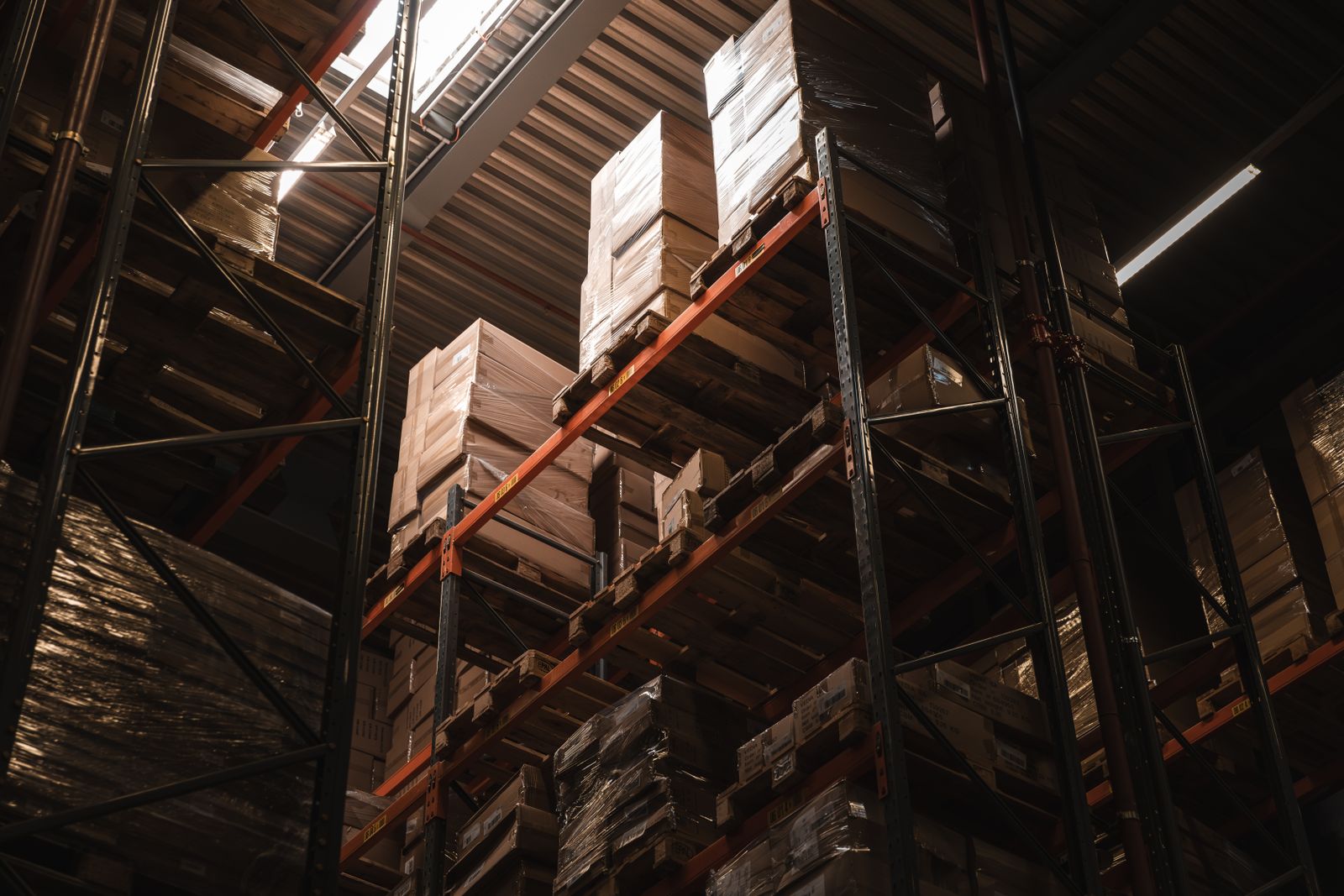
Force one: steel is national, freight is not
Rack steel is priced off national steel markets, which tempts buyers to expect national prices. But racking is heavy, bulky, and cheap per pound — the profile of a product whose delivered price is dominated by freight. Uprights are mostly air and length; a truck fills up by volume long before it fills by weight. The result is a map of manufacturing and distribution gravity: rack made or stocked near the big production and import corridors travels short distances to the warehouse belts around them, while a project in a thin market pays to haul steel hundreds of miles and pays again in lead time. Quotes in this industry are frequently FOB — freight on board — meaning the material price excludes shipping entirely, and the freight line arrives later as the surprise. Two quotes $20 apart per position can reverse their order once freight is in. The first geographic question to ask any bidder is not "what's your price" but "where does this ship from?"
Force two: labor markets set the installation line
Installation is skilled, insured, physical work — anchoring into slabs, leveling frames, hanging beams at height — and it is priced by local labor markets like every other trade. Published installation ranges reflect that spread: basic selective installation is quoted as low as $3–$8 per position in cost-guide tables, typical dealer pricing runs $15–$35 per position, and complex systems in expensive labor markets push far higher, with installation overall landing at 15 to 35 percent of material cost. The same crew-day costs what a crew-day costs in that metro: warehouse labor in coastal California, the Pacific Northwest, and the Northeast corridor prices against some of the most expensive labor markets in the country, while the Southeast, Texas, and the Midwest price against cheaper ones. This is the largest single reason the "same job" doubles: on a 2,000-position project, a $20-per-position installation gap is $40,000 — more than the entire engineering budget — and it reflects wages and insurance, not margin.
Insurance rides along inside that line. Installers working in warehouses carry liability and workers' compensation priced by state regimes, and buyers in litigious, high-cost states pay for those regimes whether or not the quote itemizes them.
Force three: seismic country rewrites the job
Nowhere does geography change the physical job itself more than in earthquake country. Most states follow the International Building Code, under which rack systems over about 8 feet attract permits; California's building code triggers a rack permit at 5 feet 9 inches of height — a threshold an ordinary warehouse rack passes on its way up. Beyond the permit, California seismic design changes the hardware and the paperwork together:
- Stamped engineering is mandatory in practice. A licensed structural or civil engineer must calculate site-specific seismic loads under ANSI MH16.1 (the Rack Manufacturers Institute standard) and ASCE 7, specify anchoring and bracing, and stamp the drawings before the building department issues a permit.
- The steel gets heavier. Seismic installations use larger baseplates — 8×8 or 12×12 inches against a standard 3×5 — high-strength wedge or epoxy anchors drilled deep into the slab, and cross-aisle bracing at specified intervals on taller systems.
- A second permit joins the first. Storage with product above 12 feet (6 feet for high-hazard goods) is high-piled storage under the fire code, bringing a fire-marshal review of sprinklers and flue spaces on top of the building permit.
Cost guides put engineering and permits at $2,000–$8,000 a project nationally; California permit guidance goes further, with fees alone sometimes running 10 to 30 percent of project value on permitted work, plus the engineering invoice, plus timelines measured in weeks — one Texas dealer budgets two to six weeks for permit-and-engineering on tall systems even outside seismic country. A California quote that looks bloated next to a Nevada quote for identical rack is usually carrying an engineer, a building department, a fire marshal, and heavier baseplates. It is not the same job. It only photographs the same.
There is a corollary for the used market: racking engineered for a low-seismic state may not satisfy California's Seismic Design Category D and E requirements, which is why California dealers warn that out-of-state used rack often can't be permitted at home. Geography doesn't just change the price of used steel; in seismic country it can disqualify it.
Force four: the used-rack map is a liquidation map
Used racking is the great equalizer — 40 to 60 percent of new material prices, available immediately instead of on factory lead times — but its supply is intensely local. Used rack comes from warehouse closures, consolidations, and reconfigurations, which means it pools where warehouses churn: the great logistics corridors. A buyer near a distribution hub shops a deep local inventory of used uprights and beams, inspects it in person, and hauls it a short distance. A buyer in a thin market chooses between a shallow local pool, long freight on used steel (which eats the savings), or new. This is why two states can have identical new-rack pricing and wildly different project costs for a budget buyer: the discount market exists in one and barely in the other. On a tight budget — and this site lists 363 commercial and industrial shelving providers, so the shortlist is rarely the problem — the used dealers within a hundred miles of your slab are worth more than any national price table, including the ones in this guide.
How to tell whether your local price is fair
- Convert every quote to dollars per pallet position, installed, freight included. Quotes that exclude freight, installation, or engineering are not cheaper; they are unfinished. A complete selective job should land somewhere in the $80–$160 band in a normal market — higher with seismic engineering or density systems, lower with used steel.
- Ask where the material ships from and what the freight line is. If freight is "TBD," the quote is a partial number wearing a total's clothes.
- Separate the permit question early. Ask the bidder what your jurisdiction requires at your rack height and storage height — and whether their price includes stamped engineering. In California and other seismic jurisdictions, a quote without engineering is a quote for a different, unpermittable job.
- Get the installation line on its own. Compare it against the $15–$35 typical band and your local labor market. Outliers in either direction deserve a question.
- Price the used option locally before defaulting to new. A 40–60 percent material saving is the largest single lever most budgets have — provided the used system can be permitted where you stand, which in seismic country is a question for the engineer, not the seller.
- Check the system match. Density systems price at multiples of selective — push-back at $150–$300 a position, pallet flow at $200–$500 — and are worth it only when your SKU profile actually needs the density. The most expensive shelving mistake is buying flow rack economics for a selective rack problem.
The steel is a commodity. The job is not. Once a quote is decomposed into steel, freight, labor, and law, the map explains itself — and a price that is twice the next state's stops looking like a rip-off and starts looking like what it usually is: the same rack, standing on different ground, priced by the ground it stands on.
Sources
- Massey Rack, "Used Vs. New Pallet Racking Cost in Texas (2026)" — Austin pricing: new selective racking at $85–$125 per pallet position, used at $60–$85; a 16-foot bay at $580–$770 new and $350–$540 used; component prices for uprights, beams, and wire decks; installation at $15–$35 per position; permits and engineering budgeted at $1,500–$5,000 with two-to-six-week timelines.
- WarehousingCosts, "Pallet Racking Cost in 2026" — selective materials at $50–$120 per position by system type; basic installation $3–$8 and complex installation $10–$25 per position; engineering and permits at $2,000–$8,000; used racking at 40–60 percent of new; a 1,000-position selective system at $65,000–$150,000 installed.
- Conesco, "How Much Does Pallet Racking Cost? (2026)" — new racking at $50–$500 per position by system and used at $20–$300; installation at 15–35 percent of material cost; FOB pricing with freight on the buyer; liquidation recovery of 20–50 percent of original cost.
- RackCity, "Pallet Racking Cost per Position, Installed (2026)" — installed selective racking at $80–$160 per position nationally; the component split of a typical $115 installed position across frames, beams, decking, and installation; a worked 1,800-position quote landing at $119 per position.
- Rack Man, "California Pallet Rack Seismic Requirements" — California's permit trigger at 5 feet 9 inches against the IBC's roughly 8 feet; licensed-engineer seismic calculations under ANSI MH16.1 and ASCE 7; seismic baseplates of 8×8 to 12×12 inches against a standard 3×5; high-strength anchoring and cross-aisle bracing.
- Speedrack West, warehouse racking permit guide — building permits and high-piled storage fire permits as the two approvals; stored product above 12 feet (6 feet for high-hazard goods) triggering fire-marshal review.
- Lean Inc, "Building Permit Requirements for Racking Installation in California" — permit fees ranging from 10–30 percent of total project value on California racking work, and the seismic calculation and drawing submission process.
- Photo by Ryan Klaus, https://www.pexels.com/photo/low-angle-shot-of-boxes-standing-on-the-shelves-in-a-warehouse-27111449/
- Photo by ELEVATE, https://www.pexels.com/photo/man-riding-a-yellow-forklift-lifting-boxes-1267324/
- Photo by Alexander Isreb, https://www.pexels.com/photo/men-going-around-a-warehouse-1797428/
More guides
- How to Hire a Moving Company That Won't Hold Your Furniture HostageMovers › Moving & Storage
- How Much Do Movers Cost? Local vs. Long-Distance Pricing ExplainedMovers › Moving & Storage
- Binding vs. Non-Binding Estimates: The Difference That Decides Your Final BillMovers › Moving & Storage
- Moving Insurance and Valuation: What 'Full Value Protection' Really CoversMovers › Moving & Storage
- Long-Distance Moving: A Start-to-Finish Guide for Household GoodsMovers › Household Goods Moving & Storage
- All Guides & ArticlesBrowse the full guides library