Movers › Specialty Movers
Specialty Moving Services Warranties and Guarantees: What They Promise and What They Quietly Exclude
A specialty mover's website is a wall of reassurance: fully protected, guaranteed safe delivery, white-glove care, your piano in expert hands. Some of that language describes real, enforceable commitments. Much of it describes marketing. And the distance between the two only becomes visible on the worst day of the process — the day something irreplaceable comes off the truck damaged, and everyone reaches for the paperwork.
Downsizing households meet specialty movers at exactly the wrong end of life for this lesson: the shipment is a piano bought in 1978, a mother's china, an antique dresser, a safe. The items least replaceable get moved by the companies with the warmest promises. This guide decodes the promises — what the law actually guarantees, what company "warranties" add, and the exclusions that quietly decide whether any of it pays.
The floor the law sets: valuation is not insurance
Start with the most misunderstood word in moving: the protection on your contract is almost certainly valuation, not insurance. Federal law — for interstate moves, the rules administered by the FMCSA — requires movers to offer exactly two liability levels, and neither is an insurance policy governed by state insurance law. They are tariff levels of carrier liability:
| Released Value | Full Value Protection (FVP) | |
|---|---|---|
| Cost | No additional charge | Added charge; varies by mover and deductible |
| What the mover owes | At most 60 cents per pound per article | The replacement value of lost or damaged goods in the shipment |
| How you get it | You must sign a specific waiver of FVP to choose it | The default on interstate moves unless you waive it in writing |
| What it means in practice | A 25-lb television is worth $15; a 200-lb antique dresser, $120 | The mover may repair the item, replace it with a like item, or settle at current market value — at the mover's choice |
Read the FVP column again, because specialty marketing leans on it hard. "Full value" does not mean your declared value, your purchase price, or your appraisal. It means replacement value as the mover determines it, with the remedy — repair, replace, or cash — at the mover's discretion. A specialist who "guarantees your piano will be made whole" is, in the contract, usually offering standard FVP plus a service promise. The service promise may be genuine. It is not a different legal instrument.
One more federal limit matters enormously for specialty shipments: movers may cap their liability for articles of extraordinary value — anything worth more than $100 per pound — unless you list those items in writing on the shipping documents. Jewelry and furs are the textbook examples, but for downsizers the trap items are the small, dense, precious ones: the coin collection, the sterling, the good watch, the antique clock's works. Undeclared, they ride at the cap. Declared on the high-value inventory, the mover accepts responsibility for them. This single form decides more specialty claims than any guarantee on any website.
The guarantees, translated
"On-time guarantee." Real versions exist and are worth having: one mover we reviewed waives its transportation fee — about $250 — if the crew misses its arrival window; another applies an automatic discount, no claim required. But long-distance delivery is a different animal from local arrival. Interstate delivery runs in windows measured in days, and a "guaranteed delivery date" is only as strong as its remedy clause: a per-diem payment, free storage-in-transit, or reimbursement of verified expenses, with a cap. If the guarantee names no remedy, it is a slogan. Ask: What do I receive, automatically or by claim, if the date is missed — and where is that written?
"Damage-free guarantee" / "white-glove guarantee." There is no such legal category. What a specialty mover can genuinely stand behind is process: trained crews, custom crating, climate-controlled trucks, single-item handling. When the process fails, your recovery still runs through valuation and the claims process below. Treat any damage-free language as a statement about how they work, never about what they'll pay.
"Satisfaction guarantee." The softest promise of all. Legitimate versions offer a defined remedy — a crew member replaced the same day, a service re-performed, a fee refunded. Undefined versions offer a phone call with a manager. The test is identical: remedy, trigger, and writing.
Price guarantees are the honorable exception. A binding or not-to-exceed estimate is a real contractual commitment about price, enforceable as written — which is why it is the guarantee whose terms specialty movers actually draft carefully.
The exclusions that decide claims
Every specialty contract carries an exclusion list, and the lists are strikingly similar across the industry. Compiled from published mover terms, these are the exclusions that most often swallow a downsizer's claim:
- Owner-packed boxes (PBO). Contents of boxes you packed yourself are excluded or reduced to the 60-cent floor across virtually every mover's terms — the carrier cannot verify what was in the box or how it was packed. If the china matters, the mover packs the china. This is the single most consequential exclusion in specialty moving, and it is entirely within your control.
- Particle board and flat-pack furniture. Pressboard and ready-to-assemble pieces are excluded beyond standard liability almost universally, on the stated ground that the material can fail under careful handling. The IKEA bookcase is, contractually, nearly uninsurable.
- Mechanical and internal condition. Electronics, appliances, and instruments that arrive with no visible external damage but no longer work are excluded: the mover is not liable for internal failure it cannot be shown to have caused. For pianos, this is the clause that matters — a piano that arrives intact but out of regulation, or with a cracked soundboard discovered by your tuner, will meet this exclusion head-on. A pre-move tuning and condition report, and a post-move inspection within days, are how you build the counter-evidence.
- Pre-existing damage and prior repairs — including loose veneer, dried-out glue joints, and previously broken-and-repaired items. Antique furniture lives in this clause. The origin inventory's condition notations are the battlefield: read them before you sign, and correct them in writing.
- Glass, marble, artwork, and lamps not packed or crated by the carrier. Uncrated stone and glass travel at your risk under many terms; the crating charge you declined is the exclusion you accepted.
- Sets and pairs. If one of a set is damaged, only that item is covered — not the set's lost value as a set.
- Items in third-party storage. Goods held at a storage facility the mover doesn't control fall outside its liability for that period.
- Acts of God and inherent vice — weather events, and damage arising from the item's own nature (humidity-sensitive finishes, temperature) are standard exclusions.

The claim steps that decide whether it pays
Federal rules give interstate customers nine months from delivery to file a written claim; the mover must acknowledge it within 30 days and pay, deny, or make an offer within 120 days, with status updates if it runs longer. Those are floors, not strategies. Claims are won or lost on four habits:
- Note damage on the delivery paperwork before signing — specifically, item by item. A signature on a clean inventory sheet is the mover's best exhibit. And never sign a receipt that contains language releasing the mover from liability; the FMCSA explicitly warns against it.
- Photograph everything twice — before the crew touches it (condition) and at delivery (damage), with the inventory numbers visible.
- Keep the packing. A claim about a broken item inside a mover-packed box is evaluated with the box and materials; discard them and you've discarded the evidence of how it was packed.
- File in writing, promptly, with values documented — appraisals, purchase records, or repair estimates. "Sentimental value" is not a recoverable category under any plan; documented market value is.
If the mover denies or lowballs, the escalation ladder runs: the mover's claims department in writing, then a complaint to the FMCSA (for interstate moves), your state regulator for intrastate moves, and — for amounts that justify it — the arbitration programs many van lines maintain, or small-claims court.

Buying the promise properly
None of this argues against specialty movers; a piano, a safe, or a fragile antique genuinely needs one — the directory behind this guide lists 377 Piano & Organ Moving businesses and 178 Specialty Movers in its Movers category alone, because the work is real. It argues for buying the promise in its contractual form: FVP selected, not waived; high-value items declared in writing; the mover packing everything fragile; condition documented before and after; and every guarantee you were sold produced in writing with its remedy attached. A specialty mover who welcomes those requests is telling you something true about itself. One who prefers the reassurance to stay verbal is telling you something, too.
Sources
- FMCSA, "Liability & Protection" (Protect Your Move) — the two federal valuation options; Released Value at 60 cents per pound per article; Full Value Protection as replacement-value liability; the $100-per-pound extraordinary-value limitation and declaring high-value items; the nine-month claim window. https://www.fmcsa.dot.gov/consumer-protection/protect-your-move/are-you-moving/liability-protection
- FMCSA, "Protect Your Move" brochure — the warning against signing delivery receipts containing release-of-liability language, and the nine-month written-claim rule. https://www.fmcsa.dot.gov/sites/fmcsa.dot.gov/files/docs/Understanding_Valuation_and_Insurance_Options_Brochure_0.pdf
- Surface Transportation Board, "Lost or Damaged Items" guidance — released rates at $0.60/lb, the bill-of-lading valuation statement, and claim periods that cannot be shorter than nine months under federal law. https://www.stb.gov/resources/need-assistance/hhg-moving/hhg-lost-or-damaged-items/
- Paradise Moving & Storage, published valuation-plan exclusions, and Mighty Moves published terms — representative exclusion lists: particle board, owner-packed box contents, mechanical/electronic failure, pre-existing damage, uncrated glass/marble/artwork, sets, third-party storage, acts of God. https://paradisemove.com/valuation-plans/ and https://www.mightymoves.us/terms/
- Silicon Valley Moving & Storage, "Moving Insurance Explained" — claim deadlines under 49 CFR Part 370 (acknowledgment within 30 days; disposition within 120 days) and the high-value declaration rule in practice. https://www.siliconvalleymoving.com/blog/moving-insurance-and-valuation-explained
- Extra Mile Moving and T&T Moving and Packing, published on-time guarantees — examples of guarantee language with stated remedies (transportation fee waived, ~$250; automatic discount for a missed arrival window). https://www.extramilemoving.com/services and https://www.tandtmoving.com/on-time-guarantee/
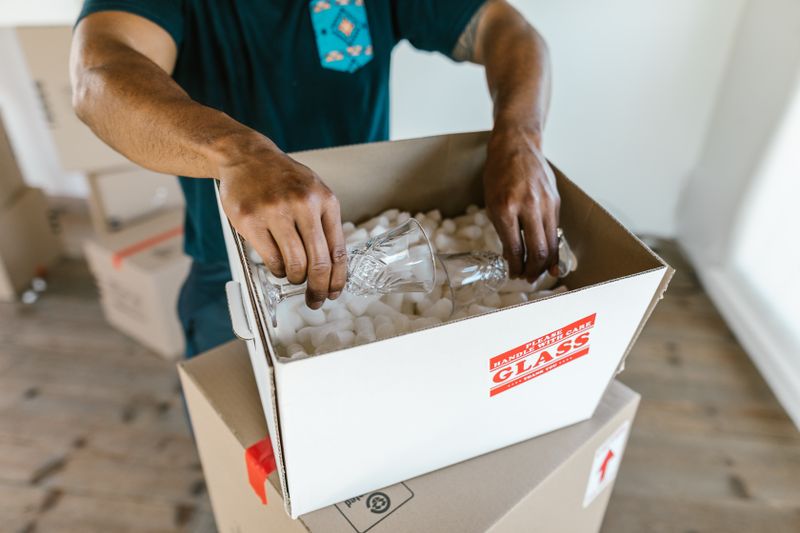
- Photos: packing crystal glassware — Pexels photo 7464230, https://www.pexels.com/photo/7464230/ ; sealed boxes by double doors — photo by cottonbro studio, https://www.pexels.com/photo/4553261/ ; woman resting on a moving box — photo by RDNE Stock project, https://www.pexels.com/photo/7464466/
More guides
- How to Hire a Moving Company That Won't Hold Your Furniture HostageMovers › Moving & Storage
- How Much Do Movers Cost? Local vs. Long-Distance Pricing ExplainedMovers › Moving & Storage
- Binding vs. Non-Binding Estimates: The Difference That Decides Your Final BillMovers › Moving & Storage
- Moving Insurance and Valuation: What 'Full Value Protection' Really CoversMovers › Moving & Storage
- Long-Distance Moving: A Start-to-Finish Guide for Household GoodsMovers › Household Goods Moving & Storage
- All Guides & ArticlesBrowse the full guides library