Movers › Household Goods & Furniture Storage
The True Cost of Household Goods and Furniture Storage, Line by Line: A Deep-Dive Budget Breakdown
Storage is the least examined line on a moving budget, and it should be the most examined, because it is the only line that bills you again every month for as long as your plans stay uncertain. Families plan a move as an event. Storage turns it into a subscription — and subscriptions are where quiet money goes.
Working dispatch, I watched the same misunderstanding repeat. A customer would compare two storage options by the monthly rent, choose the cheaper one, and end up paying more in total because the rent was never the whole price. There are two different products hiding under the word "storage," they are priced in different units, and each carries its own set of side charges. This breakdown goes through both, line by line, so you can build the real number for your household and compare quotes on equal terms.
First, the two products are not the same product
Self-storage is a rented room. You (or your movers) carry everything in, you hold the key, you can visit whenever the gate hours allow, and the facility's legal responsibility for your goods is close to zero. It is priced by the unit, by the month.
Mover warehouse storage — including storage-in-transit, or SIT, on a long-distance move — is a service. The crew inventories, pads, and loads your furniture into vaults or a warehouse bay; you have no key and usually no casual access; and on an interstate move your shipment stays under the moving contract's valuation coverage while it sits. It is priced by weight, by cubic foot, or by the vault — almost never by the tidy monthly unit price in an advertisement.
The directory behind this site reflects how large the warehouse side is: Household Goods Moving & Storage accounts for 9,547 listings, the second-largest storage category on the site. Most families in mid-move are quoted this product first, often without being told there was a choice.
Line by line: self-storage
Start with the rent, because it is the only line anyone quotes you. National pricing guides for 2026 put a standard 10×10 unit — the size that holds a one- to two-bedroom apartment — at roughly $115 to $123 a month on average, a 10×15 at about $150 to $176, and a 10×20, which takes a three- to four-bedroom home, at roughly $194 to $217. Averages conceal geography: the same 10×10 averages under $100 in lower-cost metros and over $200 in Los Angeles and San Francisco. Then the rest of the bill assembles itself:
| Line item | Typical cost | Notes |
|---|---|---|
| Monthly rent (10×10, standard) | ~$115–$123 national average | Introductory rates commonly rise after the first months |
| Climate control premium | +15–30% (about +$30–$75/mo on a 10×10) | Worth it for wood furniture, instruments, electronics, photos in hot or humid climates |
| Admin / move-in fee | One-time, commonly $25–$50 in worked examples | Ask whether any part is refundable (it usually is not) |
| Lock | One-time, ~$15–$40 if you must buy theirs | A disc lock is the standard requirement |
| Insurance / protection plan | ~$29/mo in a published 10×10 cost example | Your renters or homeowners policy may already cover stored goods — check before buying |
| Getting your goods there | Your movers' hourly time, or a truck rental | The line everyone forgets: self-storage rent excludes all transport and handling |
| Rate increases | Commonly 5–10% a year; sometimes sooner | Month-to-month agreements typically allow increases on about 30 days' notice |
Build the honest monthly figure for a typical family — a 10×15 standard unit at $157, a protection plan at $29 — and you are at roughly $186 a month before anyone has driven a truck anywhere. Over a three-month gap between homes, that is about $560 plus move-in costs and transport. The rent was $157. The storage cost was not.
Line by line: mover warehouse storage and SIT
Warehouse storage prices in units that resist comparison, which is partly tradition and partly the point. The published pricing models are:
- Per cubic foot: roughly $0.50 to $1.50 per cubic foot per month.
- Per pound: roughly $0.05 to $0.10 per pound per month, often with a one-time warehouse handling charge of about $0.10 to $0.20 per pound for moving goods in and out of storage.
- Per vault: a sealed wooden vault holds roughly a room's worth of furniture; one Los Angeles operator's published guide puts vaulted storage at $60 to $90 per vault per month in that market, with the count of vaults your household fills as the main cost driver.
- Storage-in-transit: industry guides put SIT at roughly $150 to $500 a month depending on shipment size, and note that interstate carriers frequently include an initial SIT period — commonly 30 days, sometimes up to 90 — in the move price before storage charges begin. Under federal rules, SIT is capped at 90 days in most interstate tariffs; after that the shipment converts to permanent storage under a separate warehouse contract, often at a different rate and under different liability terms.
The handling charge deserves its own paragraph, because it is the line that surprises families at delivery. Every time your goods change state — truck to warehouse, warehouse to truck — someone lifts every piece twice, and warehouse storage bills for that labor separately from the monthly rent. On a weight-priced shipment, handling in and out can add the equivalent of a month or more of storage rent to the total. A quote that shows a low monthly rate and buries handling is not cheaper than a quote that shows both. It is just quieter.
Also priced separately, usually: valuation. Your move's liability coverage continues during SIT under the interstate contract, but the level you chose still governs — Released Value still pays only 60 cents per pound per article on a loss, whether the damage happened on the highway or in the warehouse. Extended or higher-value protection during a long storage stay is an added charge, and on permanent storage the liability regime changes entirely when the warehouse contract replaces the moving contract. Ask, in writing, which regime covers your goods in month four.
A worked example: a three-bedroom household, three months
Take a family between homes for a quarter, with a three-bedroom household to store. Two honest budgets:
| Self-storage route | Mover warehouse route | |
|---|---|---|
| Space | 10×20 unit | ~7,000 lb shipment in vaults |
| Rent / storage | ~$204/mo × 3 = $612 | At $0.07/lb/mo ≈ $490/mo; if the first 30 days are included SIT, ~$980 for months 2–3 |
| Protection | ~$29/mo × 3 = $87 | Valuation already chosen on the move; extended coverage extra if elected |
| One-time fees | ~$50 admin + ~$15 lock | Warehouse handling in/out at ~$0.15/lb ≈ $1,050 |
| Transport & handling | Movers' time to load the unit and later empty it — two extra handlings you pay hourly | Included in the move's delivery leg |
| Indicative total | ~$765 + two local handling jobs | ~$2,030, but with no extra handling to buy |
These are planning figures built from the published ranges above, not quotes — your market and your shipment will move them. But the shape is the lesson dispatch teaches: self-storage wins on rent and loses on handling; warehouse storage looks expensive per month and quietly includes the labor that self-storage makes you buy twice. For a one-month gap with a local crew already booked, the warehouse premium often buys nothing. For a three-month gap across a long-distance move, the self-storage "saving" can evaporate into double handling, a second truck day, and a protection gap.
The lines that inflate both bills
Time itself. Every storage budget is a guess about a closing date, a construction finish, or a lease start — and every one of those guesses is optimistic in the same direction. Price your storage at your expected duration plus one month. If the extra month shocks you, that is information about which option to choose.
The wrong size. A unit one size too small gets packed to the ceiling, damages furniture, and gets traded up mid-stay at the new-customer rate's mercy. One size too large bills you monthly for air. Movers estimate volume for a living; a self-storage facility's size chart is a starting point, not a measurement of your household.
Access you do not need, or do. Warehouse storage charges for access visits and partial deliveries; if you will need the crib, the documents, or the winter coats mid-stay, self-storage's open door has real value. If you will never visit, you are paying self-storage prices for a feature you do not use while buying handling the warehouse includes.
Insurance bought twice — or zero times. Check your homeowners or renters policy's off-premises coverage before buying a facility plan, and check whether your mover's valuation survives the conversion from SIT to permanent storage. The expensive outcomes live at the two extremes: double-covered for trivia, uncovered for the one thing that mattered.

Questions that produce comparable quotes
- What is the all-in monthly figure — rent or storage charge, protection, taxes, and every recurring fee — and what is the one-time total to start?
- For warehouse storage: what is the handling charge in and out, in dollars for my shipment's weight, and how many SIT days are included before storage billing begins?
- When does SIT convert to permanent storage, what changes in rate and in liability on that day, and will you notify me before it happens?
- How and when can the monthly rate increase, and what notice will I get?
- What does access cost — a visit, a partial delivery, a full redelivery — and how much notice do you need?
- Which of my existing policies (homeowners, renters, the move's valuation) already covers these goods in your facility, and what gap remains?
Get those six answers from both kinds of provider, in writing, and storage stops being the vaguest line in your moving budget. It becomes what it should have been from the first quote: a priced decision, with the duration risk — the one variable nobody can quote away — sitting visibly on your side of the page, where you can plan for it.
Sources
- Extra Space Storage, "Storage Unit Pricing Guide: How Much Do Storage Units Cost in 2026?" — average monthly prices by unit size (10×10 at $119.50 in its rate table), and climate-controlled units costing roughly 20–30 percent more: https://www.extraspace.com/blog/self-storage/how-much-do-storage-units-cost/amp/
- Public Storage, "The Complete Guide to Storage Unit Prices in 2026" — national average prices by size (10×10 at $123 standard, $125 climate-controlled; 10×20 at $207) and price-per-square-foot comparisons: https://www.publicstorage.com/blog/public-storage/the-complete-guide-to-storage-unit-prices-in-2026.html?utm_source=nsastorage&utm_medium=redirect
- Neighbor, "What Does a Storage Unit Cost? A 50-State Guide for 2026" — a standard 10×10 averaging $120 a month nationally, climate-control premiums by size, and city-level price differences: https://www.neighbor.com/storage-blog/storage-unit-costs/
- My Good Movers, "How Much Does a Self-Storage Unit Cost in 2026?" — a worked 10×10 example itemizing base rent, $29/month storage insurance, a $50 one-time admin fee, and a $15 lock: https://mygoodmovers.com/storage-guide/how-much-does-a-self-storage-unit-cost
- FreightAmigo, "Cost to Store Furniture with a Moving Company: 2025–2026 Pricing Guide" — warehouse pricing models ($0.50–$1.50 per cubic foot per month; $0.05–$0.10 per pound per month plus handling), and storage-in-transit at $150–$500 a month with initial periods often included: https://www.freightamigo.com/en/blog/international-relocation/cost-to-store-furniture-with-a-moving-company-20252026-pricing-guide/
- Popeye Moving, "What Vaulted Storage Costs in Los Angeles" — vaulted warehouse storage at $60–$90 per vault per month, and storage-in-transit converting to a warehouse contract after 90 days: https://www.popeyemoving.com/blog/vaulted-storage-cost-los-angeles
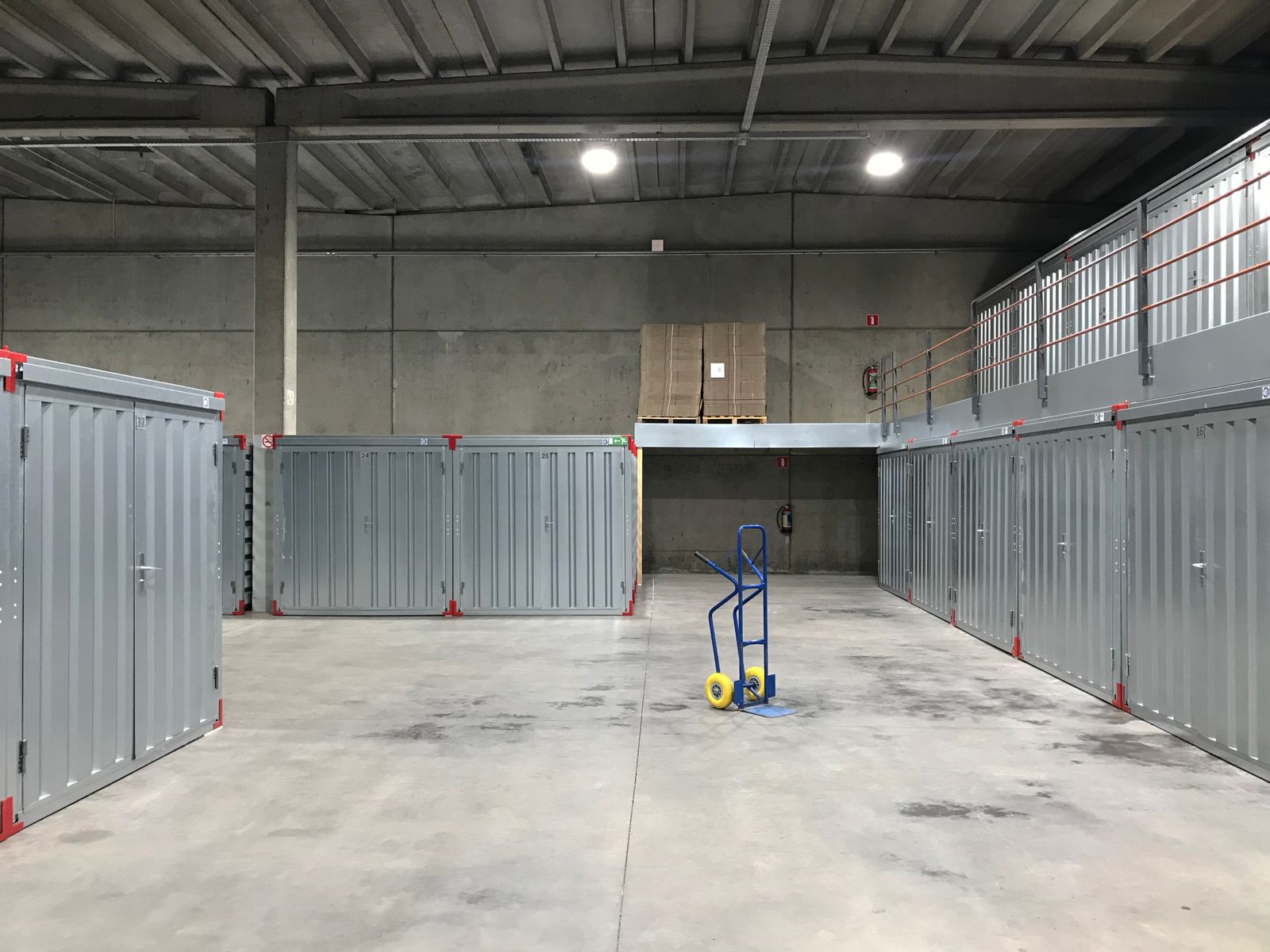
- Warehouse storage units with a hand truck — photo by David Slaager, https://www.pexels.com/photo/5759147/
- Cardboard boxes stacked on a wooden floor — photo by cottonbro studio, https://www.pexels.com/photo/4568693/
More guides
- How to Hire a Moving Company That Won't Hold Your Furniture HostageMovers › Moving & Storage
- How Much Do Movers Cost? Local vs. Long-Distance Pricing ExplainedMovers › Moving & Storage
- Binding vs. Non-Binding Estimates: The Difference That Decides Your Final BillMovers › Moving & Storage
- Moving Insurance and Valuation: What 'Full Value Protection' Really CoversMovers › Moving & Storage
- Long-Distance Moving: A Start-to-Finish Guide for Household GoodsMovers › Household Goods Moving & Storage
- All Guides & ArticlesBrowse the full guides library