Movers › Containers Industrial
What Good Containers Industrial Looks Like: The Standards Professionals Judge Each Other By
Every industry has a version of good that insiders can see at a glance and outsiders cannot see at all. Industrial containers — the steel shipping containers that get sold and rented for storage, job sites, farm use, and, increasingly, for household moves — have one of the widest gaps between the two. To a professional, a container announces its quality in about ninety seconds: the plate on the door, the light test, the floor, the corner castings. To a family buying one for a move, it is a large colored box, and all large colored boxes look alike. Most of the complaints I read live in that gap — not fraud, exactly, but a buyer and a seller using the same words ("good condition," "cargo worthy," "watertight") to mean measurably different things.
This guide translates the professional standard into plain checks. You do not need to become a marine surveyor. You need to know what the surveyor looks at, in what order, and which findings are cosmetic, which are negotiable, and which end the conversation.
The grade ladder — and who assigns each rung
Containers are sold on a ladder of condition grades. The crucial fact, the one that explains most disputes, is that the rungs are not certified by the same authority. Some are inspected standards. Some are a seller's description. Professionals know which is which; listings rarely volunteer it.
| Grade | What it certifies | Who stands behind it | Typical price signal (20 ft / 40 ft) |
|---|---|---|---|
| One-trip ("new") | A single loaded voyage from the factory, usually in Asia; near-new condition | Manufacturer and shipping-line records; valid CSC plate | $2,800–$4,500 / $3,200–$6,000 |
| IICL | Meets the Institute of International Container Lessors' repair and inspection standards — the strictest used-equipment standard in the trade | IICL-standard inspection | $2,400–$3,500 / $3,000–$4,500 |
| Cargo worthy (CW) | Fit to return to ocean service: structure and weatherproofing pass survey | A certified marine surveyor; valid CSC plate | $1,900–$2,800 / $2,500–$3,500 |
| Wind and water tight (WWT) | Keeps weather out; sound enough for storage | The seller's or depot's visual inspection — no official standard | $1,225–$2,500 / $1,575–$3,500 |
| As-is | Nothing guaranteed | Nobody | Cheapest; a repair project |
Read the third column until it sinks in. Cargo worthy is the only used grade that requires a third-party inspection. WWT — the grade most storage and moving buyers actually purchase — is a description, not a certification, which is why two sellers can both honestly label units "WWT" and deliver noticeably different boxes. That is not a reason to avoid WWT; for ground storage and most household moves it is the rational buy. It is a reason to inspect a WWT unit (or get inspection photos) rather than trusting the label, and to buy the label from a seller whose reputation depends on grading consistently.
Professionals also separate two questions that buyers merge: is it weatherproof, and is it structural? A container can pass the first and fail the second. The grading literature makes the point precisely: the wind-and-water-tight test — shut yourself inside, close the doors, look for daylight — says nothing about the understructure. A WWT unit with a tired frame is a fine garden store and a bad thing to lift loaded. If your plan involves the container being moved with your goods inside it, you are shopping in cargo-worthy territory whether the salesperson uses the phrase or not.

The ninety-second professional walk-around
Surveyors and experienced depot buyers inspect in a fixed order, cheapest tests first. Here is the order, and what "good" looks like at each stop.
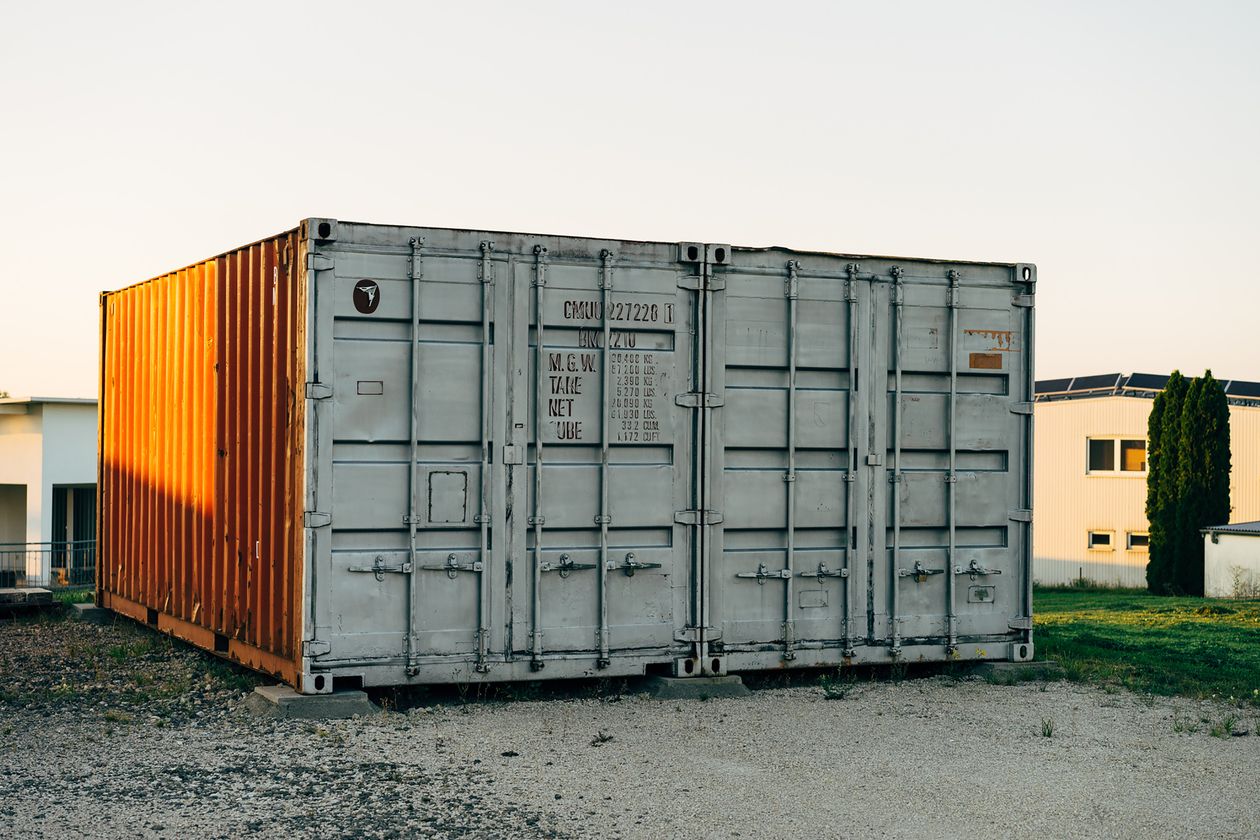
1. The CSC plate. Every container built for international service carries a metal safety approval plate on the left door, issued under the International Convention for Safe Containers. It records the manufacturer, the date of manufacture, the maximum gross weight, the allowable stacking load, and the inspection history or ACEP (Approved Continuous Examination Programme) status. A valid, in-date plate is the container's passport: it is what allows the unit to be loaded on a ship, and its presence and currency are the fastest single signal of a maintained unit. An expired plate does not make a storage container useless — plenty of sound units sit in yards with lapsed paperwork — but a seller describing a unit as "cargo worthy" while its plate is out of date is telling you the survey hasn't happened. Professionals also read the container's identification number (the ISO 6346 code: owner prefix, serial, check digit) and expect it to match the paperwork exactly.
2. The light test. Step inside on a bright day, pull the doors shut, and let your eyes adjust. Good is total darkness. Pinpoints of light mean pinhole rust or seam gaps in the roof and walls — each one a future drip with a specific address. This test takes thirty seconds, costs nothing, and is the single most skipped step in the complaints I read. If you are buying remotely, ask for this photograph: interior, doors closed. A seller who grades honestly can produce it; the request itself signals that you know the trade's own test.
3. The doors. Doors are the container's only moving machinery and its most common failure point. Good doors swing freely through their full arc, meet evenly, and close with all four locking rods engaging their cams without a cheater bar or a shoulder. The rubber gaskets around the door frame should be intact, pliable, and continuous — cracked, shrunken, or missing gasket sections are where "watertight" goes to die, and they are a normal wear item a good seller replaces rather than explains away. Check the bottom rail and threshold for the rust and impact damage that ground-level units collect.
4. The floor. Original container floors are marine plywood (or bamboo on newer units) over steel cross-members, built to carry forklift loads. Walk every board. Good is firm and flat underfoot, with stains and scuffs acceptable at used grades. Soft spots, delamination, holes, and patched sections are not cosmetic: floor replacement is one of the most expensive repairs on the unit, and a floor that fails under a loaded pallet or a piano is a moving-day catastrophe rather than a maintenance item. Smell matters too — professionals put their nose in every unit, because chemical and fuel residues from a previous cargo can rule a container out for household goods no matter how sound its steel is.
5. The frame and the corners. The container's strength lives in its frame: corner posts, rails, and the eight corner castings — the standardized steel blocks, built to ISO 1161 dimensions, through which every crane lift, twist-lock, and stack load passes. Professionals crouch here. Castings should be undeformed, with their apertures clean and un-elongated; corner posts straight, without creases or weld repairs that suggest a past impact hard enough to bend the structure. Surface rust on the frame is normal at used grades. Rust-through, flaking scale on load-bearing members, and visible distortion are not — they are the difference between a unit with fifteen years left and one being sold ahead of its decay.
6. The roof and walls. Corrugated walls are allowed their dents at used grades — the trade's standards treat dents as cosmetic until they breach the envelope or interfere with the door frame. The roof deserves a harder look than buyers give it, ideally from a ladder or the seller's photos: standing water pools in roof dents, and pooled water finds pinholes. Look for amateur patches — tar, silicone smears, pop-riveted plates. A professional repair is welded, ground, and painted; a smeared patch is a countdown timer.
The paperwork professionals expect
Good containers travel with boring paper. A cargo-worthy unit has a survey certificate from the marine surveyor who passed it. Any unit's CSC plate data should match its invoice. Sellers who grade to IICL standards can say so specifically — "IICL" is a defined repair standard, not an adjective, and a seller using it loosely for ordinary used stock is grading their own homework. Warranties, where offered, follow the grade: one large national seller's published terms, for example, run to ten years structural and no-leak on one-trip units and five years on cargo-worthy and WWT units. You are not buying that seller's warranty — you are learning the shape of a confident one. A seller offering no written leak warranty on a unit sold as watertight is telling you how much their own label is worth.
Delivery is part of the standard too. A professional seller confirms the delivery truck type (tilt-bed versus flatbed with your forklift), the ground the unit will sit on, and door direction — which way the doors face when the unit lands is a decision you make once and live with daily. Complaints about containers "delivered wrong" are usually complaints about questions the seller never asked.
For a family move, translate it this way
This site lists 476 industrial container providers alongside 495 storage trailer and container listings, so supply is not your problem; specification is. Match the grade to the job with the same logic the trade uses:
- Container stays on the ground, goods loaded and unloaded in place (the common moving pattern: unit dropped at the old house, trucked empty or loaded by arrangement, stored, delivered to the new house) — a genuinely inspected WWT unit is the value buy. Spend your diligence on the light test, the gaskets, and the floor.
- Container will be lifted or shipped loaded — cargo worthy, with a current survey and CSC plate. This is not upsell territory; it is what the certification exists for.
- Container will be seen every day — a one-trip unit's factory paint and clean interior are why it costs what it costs, and for a unit that will sit in a driveway for a year of renovation, that premium is sometimes the honest one.
Then do the ninety-second walk-around on delivery, before the truck leaves, in the professional order: plate, light, doors, floor, frame, roof. A container that passes is not a prettier box than the one that fails. It is a different product — and now you can see it at a glance, which was the whole secret.
Sources
- Container xChange, "Container conditions: Why they matter" — the grade comparison from brand-new/IICL through cargo-worthy and WWT to as-is, including CSC plate validity by grade and IICL-6/IICL-5 standards.
- Container Services International, "Shipping Container Grading & Certification" — cargo worthy defined against TIR/UIC/CSC criteria with a valid CSC plate; the wind-and-water-tight light test and its explicit limitation that WWT makes no reference to understructure quality ("WWT + CSC = CW").
- Container Sales Group, "Shipping Container Grades Explained" — grade-by-grade prices and ages (one-trip 20 ft at $2,800–$4,500, cargo worthy at $1,900–$2,800, WWT at $1,225–$2,500), and who assigns each grade: manufacturer records for one-trip, a certified marine surveyor for cargo worthy, the IICL standard for IICL grade, and depot visual inspection for WWT.
- Arkansas Storage Containers / Container One, "Shipping Container Condition Guide" — WWT inspection points (door seals, roof, floor with no rot or soft spots), the WWT-versus-cargo-worthy distinction, and warranty terms by grade (ten years on one-trip, five years on cargo worthy and WWT).
- HZ Containers, "Manufacturing and Testing Process of New Containers According to ISO and CSC" and "Anatomy of a Shipping Container" — ISO 668 dimensions, ISO 1161 corner fittings, ISO 1496 prototype testing, the CSC plate's contents (manufacture date, maximum gross weight, stacking load, inspection dates), corner castings designed for stacking and lifting, and door locking-rod and gasket construction.
- Photo by Tom Fisk, https://www.pexels.com/photo/2226458/
- Photo by Markus Winkler, https://www.pexels.com/photo/18609057/
- Photo by Ollie Craig, https://www.pexels.com/photo/7519246/
More guides
- How to Hire a Moving Company That Won't Hold Your Furniture HostageMovers › Moving & Storage
- How Much Do Movers Cost? Local vs. Long-Distance Pricing ExplainedMovers › Moving & Storage
- Binding vs. Non-Binding Estimates: The Difference That Decides Your Final BillMovers › Moving & Storage
- Moving Insurance and Valuation: What 'Full Value Protection' Really CoversMovers › Moving & Storage
- Long-Distance Moving: A Start-to-Finish Guide for Household GoodsMovers › Household Goods Moving & Storage
- All Guides & ArticlesBrowse the full guides library