Movers › Shelving Commercial & Industrial
What Shelving Commercial and Industrial Actually Includes: The Service Broken Down in Plain Language
"Shelving, commercial and industrial" is one of those directory phrases that sounds self-explanatory and is not. It covers everything from a $200 boltless bay in a storage unit to a six-figure pallet-racking installation with stamped engineering, a building permit and a fire marshal's signature. Companies quote it as one service. Complaint files show it is at least seven services wearing one coat, and the disputes begin where a customer assumed one of the seven was included and the quote quietly assumed it was not.
This site lists 363 shelving commercial and industrial providers. This guide breaks the service into its parts, in plain language: what each part is, roughly what it costs, which parts are optional, and which parts are not optional no matter what a salesperson says. It is written for anyone buying at either end of the scale — a warehouse operator fitting out a building, and, at the smaller end, an older homeowner or downsizer putting serious shelving into a garage, workshop or storage unit, where the loads are lighter but the same physics applies.
Part one: the shelving itself — four families, four price worlds
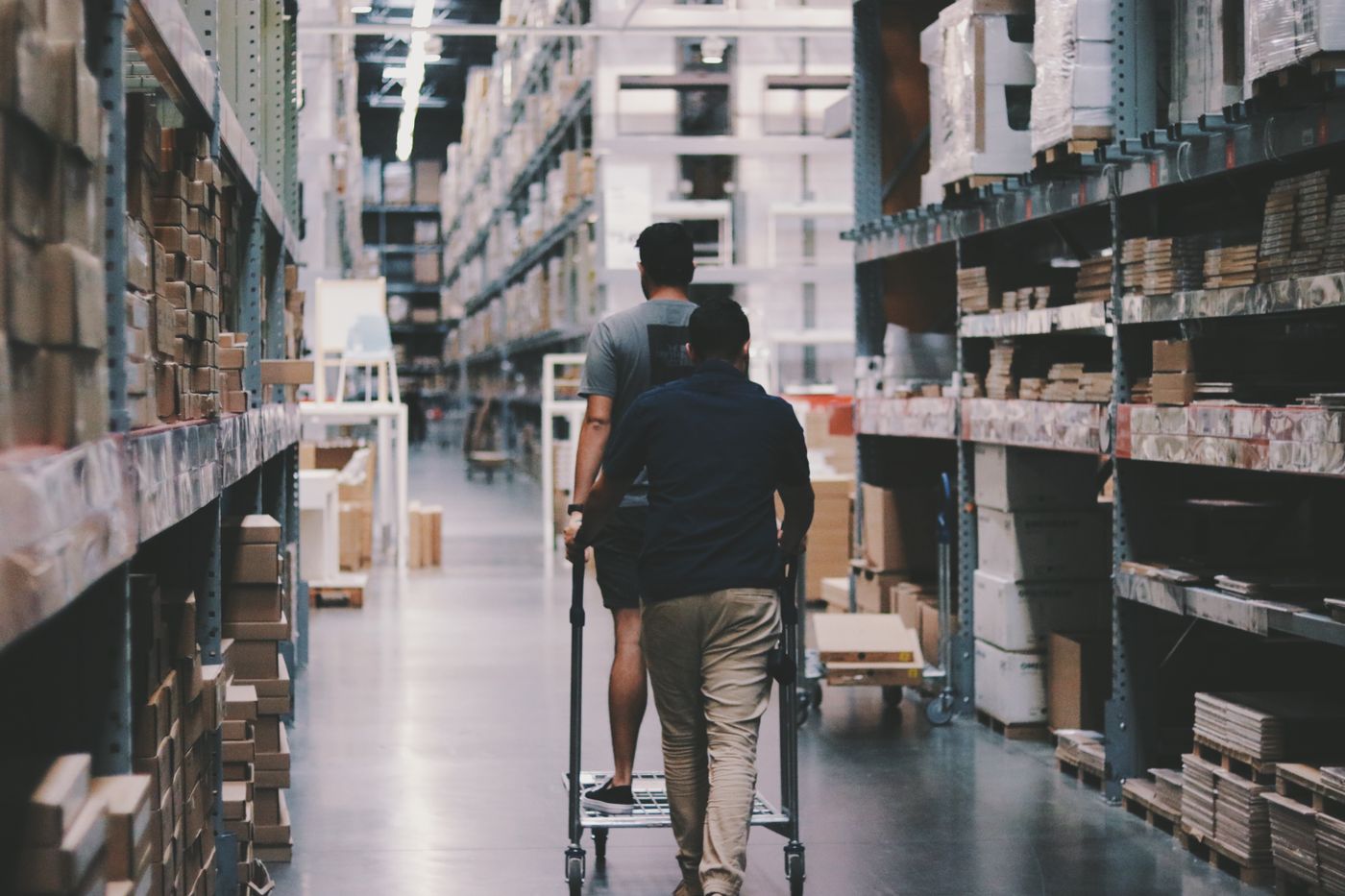
Boltless and clip shelving is the light end: steel uprights and beams that lock together without bolts, with particleboard, wire or steel decks. It holds cartons, bins, tools and archives — hand-loaded goods, no forklift. Published price guides put a single bay (roughly 3 feet wide, 6 feet high, 18 inches deep) at about $200 to $800: light-duty units rated up to about 500 pounds per shelf sit at $200 to $400, medium-duty up to about 1,500 pounds per shelf at $400 to $600, and heavy-duty above 2,000 pounds per shelf above $800. This is the family that belongs in garages, stockrooms and storage units.
Selective pallet racking is the warehouse standard: upright frames and horizontal beams forming bays that a forklift loads with pallets, every pallet directly accessible. It is priced per pallet position, and published ranges disagree because scope disagrees — one major guide puts selective racking at $50 to $80 per pallet position including installation for its network, broader market guides put materials alone at $100 to $400 per position. The honest takeaway is not a number but a question: per position, including what?
High-density racking trades access for space: double-deep, drive-in, pushback and pallet-flow systems store pallets several deep, with published costs climbing from roughly $75 to $105 per position for double-deep, through $115 to $140 for drive-in, $150 to $300 for pushback and $200 to $400 for pallet flow. Each needs the right forklift and the right inventory pattern; each is a poor buy for mixed, fast-turning stock.
Cantilever racking has arms instead of shelves, for long things — lumber, pipe, furniture, carpet rolls. Guides put it around $1,000 to $3,000 or more per bay, with arms and bases priced separately, which is why cantilever quotes are the hardest to compare at a glance.
| Family | Loaded by | Published price shape | Right for |
|---|---|---|---|
| Boltless / clip shelving | Hand | $200–$800 per bay, by duty rating | Cartons, parts, archives, garages, storage units |
| Selective pallet rack | Forklift | $50–$400 per pallet position, scope-dependent | General warehousing, mixed pallets |
| High-density rack | Forklift, sometimes specialised | $75–$400 per position, by system | Many pallets of few products |
| Cantilever | Hand or forklift | $1,000–$3,000+ per bay | Long, bulky, awkward loads |
Part two: design and layout — the part that is actually engineering
A real shelving service includes a layout: bay sizes matched to your pallet or carton dimensions, aisle widths matched to your forklift's turning radius (or, at the small end, to a person with a trolley), load capacities calculated per level and per bay, and a check that the floor can carry it. Steel storage racks are designed to a standard — ANSI MH16.1, referenced by the building code — which is where anchoring, base plates and capacity plaques come from.
When this part is skipped, the complaint pattern is predictable: beams that bow, a bay loaded past its frame capacity because no plaque ever said what the capacity was, or a layout a forklift cannot legally or physically serve. Ask whether your quote includes a layout drawing and load plaques. If the answer is a shrug, you are buying steel, not a system.
Part three: permits, seismic and fire — the unglamorous third of the job
Three rulebooks govern installed racking, and a complete service navigates all three. Workplace safety: OSHA has no racking-specific standard and does not certify racks — a point worth repeating, because "OSHA certified shelving" is a sales phrase for a label OSHA does not issue. OSHA enforces stable, secure storage under its materials-handling rule, 29 CFR 1910.176(b), and cites damaged or unanchored racks under the General Duty Clause. Building code: your city enforces rack design, anchoring and seismic requirements through permits; many jurisdictions trigger permits and stamped engineering at around 8 feet of rack height, and racks 8 feet or taller in higher seismic categories need a certificate of compliance and special inspection. Fire code: high-piled combustible storage — generally above 12 feet, lower for high-hazard goods — brings its own permit, aisle and flue-space rules, enforced by the fire marshal.
Installation typically runs 15 to 35 percent of a project's total cost, and the permit-and-engineering layer is part of why. A quote that is mysteriously cheaper than its rivals has usually deleted this layer, not outsmarted it. For the small end — freestanding boltless shelving in a home garage or a storage unit — building permits generally do not enter into it, but anchoring tall units to a wall, respecting the facility's rules about fixtures, and never exceeding a shelf's rated load absolutely do.
Part four: delivery, installation and anchoring
The physical service: freight to your site, unloading, assembly, levelling, anchoring to the slab with the specified anchors, beam safety locks or clips, row spacers and wall ties where the design calls for them, and column guards where forklifts will pass. Anchoring is the line item to interrogate. An unanchored rack is a complaint and an injury waiting for a date; the anchor count and type belong on the quote, not in a verbal assurance.
Used racking deserves its own sentence, because it fills the complaint files disproportionately: used uprights and beams are a legitimate economy only when capacities are known, components match, and damage — bent columns, cracked welds, sprung beam connectors — is inspected piece by piece. Mismatched used components with unknown ratings are how a cheap installation becomes an uninsurable one.
Part five: decking, accessories and the extras that are genuinely optional
Wire decks, particleboard decks, shelf dividers, bin boxes, label holders, end guards, netting and back stops. Some are safety-relevant in context — wire decking can matter to fire sprinkler performance, column guards matter wherever forklifts turn — and some are pure convenience. A good quote separates the two. A bad one bundles convenience items at safety prices, or omits the guards and calls the saving a discount.
Part six: inspection and maintenance — the service after the service
The Rack Manufacturers Institute recommends a full rack inspection at least once a year, and immediately after a forklift impact or an earthquake. Some providers sell inspection as a standing service: a documented walk of every bay, damage graded, repair quotes itemised, plaques checked against actual loads. After damage, a registered design professional must certify a repair before the rack is loaded again. If your provider offers no inspection path at all, ask who they expect to do it — because "no one" is the answer behind most of the collapse stories I read.
Part seven: teardown, relocation and disposal
The moving-industry end of the trade: dismantling racking for a warehouse move, labelling components so the system reassembles as a system, transporting, reinstalling at the new site to the same anchoring and plaque standard, and disposing of or buying back what does not travel. Priced properly, this is a service in its own right. Priced as an afterthought — "the movers will take it down" — it produces the classic outcome: a pile of mixed beams at the new building and a shelving system that no longer exists, only its parts.
For downsizers and home buyers of shelving: the same checklist, smaller
If you are an older homeowner fitting out a garage or a storage unit, your version of this service is the boltless family plus judgement: choose the duty rating by the heaviest shelf you will honestly load (books and tools are heavier than they look), anchor tall units, keep heavy items at waist height or below, leave a step-free path to every shelf, and never store above head height anything you would not want landing on you. The provider who asks what you are storing, and how often you will reach it, is selling the right service at any scale.
How the money is quoted, and why comparisons go wrong
Shelving is quoted three ways — per bay, per pallet position and per project — and a complaint I see repeatedly is a customer comparing a per-position materials price from one firm against a per-project installed price from another, then choosing the first and discovering the difference as change orders. Installation alone commonly runs 15 to 35 percent of a project's total, before engineering, permits, freight and guards. The only safe comparison is a written scope list, identical for every bidder: components, decking, anchors, locks, plaques, layout, permits, installation, inspection. Give three providers the same list and the prices will cluster. Give them a vague description and you are not comparing prices at all — you are comparing imaginations, and the cheapest imagination wins until the invoice arrives.
Questions that expose a complete quote
- Per bay or per position — and including exactly what: frames, beams, decks, anchors, locks, plaques?
- Who does the layout and the load calculations, and to what standard?
- Does this height, in this city, need a permit or stamped engineering — and who files it?
- How many anchors, of what type, per upright?
- New or used components — and if used, whose inspection, documented how?
- What does annual inspection cost, and who certifies repairs?
- If we move, what do teardown, transport and reinstallation cost as a separate line?
A complete shelving service is steel plus engineering plus permission plus anchoring plus inspection. Buy all five, in writing, and the phrase "commercial and industrial shelving" finally means something you can hold a provider to.
Sources
- ShipBob, Warehouse Racks and Racking Systems — racking types and costs per pallet position, from selective at $50–$80 through pallet flow at $200–$400.
- Guangshun, Warehouse Shelving Prices guide — boltless shelving at $200–$800 per bay by duty rating, cantilever at $1,000–$3,000+ per bay, mezzanine and installation cost factors; installation commonly 15–35 percent of project cost.
- Speedrack West, Warehouse Racking Requirements — OSHA's materials-handling rule 29 CFR 1910.176(b) and General Duty Clause enforcement, ANSI MH16.1 as the building-code design standard, high-piled storage permits, and annual RMI inspection recommendations.
- Speedrack West, Does Pallet Racking Need to Be Certified? — OSHA does not certify racks; certificates of compliance for racks 8 feet or taller in higher seismic categories; engineer certification required for repairs after damage.
Photos: warehouse workers among shelving — photo by Alexander Isreb, https://www.pexels.com/photo/men-going-around-a-warehouse-1797428/ ; industrial plant floor — photo by Pexels contributor, https://www.pexels.com/photo/236698/
More guides
- How to Hire a Moving Company That Won't Hold Your Furniture HostageMovers › Moving & Storage
- How Much Do Movers Cost? Local vs. Long-Distance Pricing ExplainedMovers › Moving & Storage
- Binding vs. Non-Binding Estimates: The Difference That Decides Your Final BillMovers › Moving & Storage
- Moving Insurance and Valuation: What 'Full Value Protection' Really CoversMovers › Moving & Storage
- Long-Distance Moving: A Start-to-Finish Guide for Household GoodsMovers › Household Goods Moving & Storage
- All Guides & ArticlesBrowse the full guides library